Ronald and Cindi
Tustin homeowners
“We were completely pleased with the installation of a water softener system.”
They wrote that Brian and Alan answered every question and made the adjustments needed to fit the softener perfectly in their garage.
Hague Quality Water International
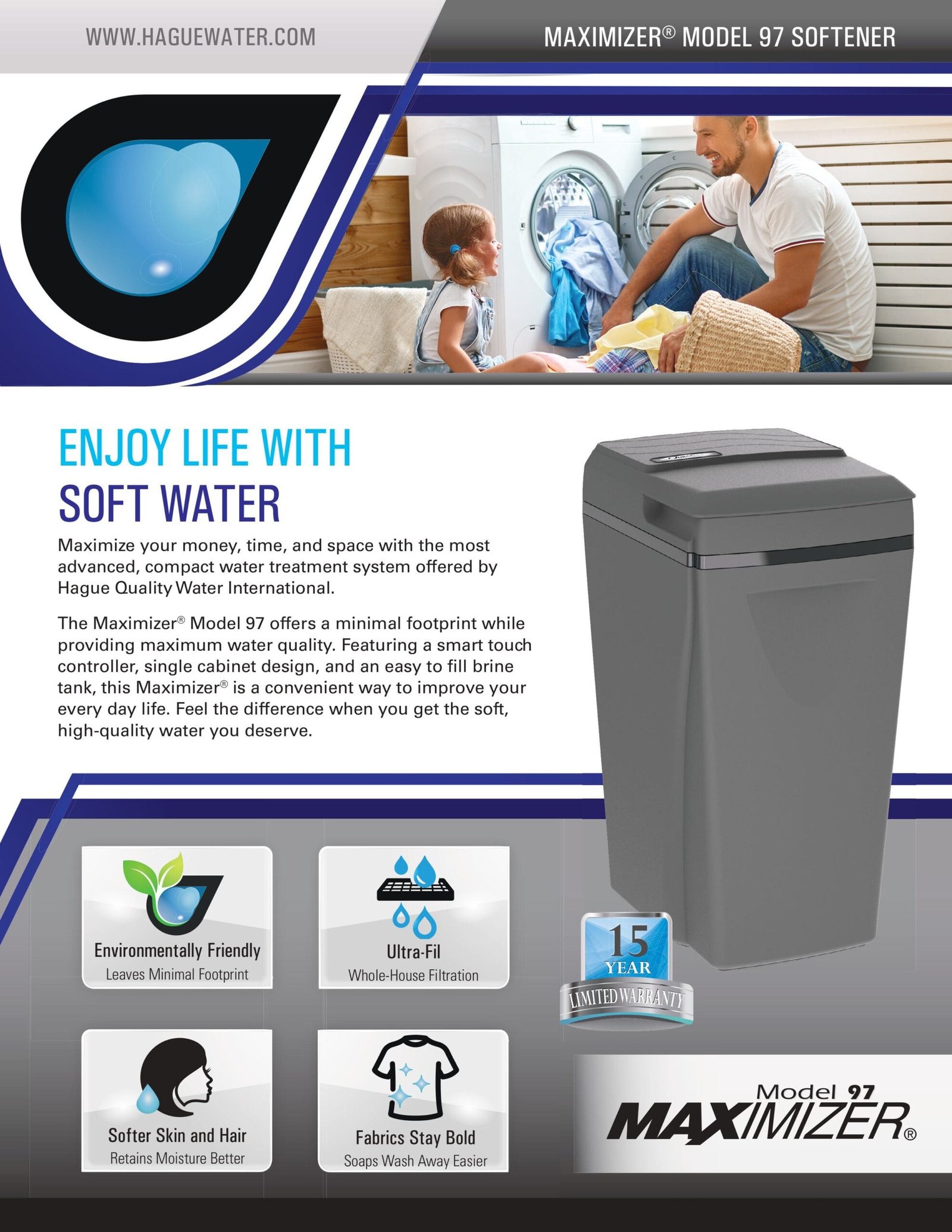
Fifteen inches wide, everything in one cabinet including the brine tank. Orange County has hard water, and Orange County garages are already full. If that's been the standoff at your house, this is the softener worth a look.
Tap the image to view it full size
Why this one exists
A conventional softener is two pieces of luggage: a resin tank, plus a separate brine tank standing next to it. That's a real amount of garage, and in plenty of Orange County homes it's the reason the water never got sorted out. People look at where the thing would have to live, picture losing that corner, and quietly drop the idea.
The Maximizer Model 97 packs it all into one case. Fifteen inches wide, thirty high, nineteen deep, with the brine tank built in and easy to fill. Roughly the footprint of a kitchen trash can, and about as tall as a countertop. It tucks into a garage corner, a utility closet, or the gap beside the washer.
Small doesn't mean underpowered. It's rated to 90 grains per gallon compensated hardness, which is a bit like a truck rated to tow ten thousand pounds when you'll never hitch more than two. Local water doesn't come close to that ceiling. It also knocks down ferrous iron up to 10 ppm, which matters more on a well than on city water, and the Ultra-Fil sediment filtration cleans itself, so there's no cartridge to buy twice a year.
How it actually works
Nobody explains this, which is odd, because once you understand it the rest of the decision gets a lot easier.
Hard water isn't dirty. It's water carrying dissolved calcium and magnesium, picked up from rock on the way to your house. Those two minerals are perfectly safe to drink. They're just terrible houseguests. They come out of solution as limescale the moment water gets heated or evaporates, which is why you find white crust on the showerhead, spots on glassware and a chalky film on faucets and fixtures.
A water softener fixes that through ion exchange, and the coat check is the easiest way to picture it. Inside the tank sits a bed of resin beads, each one holding harmless sodium ions. Hard water flows through, the beads grab the calcium and magnesium and hand back sodium in the swap. Hard minerals go in, soft water comes out the other side. That's the whole trick.
Eventually every bead is holding calcium and magnesium and has no sodium left to trade. That's when the system regenerates. It draws brine from the salt tank, flushes the resin bed, sends the collected hardness down the drain and reloads the beads with fresh sodium. Like wringing out a sponge so it can soak up more. On the Maximizer Model 97 that cycle is what the four salt settings control, and the fine mesh resin is why each cycle uses less salt and water than a standard bed.
Two things worth knowing. First, this is a whole house system installed at the point of entry, where the main line comes into your home, so every tap downstream gets treated rather than one faucet. Second, softening and filtering are different jobs. Softening handles calcium and magnesium. Filtering handles what you can taste and smell, mainly chlorine, chloramine and sediment. The Model 97 does the softening and carries Ultra-Fil sediment filtration alongside it.
Room by room
Hard water doesn't send you a bill. It just quietly shortens the life of expensive things while you wonder why the dishes never look right.
This is the expensive one. Limescale settles on the heating element and acts like a blanket, so the unit burns more energy to hit the same temperature and works harder every single day. That rumbling noise from the garage is scale on the burner plate. Hard water is the reason plenty of water heaters die years before they should, and it quietly shortens the life of every other appliance that touches it.
Scale builds up inside the dishwasher and the washing machine exactly the way it builds up on your showerhead, just where you can't see it. Softened water means detergent actually rinses away instead of leaving soap scum and residue, so glassware comes out without spotting and laundry and towels feel soft rather than stiff.
The white crust on the showerhead, the ring around the faucet, the cloudy film on the shower door. All the same mineral, and all of it stops being a weekly chore. Your fixtures stop looking older than they are.
Hard water stops soap lathering properly and leaves a film behind that rinsing doesn't fully remove. That film is a big part of why skin can feel tight or dry after a shower and hair feels squeaky. With softened water you'll use noticeably less shampoo and detergent, because what you're using finally works.
What's crusted on the chrome is also lining the inside of your pipes. Scale narrows them over years, which chips away at flow and at the efficiency of everything downstream. This is the part nobody notices until a plumber is quoting a repipe.
Softening isn't filtering. It won't fix a chlorine taste on its own, and it won't touch iron staining or a sulfur smell unless you're in one of the model variants built for that. If those are your complaints, say so at the test and we'll aim you somewhere else.
Advanced design
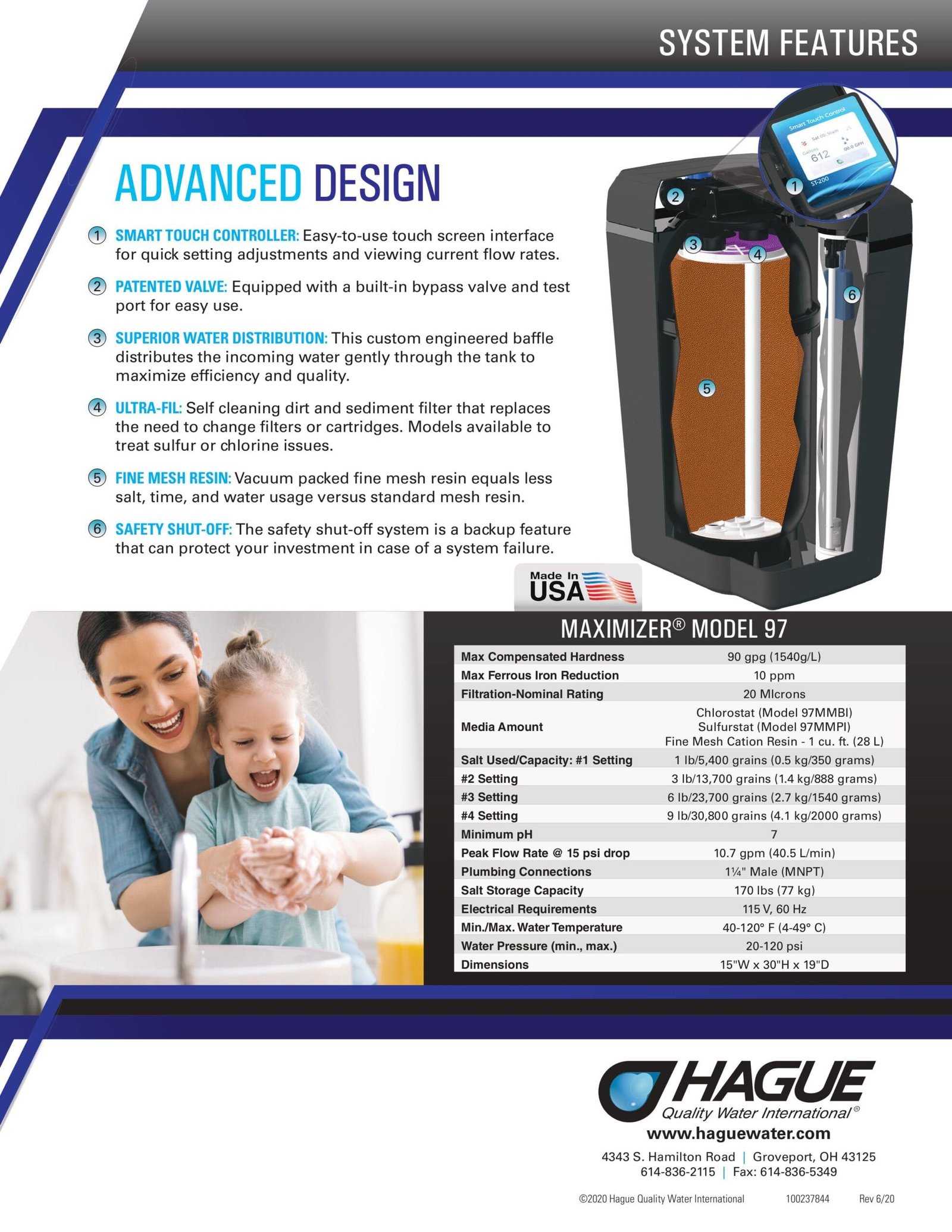
From the manufacturer's own sheet, with a note on why each one matters once it is actually installed in a house.
A touch screen for changing settings and reading your current flow rate. Think of it as the dashboard. That flow rate readout is more useful than it sounds, because it's how you find out what your house really draws instead of guessing at it.
A built in bypass valve and test port. The bypass is an off ramp: send water around the softener when you're watering the lawn, because grass doesn't care and salt isn't free. The test port lets a technician check the system without taking anything apart.
A custom engineered baffle spreads incoming water gently across the tank. Without it you get channeling, which is water carving a single gully through the resin the way a stream cuts through sand. The gully gets all the traffic and the rest of the bed sits there doing nothing. Even distribution means every bit of resin earns its keep.
A self cleaning dirt and sediment filter, so there's nothing to swap out. It's the difference between a self cleaning oven and one you scrub. Rated at 20 microns nominal, and a human hair is around 70 microns wide, so it's catching grit you'd never see. Variants handle sulfur or chlorine, and we pick based on your test.
Vacuum packed fine mesh resin. Finer beads mean more surface area doing the work, the same reason ground coffee brews faster than whole beans. More surface area means less salt, less water and less time per regeneration. This is the feature you'll notice on your salt bill for the next fifteen years.
A backup that shuts things down if something goes wrong. It's the circuit breaker of the system: you'll probably never think about it, and the one time you need it, it's the difference between an inconvenience and a flooded garage.
Full specifications
Most water company websites won't show you this table. Here it is, straight from Hague, so you can hold it up against anything else you're considering.
| Max compensated hardness | 90 gpg (1540 g/L) |
|---|---|
| Max ferrous iron reduction | 10 ppm |
| Filtration, nominal rating | 20 microns |
| Media | Fine Mesh Cation Resin, 1 cu. ft. (28 L). Chlorostat on Model 97MMBI, Sulfurstat on Model 97MMPI |
| Salt used and capacity, setting 1 | 1 lb / 5,400 grains (0.5 kg / 350 g) |
| Setting 2 | 3 lb / 13,700 grains (1.4 kg / 888 g) |
| Setting 3 | 6 lb / 23,700 grains (2.7 kg / 1540 g) |
| Setting 4 | 9 lb / 30,800 grains (4.1 kg / 2000 g) |
| Minimum pH | 7 |
| Peak flow rate at 15 psi drop | 10.7 gpm (40.5 L/min) |
| Plumbing connections | 1¼″ Male (MNPT) |
| Salt storage capacity | 170 lbs (77 kg) |
| Electrical requirements | 115 V, 60 Hz |
| Water temperature, min and max | 40 to 120° F (4 to 49° C) |
| Water pressure, min and max | 20 to 120 psi |
| Dimensions | 15″W x 30″H x 19″D |
| Warranty | 15 year limited warranty from the manufacturer |
The line worth staring at is peak flow rate. Think of it like a doorway. Ten point seven gallons per minute is a comfortable doorway for most three and four bedroom homes, and nobody's bumping shoulders. Put six bathrooms behind it and have everyone leave at seven in the morning and it starts to feel narrow. That's why we measure your actual flow at the hose bib before we recommend this, not after. Undersizing a softener is the number one way people end up calling about pressure.
Local context
We work one county, so we can be specific about this rather than vague.
Hardness is not the constraint. Water here typically measures somewhere between 12 and 23 grains per gallon. The Model 97 is rated to 90. That's a lot of headroom, which is why hardness almost never rules this system out locally. Flow rate does, and that's the number we go measure.
The garage usually is. A two car garage in a 1970s tract home is already holding a washer, a dryer, a water heater and boxes nobody has opened since the move. A conventional two tank softener wants a real piece of that. This one wants a strip about the width of a kitchen trash can. In plenty of these houses that difference is the whole decision.
Wells are a different conversation. Out in the canyons some properties run on private wells instead of city water, which brings iron, sulfur and sediment that municipal supply never does. The Model 97 reduces ferrous iron up to 10 ppm and there are Chlorostat and Sulfurstat variants, but on a well we test first and talk second.
We stay in Orange County on purpose. One county means the crew already knows how the water behaves from Irvine down to the coast, so nobody's learning your neighborhood on your job. We install and service across the county, and our trucks are in these towns most weeks.
Our shop is at 222 Goddard in Irvine and our trucks run daily, so most appointments land the same week.
Model 97 or Signature Series
People ask us to compare these two constantly, so here they are side by side instead of each sitting on its own page pretending the other doesn't exist.
| Maximizer Model 97 | WaterMax Signature Series | |
|---|---|---|
| Best for | Hardness is the main problem, and space is tight | Several water problems at once needing different media |
| Design | Single cabinet, brine tank built in | 2 or 3 customizable media chambers |
| Footprint | 15″W x 30″H x 19″D | Larger, varies by configuration |
| Filtration | Ultra-Fil self cleaning sediment, 20 micron nominal. Chlorostat or Sulfurstat variants | Eleven media options including carbon, iron, nitrate and tannin media |
| Peak flow rate | 10.7 gpm at 15 psi drop | Varies by configuration |
| Cartridges to replace | None, the filtration is self cleaning | None, media is configured in the chambers |
| Manufacturer warranty | 15 year limited | 25 year limited |
Here's the simple version. If your water test comes back showing hardness and not much else, the Model 97 handles it properly and takes up half the room. If it comes back showing hardness plus chlorine plus sediment plus something else, that's a Swiss Army knife problem, and the Signature Series chambers exist for exactly that. We'd rather put you in the right one than the bigger one.
The honest part
It's probably right for you if hardness is your main complaint, you own the place, and you've got a specific spot in mind that a two tank system would never squeeze into. Most three and four bedroom houses land here comfortably.
It's probably not right if your test turns up several different problems at once, or your home pulls more water than 10.7 gpm covers comfortably. In the first case the Signature Series chambers are the answer. In the second, squeezing this unit in would cost you pressure, and we're not going to do that to you and then act surprised.
It's also not for you if you rent, since this is permanent plumbing work, or if you're after something under a hundred dollars from a marketplace. That's a perfectly reasonable thing to want. It just isn't this.
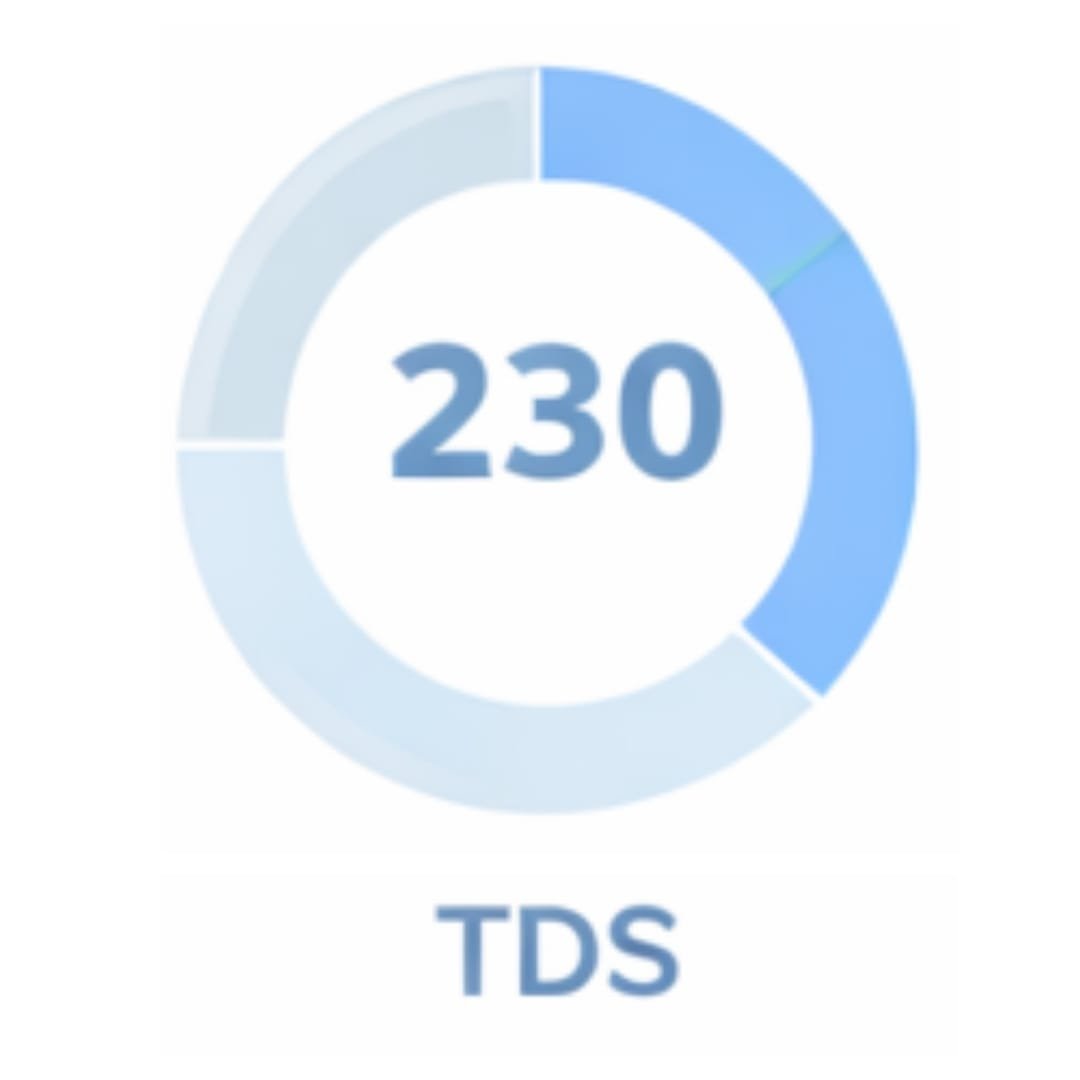
Thirty minutes at your kitchen sink settles all of it. Hardness, chlorine, total dissolved solids, pH, plus pressure and flow at the hose bib. We write the numbers down and hand them to you, whether you buy anything or not. Think of it as a blood panel for your plumbing.
Straight from Hague
Both pages Hague publishes on the Maximizer Model 97. Read the source yourself rather than taking our word for any of it.
Certification and warranty
Two separate things cover this system, and it's worth knowing which is which before you buy from anybody.
A 15 year limited warranty on the system, and it's made in the USA. Terms are Hague's, and we'll walk you through the actual document before you decide anything.
Our own work is covered under The McCowin Guarantee. We also file manufacturer warranty claims on your behalf rather than handing you a phone number for Ohio and wishing you luck.
If the Maximizer Model 97 we install doesn't do what we said it would:
The performance guarantee runs one year from your installation date. Service support doesn't expire.
From Orange County homeowners
Softener installs, plus a few on how the service has gone since. That second part is what a 15 year warranty actually rests on.
Ronald and Cindi
Tustin homeowners
“We were completely pleased with the installation of a water softener system.”
They wrote that Brian and Alan answered every question and made the adjustments needed to fit the softener perfectly in their garage.
Kathy Leedom
Irvine homeowner
“He was thorough, answered all my questions, and couldn't have been nicer.”
Brian walked her through the system, then Joel came out to install the tanks and show her how it all works.
Anita
Laguna Niguel homeowner
“They carry many different manufacturers and can recommend the one best suited for your needs.”
She wanted a system that was efficient and produced the least waste water, and wrote that is exactly what she got.
Jennifer Hill
Costa Mesa homeowner
“They're so professional and helpful. I feel completely safe with their system in my home.”
She described the team as reliable and trustworthy, and said that's rare these days.
Henry Novell
Google review
“Good company. Answered every question I had.”
After a Hague water softener and reverse osmosis installation.
Mike Michino
Google review
“Meticulous, and complete in every detail. They do not cut any corners.”
On his annual service visit. He wrote that the technician had him reprogram the unit himself so he could do it after they left.
Ethan Blair
Google review
“We have been with McCowin water for 7 years and only encountered positive results.”
Seven years of quoting, scheduling, service and follow up.
Tom Atkins
Google review
“Good company. High integrity.”
Several years as a customer. Brian came out personally on his most recent visit.
Questions
Through ion exchange. Hard water carries dissolved calcium and magnesium picked up from rock along the way. Inside the softener is a bed of resin beads holding harmless sodium ions. As water passes through, the beads grab the calcium and magnesium and hand back sodium in the swap, so hard minerals go in and soft water comes out. When the beads are full, the system regenerates: it draws brine from the salt tank, flushes the collected hardness down the drain and reloads the resin with fresh sodium. It is a whole house system installed at the point of entry, so every tap in the home is downstream of it.
No. Ion exchange adds a very small amount of sodium, and the amount depends on how hard your water was to begin with. It is nowhere near enough to taste. If you are on a sodium restricted diet or you would simply rather not, potassium can be used in place of sodium, and plenty of households pair a softener with a reverse osmosis system at the kitchen tap so drinking and cooking water goes through a separate stage anyway. Ask at the water test and we will lay out both options.
No, and this is the most common mix up we run into. A salt free conditioner does not remove calcium and magnesium. It changes their structure so they are less likely to stick as scale, which can help with buildup but does not give you the slippery soft water feel, the better lathering or the reduced detergent use. A true softener removes the hardness minerals through ion exchange. Both have a place. Which one suits you depends on what your water measures and what is actually bothering you, and we carry both so we have no reason to steer you either way.
15 inches wide by 30 inches high by 19 inches deep, all in one cabinet. That's the whole point of this unit. It carries the softener, the resin and the brine tank in a single case instead of the two tank setup most softeners need, so it tucks into a garage corner, a utility closet or the gap beside the washer without taking over the room. Roughly the footprint of a kitchen trash can, and about counter height.
For hardness, comfortably. Water here typically runs 12 to 23 grains per gallon and the Model 97 is rated to 90, so there is plenty of headroom. The question that actually matters is not hardness, it is whether the 10.7 gallon per minute peak flow suits how your house uses water. A three bedroom is a different situation from a six bathroom home. That is what we measure at your hose bib during the free water test, before recommending anything.
The Maximizer Model 97 is rated to 90 grains per gallon compensated hardness, which is a bit like a truck rated to tow ten thousand pounds when you'll never hitch more than two. Orange County's municipal water doesn't come close to that ceiling. It also reduces ferrous iron up to 10 ppm. Hardness almost never rules this system out. Flow rate is the thing to check, and that's what the free water test measures.
Peak flow rate is 10.7 gallons per minute at a 15 psi drop. Think of it as a doorway. That's a comfortable doorway for most three and four bedroom homes, and nobody's bumping shoulders. Put six bathrooms behind it with everyone leaving at seven in the morning and it starts to feel narrow. So for a larger house, or anywhere with a high fixture count, we measure your actual flow at the hose bib before recommending it, not after. If your house needs more, we'll say so and point you at something else.
It does both. Ultra-Fil is a self cleaning dirt and sediment filter rated at 20 microns nominal, so there's nothing to swap out. It's the difference between a self cleaning oven and one you scrub, and for scale, a human hair is about 70 microns wide. There are variants for specific problems too: the 97MMBI carries Chlorostat for chlorine, the 97MMPI carries Sulfurstat for sulfur. What it isn't is a fully customizable multi chamber system. If your test turns up several problems at once, that's a Swiss Army knife job and the WaterMax Signature Series is the better fit.
That depends on the setting, which works a bit like a dosage. Setting 1 uses 1 lb of salt for 5,400 grains of capacity. Setting 2 uses 3 lb for 13,700 grains. Setting 3 uses 6 lb for 23,700 grains. Setting 4 uses 9 lb for 30,800 grains. The brine tank holds 170 lbs. The vacuum packed fine mesh resin is what keeps those numbers low, because finer beads mean more surface area doing the work, the same reason ground coffee brews faster than whole beans.
No, and that's one of the real cost advantages here. The Ultra-Fil filtration cleans itself, so you're not buying a cartridge every six to twelve months the way you would with a lot of systems. You'll still need salt, and we'd still recommend an annual service check, but there's nothing to unscrew and replace.
A 15 year limited warranty from Hague Quality Water International. The terms are Hague's, and we'll walk you through the actual document before you buy rather than after. Our own installation work is covered separately under The McCowin Guarantee, and we file manufacturer warranty claims for you instead of handing you a phone number for Ohio.
115 V at 60 Hz for power, 1 1/4 inch male MNPT plumbing connections, incoming pressure between 20 and 120 psi, water temperature between 40 and 120 F, and a minimum pH of 7. Our technician checks every one of those at the free water test, because a system that doesn't suit the conditions in your garage isn't a system worth installing.
Go with the Model 97 if hardness is your main problem, space is tight, and you want something straightforward. Go with the WaterMax Signature Series if your test turns up several problems at once and you need the 2 or 3 customizable media chambers to handle them, or if the longer 25 year warranty matters to you. One's a specialist, the other's a Swiss Army knife. Your water test tells us which conversation we're having, and finding out costs nothing.
Thirty minutes at your kitchen sink tells us whether the Maximizer Model 97 belongs in your house, and whether its 10.7 gpm flow rate suits how your home actually uses water. The test is free, the numbers are yours to keep, and there is nothing to buy.
Or come see one in person at the showroom. 222 Goddard, Irvine, CA 92618. (949) 569-5736. Monday through Friday, 9 to 5.
hague maximizer water softener, hague maximizer, water solution for home