


By Brian McCowin, McCowin Water. Serving Irvine and Orange County since 1972.
You open the lid of your water softener and notice something that does not look right. The salt level has dropped faster than expected, or you find yourself adding bags of salt more often than usual. Perhaps your water softener used to last several weeks between refills, but now it seems to be consuming salt constantly.
It is easy to assume the system simply needs more salt. In reality, a water softener using too much salt may be dealing with an incorrect setting, a problem with the regeneration cycle, a water leak, or a system that is not properly matched to your home’s water use. Salt is an essential part of how a traditional water softener works, but excessive salt consumption can increase maintenance costs and may signal that the equipment needs attention. Before buying another bag, it helps to understand what is normal and what may be causing the change.
How much salt should a water softener use?
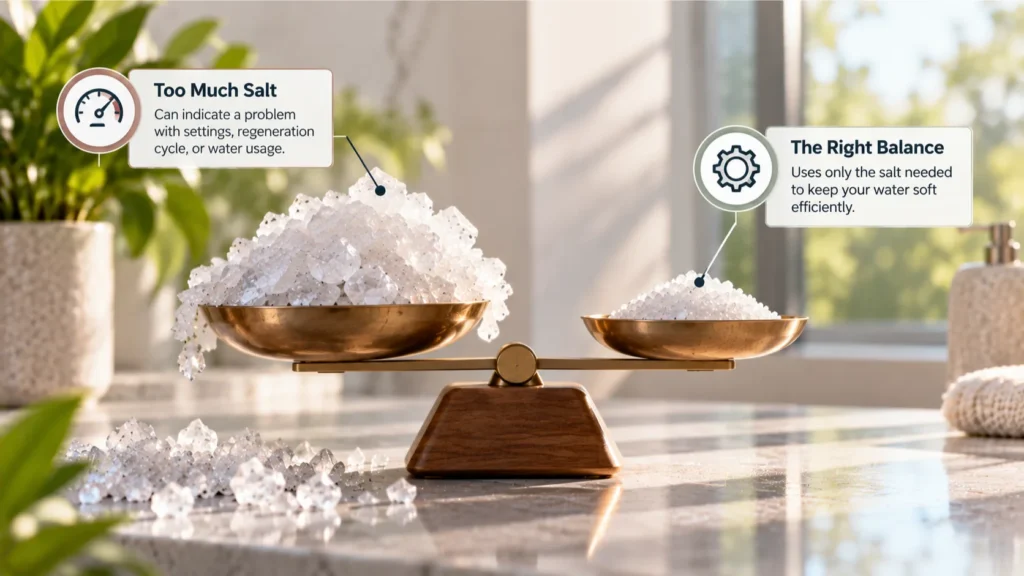
There is no single amount of salt that every water softener should use. Salt consumption depends on several factors, including the hardness of your water, the number of people in your home, your daily water use, the size of the softener, and the way the system is programmed.
A home with two people and moderately hard water may use far less salt than a larger household with six people and very hard water. A system that treats water for several bathrooms and appliances may also regenerate more often than one serving a smaller property. The important point is consistency. If your softener has always used a predictable amount of salt and suddenly begins using twice as much, something may have changed.
Your system may be regenerating more often than necessary. Its hardness setting may be too high. The salt dose may not be calibrated correctly. A toilet that runs continuously or a hidden plumbing leak may also be forcing the softener to treat more water than your household actually needs.
Why is my water softener using too much salt?
Several issues can cause excessive salt use. Some are simple programming problems, while others require a closer inspection of the equipment.
➤ The hardness setting may be too high
Your water softener should be programmed according to the actual hardness of your water. If the hardness setting is higher than necessary, the system may use more salt during each regeneration cycle.
For example, if your water tests at a certain hardness level but the control valve is programmed for a much harder supply, the softener may be treating the water as though it contains more calcium and magnesium than it really does. This can lead to unnecessary salt consumption over time.
Water hardness can also vary between properties, even within the same general area. It is better to base the setting on a current water test than on a guess or a setting copied from a neighbor’s system.
➤ The softener may be regenerating too frequently
Regeneration is the cleaning process that restores the softener’s ability to remove hardness minerals. During this cycle, the system uses a measured amount of salt and water to clean its resin bed. A properly configured system should regenerate according to the amount of water your household uses and the hardness of the water. If it regenerates every night or far more often than expected, it may be using more salt than necessary.
Frequent regeneration can happen because of incorrect programming, a faulty meter, excessive water use, or a control valve problem. In some cases, the system may be set to regenerate on a fixed schedule even when the household does not need it. A demand-based system can often be more efficient because it responds to actual water use.

➤ Your home may be using more water than you realize
A water softener responds to water passing through the system. If your household is using more water, the softener may need to regenerate more frequently. Changes such as house guests, additional occupants, more laundry, frequent gardening, or increased cleaning can all affect water use. However, sudden and unexplained increases deserve a closer look.
A leaking toilet, dripping faucet, broken irrigation line, or hidden plumbing leak can send large amounts of water through your treatment system. The softener may interpret this as normal household demand and use additional salt to keep up. If your salt consumption rises without any obvious change in your routine, check for leaks before assuming the softener itself is failing.
➤ The salt dose may be set incorrectly
Some water softeners allow the salt dose to be adjusted. If the dose is set higher than necessary, the system may use more salt during every regeneration cycle. Using more salt does not automatically mean the water will be softer. Once the system has enough salt to complete the regeneration process, additional salt may simply increase operating costs.
The correct setting depends on the system’s design, resin capacity, water hardness, and household demand. Avoid changing the salt dose randomly. A setting that works for one model may not be appropriate for another.
➤ The control valve or meter may not be working correctly
The control valve manages the softener’s operating cycles. In metered systems, a water meter tracks how much water passes through the equipment and helps determine when regeneration is needed. If the meter is inaccurate or the control valve is malfunctioning, the system may regenerate at the wrong time or use the wrong amount of salt.
You may notice other signs, such as unusual noises, unexpected regeneration times, water flowing to the drain, or a control panel that does not appear to follow its programmed schedule. When excessive salt use is accompanied by unusual system behavior, professional inspection is often the most efficient next step.
Could a salt bridge be causing the problem?
A salt bridge occurs when the salt inside the brine tank forms a hard layer or crust. The tank may appear to contain plenty of salt, but the salt underneath the crust may not be dissolving properly. A salt bridge more commonly causes insufficient salt use or poor regeneration because the system cannot create the brine it needs. It does not usually explain a softener that is genuinely consuming too much salt.
However, a salt bridge can make it difficult to judge the actual salt level. The tank may look full even when very little usable salt is available below the hardened layer. Do not strike the tank aggressively or use sharp tools to break up the salt. Doing so may damage the brine tank. If you suspect a salt bridge, have the issue checked carefully.
Does using more salt make water softer?
Not necessarily. A water softener does not produce better results simply because you add more salt. The purpose of salt is to help regenerate the resin that captures calcium and magnesium. Once the system has the appropriate amount of salt for its regeneration cycle, adding more does not automatically improve the quality of the softened water.
Excess salt use may indicate that the system is poorly adjusted or that it is not operating efficiently. The goal should be to achieve the right level of water softness while using an appropriate amount of salt and water. An efficient system is not necessarily the one that uses the most salt. It is the one that is correctly sized, properly programmed, and maintained for your home.
How to reduce water softener salt consumption
If your water softener is using too much salt, start by paying attention to when the problem began. Think about whether your household water use has changed, whether the system has recently been serviced, or whether someone adjusted the control settings. Check the programmed hardness level and regeneration schedule, but avoid making major changes without understanding the equipment. A wrong adjustment may create another problem.
Inspect nearby toilets and faucets for leaks. Listen for water running when no one is using it. If your system has a water meter or usage display, review the readings for unusual changes. Make sure the brine tank is maintained according to the manufacturer’s instructions. Use the recommended type of salt, and do not fill the tank beyond the level advised for your system.
If the softener continues to consume salt unusually quickly, arrange for a water test and equipment inspection. Testing can help determine whether the system is removing hardness properly and whether its settings match the actual water conditions in your home.
Why Irvine homeowners have trusted the McCowin family since 1972
I’m Brian McCowin. My family has been solving water problems in Orange County since 1972, one home and one honest answer at a time. A water softener should not be selected or adjusted simply because a particular model is popular or because another home uses the same settings. Water hardness, household size, plumbing conditions, and daily water use all matter.
Our approach begins with understanding the water. Through a free, in-home water test, we can help identify the hardness level and discuss whether your current softener is properly suited to your home. If your system is using too much salt, we can look at possible causes instead of immediately recommending a replacement.
We’re a licensed California water treatment contractor (CSLB C-55 #1022717), serving Irvine and the surrounding communities: Tustin, Santa Ana, Newport Beach, Costa Mesa, Lake Forest, Mission Viejo, Orange, Anaheim, Huntington Beach, Fountain Valley, Yorba Linda, Laguna Niguel, Laguna Hills, Aliso Viejo, Rancho Santa Margarita, San Juan Capistrano, and San Clemente.
The McCowin Promise
For more than fifty years, we’ve helped Orange County homeowners understand their water through professional testing, honest recommendations, and customized solutions.
“If the system we install doesn’t perform the way we promised… If your water doesn’t taste, feel, or behave the way we said it would… We’ll pull the whole system out. And either replace it or make it right. No fine print. Because your trust is worth more than the sale.”
How can I find out whether my water softener is working correctly?
A water test and a professional system inspection can help determine whether the softener is removing hardness properly, regenerating at the right time, and using an appropriate amount of salt.
Book your free, in-home water test today, or call (949) 569-5736.
If your water softener is using too much salt, the issue may be a simple setting or a sign that the system needs attention. The best starting point is to understand your water, check for changes in household use, and have the equipment evaluated before spending more money on salt.
Frequently Asked Questions
Why is my water softener going through salt so quickly?
Your system may be regenerating too often, using an incorrect hardness setting, treating more water than usual, or experiencing a control valve or meter problem. A plumbing leak can also increase water use and salt consumption.
How often should I add salt to my water softener?
The refill schedule depends on your system, water hardness, household size, and water use. Some homes need salt every few weeks, while others can go longer. A sudden change in your normal refill pattern deserves attention.
Can a water softener use too much salt?
Yes. Excessive salt use may result from incorrect programming, an oversized salt dose, frequent regeneration, leaks, or equipment problems. Adding more salt will not necessarily improve water softness.
Should I change my water softener settings myself?
You can review the settings, but avoid making significant changes without knowing your water hardness and the requirements of your specific system. Incorrect settings may increase salt use or affect performance.