


By Brian McCowin, McCowin Water. Serving Irvine and Orange County since 1972.
RO vs carbon filtration comes down to what you are trying to remove from your water. Carbon filtration is excellent for improving taste, reducing chlorine, and addressing certain chemicals and odors. Reverse osmosis goes further by using a membrane to reduce many dissolved contaminants and minerals. The right choice depends on your water quality, where you want treated water, and what your household actually needs.
Choosing between these two systems can get confusing because both can make your water better, but they do very different jobs. One is not automatically a replacement for the other.
Filtration starts with your water
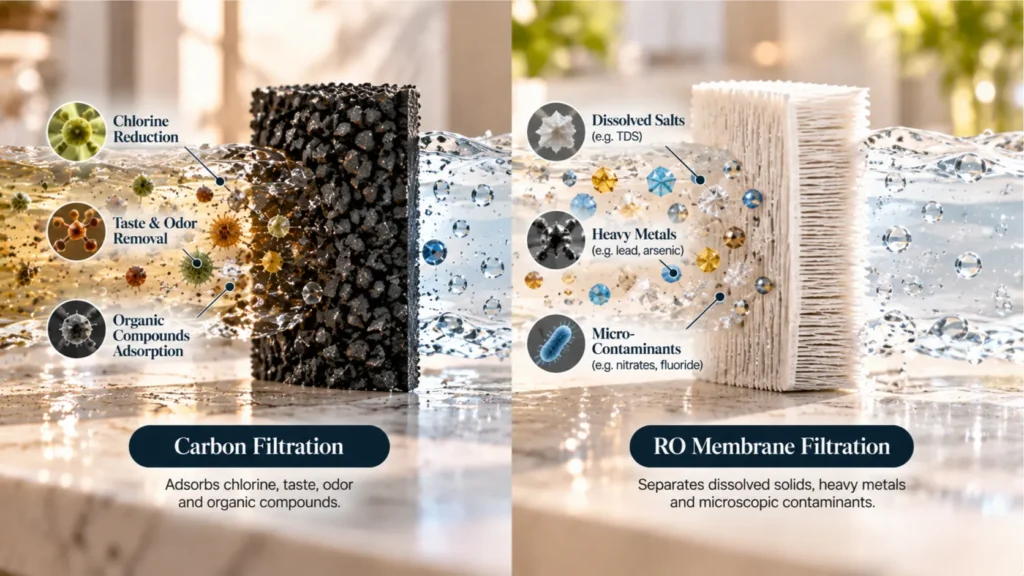
When homeowners ask about RO vs carbon filtration, the first question should not be “Which system is better?” It should be “What is in my water?” A carbon filter works by passing water through activated carbon. The carbon traps or reduces certain compounds as the water moves through the filter. It is particularly useful when the main concern is chlorine taste, odor, or certain organic compounds.
Reverse osmosis, commonly called RO, works differently. Water is pushed through a semi-permeable membrane that allows water molecules through while reducing many dissolved substances. RO systems usually also include prefilters and postfilters to protect the membrane and improve the finished water. The difference matters because a system should be selected around the problem, not simply the technology.
What carbon filtration can do well?
Carbon filtration is often a practical choice when the main complaint is about the way water tastes or smells. If your tap water has a noticeable chlorine taste, a properly selected carbon filter can make a significant difference. It can also improve odor and reduce certain organic compounds. Whole-home carbon filtration can treat water as it enters the house, so the benefit can reach showers, sinks, laundry, and other fixtures.
Carbon filtration also tends to be simpler than RO. It does not normally require the same type of membrane process, and whole-home systems can provide treated water throughout the house. Still, carbon filtration has limits. It is not designed to remove every dissolved mineral or contaminant. If your concern involves substances that require a more comprehensive reduction method, a carbon filter alone may not provide the result you are looking for.
What can reverse osmosis do differently?
The biggest difference in RO vs carbon filtration is the range of dissolved substances that reverse osmosis can reduce. An RO membrane can reduce many dissolved salts, minerals, and other contaminants that pass through or are not the primary target of standard carbon filtration. This makes RO particularly useful for drinking and cooking water when homeowners want a higher level of treatment at the tap.
RO is commonly installed under the kitchen sink. Water passes through several stages before reaching a dedicated faucet. Depending on the system, those stages can include sediment filtration, carbon filtration, the RO membrane, and a final polishing filter. This also explains why comparing RO vs carbon filtration as if they are competing products can be misleading. Carbon filtration is often one part of an RO system.
RO vs carbon filtration for drinking water
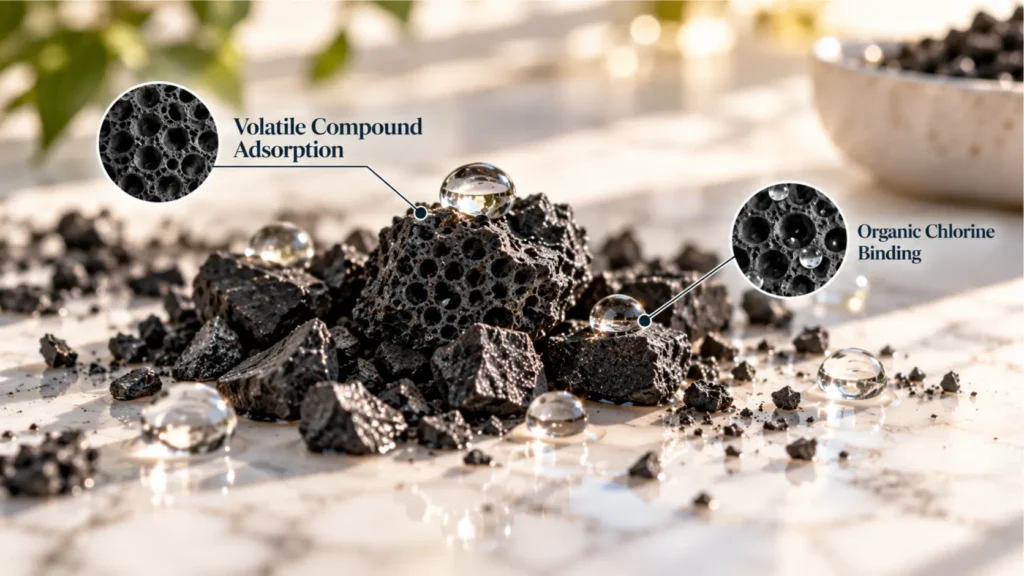
For drinking water, the right choice depends on the specific water quality concern. If your primary complaint is chlorine taste or odor, carbon filtration may be enough. If you are concerned about dissolved minerals or a broader range of contaminants, RO may make more sense.
The important point is not to assume that more filtration automatically means better water for every home. An RO system can be unnecessary if your only concern is taste, while a carbon filter may be insufficient if you need substantial reduction of dissolved substances.
A water test helps separate those two situations.
Do you need both carbon and RO?
In many homes, RO and carbon filtration is not an either-or decision. The two technologies can work together. Carbon filtration can be used before an RO membrane to help protect it and reduce chlorine and other compounds. The RO membrane then handles the dissolved contaminants it is designed to reduce. A final carbon filter can help polish the water before it reaches the drinking faucet.
This combination can be especially useful when homeowners want better-tasting drinking water along with broader contaminant reduction. The important part is designing the system around the actual water conditions rather than adding stages simply because a system has more filters.
Whole-home carbon or under-sink RO?
This is another important difference when considering RO vs carbon filtration. A whole-home carbon system treats water throughout the house. It can make sense when chlorine, odor, or certain compounds are the main concern across multiple fixtures.
An under-sink RO system concentrates treatment where drinking and cooking water are used. It can provide a higher level of treatment without requiring every gallon used for showers, toilets, and laundry to pass through an RO membrane.
For some homes, the practical solution is therefore a whole-home carbon filter combined with an under-sink RO system. For others, a simpler filtration setup may be appropriate.

Start with a water test, not a product
The biggest mistake homeowners can make with RO vs carbon filtration is choosing equipment before understanding the water. Two homes in the same Irvine neighborhood can have different plumbing, water conditions, treatment goals, and household preferences. A system that makes sense for one home may be unnecessary for another.
A proper evaluation looks at the water first, identifies the actual concerns, and then matches the treatment to those findings.
Why Irvine homeowners have trusted the McCowin family since 1972
I’m Brian McCowin. My family has been solving water problems in Orange County since 1972, one home and one honest answer at a time. The approach starts with testing and diagnosis, then moves to education and installation when treatment is actually needed. That diagnostic-first process matters because it is not simply a comparison between two products. It is a decision about which treatment fits your water, your home, and the way your family uses it.
We’re a licensed California water treatment contractor (CSLB C-55 #1022717), serving Irvine and the surrounding communities: Tustin, Santa Ana, Newport Beach, Costa Mesa, Lake Forest, Mission Viejo, Orange, Anaheim, Huntington Beach, Fountain Valley, Yorba Linda, Laguna Niguel, Laguna Hills, Aliso Viejo, Rancho Santa Margarita, San Juan Capistrano, and San Clemente.
The McCowin Promise
For more than fifty years, we’ve helped Orange County homeowners understand their water through professional testing, honest recommendations, and customized solutions.
“If the system we install doesn’t perform the way we promised… If your water doesn’t taste, feel, or behave the way we said it would… We’ll pull the whole system out. And either replace it or make it right. No fine print. Because your trust is worth more than the sale.”
Find the right treatment for your water
If you are still comparing RO vs carbon filtration, start with the water rather than guessing which system you need. A free in-home water test can help identify what is actually present and whether carbon filtration, reverse osmosis, or a combination makes sense for your home.
Book your free, in-home water test today, or call (949) 569-5736.
Frequently Asked Questions
Is RO better than carbon filtration?
Neither is automatically better. Carbon filtration and reverse osmosis address different water quality concerns. The right choice depends on what your water test shows and what you want the treatment system to accomplish.
Can carbon filtration be used with reverse osmosis?
Yes. Carbon filtration is commonly used as part of an RO system. It can help reduce chlorine and certain compounds before water reaches the RO membrane.
Does carbon filtration remove minerals from water?
Standard carbon filtration is not designed to remove most dissolved minerals. Reverse osmosis can reduce many dissolved minerals and salts, which is one reason it is commonly used for drinking water.
Is RO necessary for the whole house?
Not necessarily. RO is often installed at a drinking-water point such as the kitchen sink. Whole-home carbon filtration can be more practical when the primary concern affects water throughout the house.
How do I choose between RO vs carbon filtration?
Start with a water test. Understanding the actual water conditions helps determine whether carbon filtration, reverse osmosis, or both are appropriate for your home.