


By Brian McCowin, McCowin Water. Serving Irvine and Orange County since 1972.
If you’re concerned about high TDS water in Anaheim, the first thing to understand is what that number actually tells you. TDS, or Total Dissolved Solids, measures the combined concentration of dissolved substances in water, including minerals, salts, and certain other compounds. Reverse osmosis (RO) can reduce many of these dissolved substances, making it a useful treatment option when your water test shows elevated TDS. However, a high reading does not automatically mean your water is unsafe. You need to understand what is contributing to that number before choosing a treatment system.
A homeowner might notice white marks on glassware, a slightly different taste, or residue around faucets and start wondering whether the water needs treatment. Another homeowner may have no visible concerns but simply wants to know what is in the water their family drinks every day.
Both are reasonable reasons to investigate your water. The important part is knowing what the numbers mean before deciding what to do about them.
What does a high TDS reading actually mean?
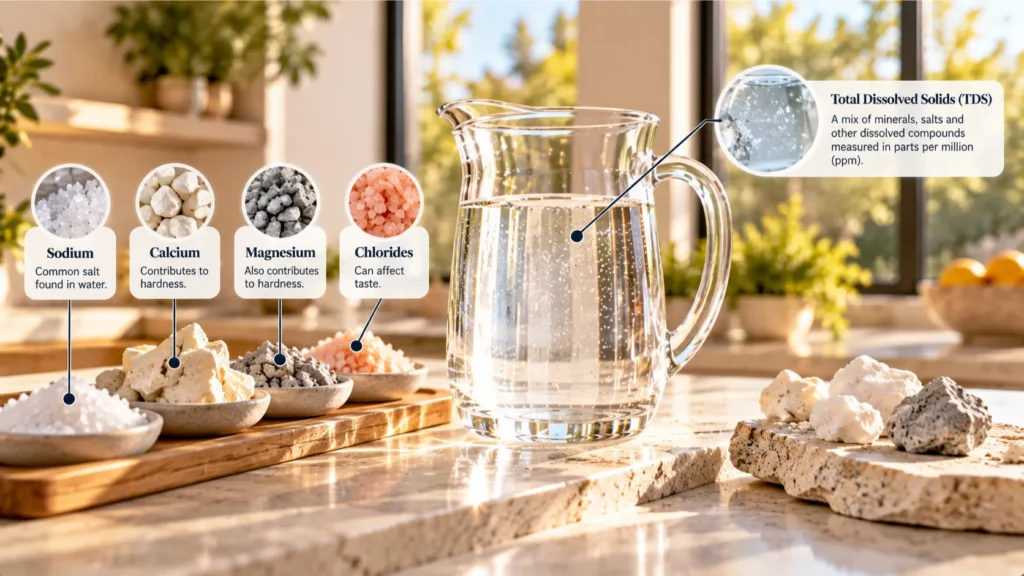
Think of a glass of water as more than just H2O. It can contain small amounts of minerals and other dissolved substances that are not visible to the eye.
A TDS meter measures the combined level of these dissolved materials and gives you a reading, usually in parts per million (ppm). The reading provides a useful starting point for understanding your water, but it does not identify every substance individually.
For example, calcium and magnesium contribute to water hardness. Sodium, chloride, and other dissolved salts can also contribute to TDS. Different substances affect water in different ways, so two water samples with similar TDS readings may have very different compositions. This is why a TDS number should never be treated as a complete water-quality report.
Why might Anaheim tap water have elevated TDS?
The dissolved content of water depends partly on where the water comes from and what it comes into contact with before reaching your home. As water moves through natural sources, it can pick up minerals from rocks and soil. Water treatment and distribution conditions can also influence its overall composition.
Anaheim households may receive water from different sources and supply arrangements, so one home’s results should not automatically be assumed to represent another home’s water. Your plumbing and any existing water treatment equipment can also influence what comes out of an individual tap.
If you are seeing a higher reading, it is worth finding out whether the dissolved content is mainly associated with naturally occurring minerals or other substances. The number alone cannot answer that question.
Does high TDS affect the taste of drinking water?
It can. Some dissolved minerals and salts influence the way water tastes. Depending on their concentration and combination, they may give water a mineral-like, salty, or slightly bitter taste. This is one reason homeowners sometimes notice a difference between untreated tap water and water that has passed through a filtration system.
However, taste is not a reliable way to measure TDS. Water can have a high reading without an obvious taste, and an unpleasant taste does not necessarily mean TDS is elevated. If the concern is drinking water quality, testing gives you a more useful starting point than relying on taste alone.
Can reverse osmosis reduce high TDS water?
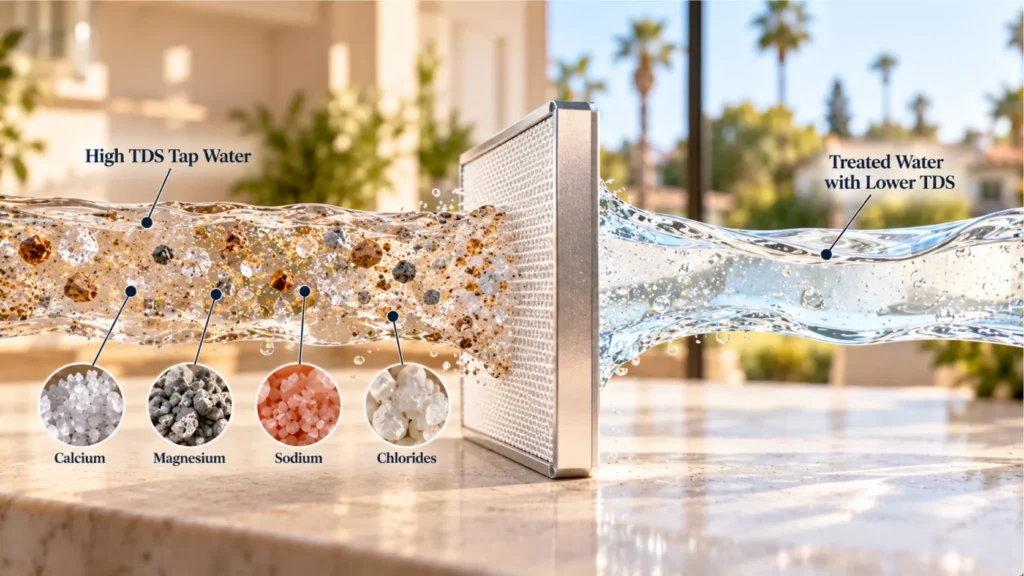
Yes. Reverse osmosis is specifically designed to reduce many dissolved substances in water. An RO system pushes water through a semi-permeable membrane. The membrane allows water molecules to pass through while retaining a substantial portion of many dissolved salts and other substances.
The water that passes through becomes the treated drinking water, while the concentrated dissolved substances leave through a separate drain line. This makes reverse osmosis particularly useful when a homeowner wants to reduce dissolved solids in water used for drinking and cooking.
The actual reduction depends on the incoming water, membrane condition, system design, water pressure, and maintenance. It is not accurate to assume every RO system will produce the same TDS reading in every home.
Why is RO often installed under the kitchen sink?
When dealing with high TDS water in Anaheim, homeowners sometimes assume they need to treat every gallon entering the house. In many cases, that is not necessary. Reverse osmosis is commonly installed beneath the kitchen sink because this is where families draw water for drinking, cooking, filling bottles, and preparing beverages.
A point-of-use RO system concentrates treatment at the location where higher-quality drinking water is most useful. It also avoids sending water used for showers, toilets, and laundry through a process designed primarily for drinking-water applications.
If your main concern is dissolved solids in drinking water, an under-sink RO system may be worth considering.
Is a high TDS water reading enough reason to install an RO system?
Not by itself. A TDS reading tells you how much dissolved material is present, but it does not tell you exactly what that material is. It also cannot establish whether the water meets every drinking-water standard. For example, a reading may be influenced by naturally occurring calcium and magnesium, while another sample may contain a different combination of dissolved substances.
The treatment decision should therefore consider more than one number. Depending on your concerns, additional testing may be needed to identify specific substances. An RO system can be a suitable option for reducing many dissolved solids, but the right system should be selected after understanding the water conditions and your household’s requirements.
What should Anaheim homeowners do about elevated TDS?
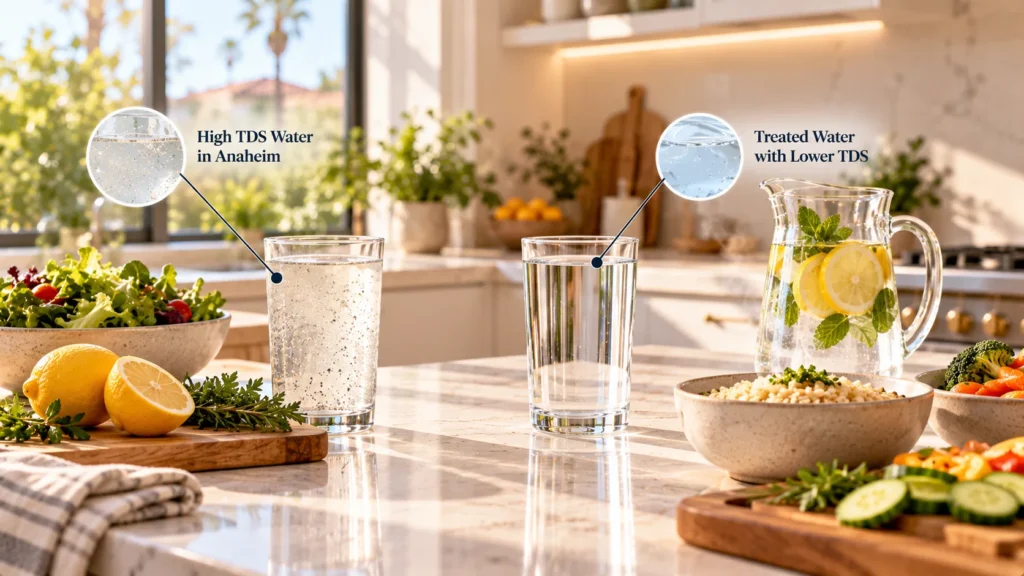
Start by testing the water rather than purchasing equipment based on a meter reading alone. If you already have a TDS meter, its reading can help identify a reason to investigate further. However, it should not be used as the only measure of water quality.
A proper assessment looks at the source of the water, relevant water-quality indicators, and the concerns you have noticed at home. If reverse osmosis is appropriate, the system can then be selected according to your water conditions and daily usage. This approach helps avoid installing equipment that does not address the actual problem.
Why Irvine homeowners have trusted the McCowin family since 1972
I’m Brian McCowin. My family has been solving water problems in Orange County since 1972, one home and one honest answer at a time. A TDS reading can raise useful questions, but it is only one part of the picture. We believe in testing first, understanding the results, explaining the available options, and recommending equipment only when it serves a clear purpose.
Whether you are concerned about dissolved minerals, drinking water taste, or the overall quality of your tap water, the goal is to understand what is happening before making a decision.
We’re a licensed California water treatment contractor (CSLB C-55 #1022717), serving Irvine and the surrounding communities: Tustin, Santa Ana, Newport Beach, Costa Mesa, Lake Forest, Mission Viejo, Orange, Anaheim, Huntington Beach, Fountain Valley, Yorba Linda, Laguna Niguel, Laguna Hills, Aliso Viejo, Rancho Santa Margarita, San Juan Capistrano, and San Clemente.
The McCowin Promise
For more than fifty years, we’ve helped Orange County homeowners understand their water through professional testing, honest recommendations, and customized solutions.
“If the system we install doesn’t perform the way we promised… If your water doesn’t taste, feel, or behave the way we said it would… We’ll pull the whole system out. And either replace it or make it right. No fine print. Because your trust is worth more than the sale.”
Let’s understand what’s in your water
If your TDS meter shows a higher reading or your tap water tastes different, you don’t have to guess what treatment your home needs.
Book your free, in-home water test today, or call (949) 569-5736.
A free in-home water test can help us understand your water conditions and explain whether reverse osmosis or another treatment option makes sense.
Frequently Asked Questions
What is considered high TDS in drinking water?
TDS readings are commonly expressed in parts per million. A higher reading indicates more dissolved material, but it does not automatically mean the water is unsafe. The substances contributing to the reading matter just as much as the total.
Does reverse osmosis remove all TDS from water?
No. Reverse osmosis can substantially reduce many dissolved solids, but it does not remove every dissolved substance completely. The final reading depends on the incoming water and the system’s performance.
Can high TDS make Anaheim tap water taste different?
Yes. Certain dissolved minerals and salts can influence taste. However, taste alone cannot establish whether TDS is high or identify which substances are present.
Will a water softener reduce TDS?
A conventional water softener exchanges hardness minerals such as calcium and magnesium for sodium or potassium ions. It addresses hardness, but it is not designed to remove the full range of dissolved solids.
How can I check the TDS level in my home?
A handheld TDS meter can provide a quick reading, usually in ppm. For a better understanding of water quality, the reading should be considered alongside other relevant tests that help identify what is dissolved in the water.