


The best whole-home filtration system for your Irvine home depends on your actual water conditions, not whatever system a salesperson happens to carry. A proper evaluation should look at chlorine levels, hard water, PFAS concerns, sediment, plumbing type, family size, and water usage habits. The right system protects your pipes, appliances, skin, and drinking water without sacrificing water pressure or creating expensive maintenance headaches. Always start with a professional, on-site water test before choosing equipment.

Why do so many homeowners buy the wrong whole-home filtration system?
Because most systems are sold backwards.
The water industry has a dirty little secret: many companies choose the product first and justify it later.
That is like a doctor prescribing medicine before checking your pulse.
I’m Brian McCowin. My family has been fixing water in Orange County since 1972. I have seen families spend thousands on oversized systems they never needed and undersized systems that failed within a few years.
The saddest part?
Most homeowners thought they were making a smart decision.
They trusted the pitch.
They trusted the shiny brochure.
They trusted the “limited-time offer.”
Meanwhile, their water still smelled like chlorine, their showers still dried out their skin, and their appliances kept collecting mineral scale.
That frustration is real.
Especially in coastal communities like Newport Beach, Laguna Niguel, and Huntington Beach where water quality conditions can vary dramatically from one neighborhood to the next.
What should I look for in a whole-home filtration system?
You should look for a system that is customized to your home’s actual water conditions, plumbing setup, and daily water demand.
Not every Irvine home needs the same solution.
That is the first thing honest water professionals will tell you.
A proper whole-home filtration evaluation should consider:
- Hardness levels
- Chlorine or chloramine content
- Sediment levels
- Total dissolved solids (TDS)
- Pipe condition and plumbing age
- Number of bathrooms
- Family size
- Peak water usage
- Water pressure requirements
- Emerging contaminant concerns like PFAS
The goal is balance.
You want strong filtration without choking your water pressure or creating constant maintenance problems.
A good system should feel invisible.
Your water should simply feel cleaner, softer, and healthier throughout the home.
Do Irvine homes really need whole-home water filtration?
Many homes in and around Irvine benefit significantly from whole-home filtration because Southern California water often contains high mineral content and disinfectant chemicals.
Hard water is one of the biggest issues we see.
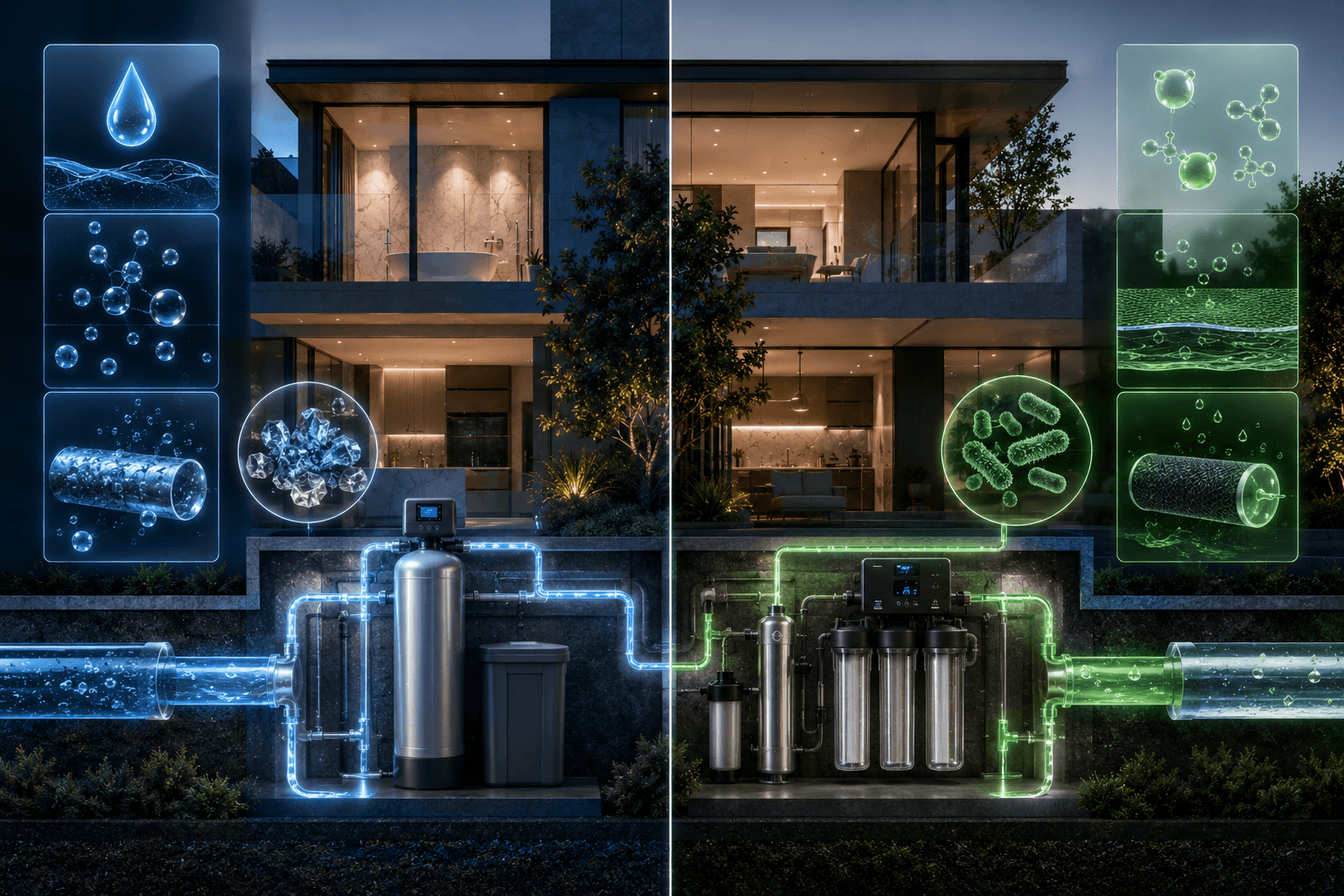
Think of hard water like tiny rock particles constantly moving through your plumbing system. Over time, those minerals stick to pipes, water heaters, fixtures, dishwashers, and showerheads.
It is slow damage.
The kind homeowners rarely notice until:
- Appliances fail early
- Water pressure drops
- Utility bills rise
- Skin irritation gets worse
- White crust forms around fixtures
Then there is chlorine.
Cities disinfect water for safety, which is important. But that same chlorine can affect taste, smell, laundry, and skin comfort.
Recent attention from 2023 through 2025 has also increased around PFAS and trace contaminants entering municipal systems nationwide. Homeowners are becoming more proactive about long-term exposure and overall water quality.
And honestly, they should.
Water is not just about drinking anymore. It touches your entire home.
What is the difference between a water softener and a whole-home filter?
A water softener removes hardness minerals. A whole-home filter targets contaminants, chemicals, sediment, taste, and odor issues.
Many homeowners confuse the two.
Here is the simplest way to understand it:
| System Type | What It Primarily Does |
|---|---|
| ➤ Water Softener | Removes hardness minerals like calcium and magnesium |
| ➤ Whole-Home Filter | Reduces chlorine, sediment, odors, and contaminants |
| ➤ Reverse Osmosis | Purifies drinking water at a specific faucet |
Sometimes homeowners need one.
Sometimes they need a combination.
This is where the industry gets tricky.
Some companies push giant “all-in-one miracle systems” that promise to fix everything. In real life, water treatment is more nuanced than that.
At McCowin Water, I compare our business to an auto mall for water.
A captive franchise can only sell what is sitting on its showroom floor.
We are different.
We carry a broad range of proven solutions so we can actually fit the system to the home instead of forcing the home to fit the inventory.
That matters more than most people realize.
Can the wrong filtration system hurt water pressure?
Yes. Poorly designed or improperly sized systems can absolutely reduce water pressure.
This happens all the time.
A system may look impressive online, but if it cannot handle your home’s real flow rate, every shower and faucet suffers.
That is why sizing matters.
A four-bedroom family home does not use water the same way as a small condo.
The filtration media, tank size, valve quality, and plumbing design all affect performance.
Bad systems create:
- Weak showers
- Slow tub fills
- Appliance strain
- Constant maintenance
- Premature wear
A properly engineered system should improve water quality without making the home feel restricted.
You should not have to choose between clean water and good pressure.
Why do some filtration systems fail after only a few years?
Because many are built to win sales presentations, not survive real-world use.
That may sound harsh, but it is true.
Cheap valves.
Low-quality resin.
Undersized carbon beds.
Poor installation practices.
It is the water industry version of putting economy tires on a heavy-duty truck.
Everything looks fine until real stress hits the system.
A quality whole-home filtration setup should be designed for:
- Long-term reliability
- Easy servicing
- Consistent flow rates
- Proper backwashing
- Future maintenance access
- Real household demand
We have removed systems only three or four years old that were already failing internally.
That should never happen with properly engineered equipment.
What guarantee should a trustworthy water company offer?
A trustworthy company should stand behind performance, not excuses.
At McCowin Water, we believe this completely:
“If the system we install doesn’t perform the way we promised… If your water doesn’t taste, feel, or behave the way we said it would… We’ll pull the whole system out. And either replace it or make it right. No fine print. Because your trust is worth more than the sale.”
That philosophy has guided our family business for decades.
Because once trust disappears, the rest of the transaction does not matter.
Final Thoughts
you deserve equipment designed around your home.
A proper whole-home filtration system should quietly improve daily life in ways you notice every single day:
- Better showers
- Softer skin
- Cleaner dishes
- Longer appliance life
- Better tasting water
- Less plumbing stress
But the system only works if the evaluation is honest from the start.
That is why every smart decision begins with a professional Free, In-Home Water Test.
Call us at (949) 569-5736 or Schedule a Free, In-Home Water Test Today.
CSLB: C-55 #1022717