
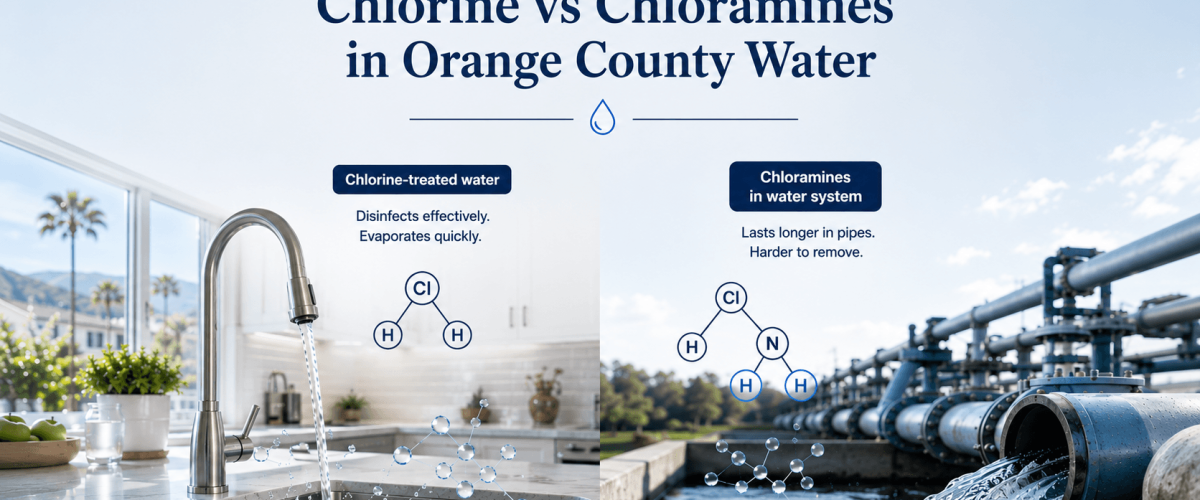

Both chlorine and chloramine keep your water safe to drink, and both can leave a taste you’d rather not have. But they behave very differently, and that difference decides which filter actually works. Here’s what Orange County homeowners should know.
The short answer: Chlorine dissipates quickly and off-gasses; chloramine (chlorine plus ammonia) is more stable and much harder to remove at home. Standard carbon handles chlorine easily, but chloramine needs catalytic carbon or reverse osmosis. Which one is in your water depends on your local agency, so check your provider’s report or measure at the tap.
Chlorine: the disinfectant that fades
Chlorine is the classic disinfectant, the pool smell you know. Its useful quirk is that it’s volatile: let a glass of chlorinated water sit out and much of the chlorine off-gasses on its own. That same quality makes it easy to remove with ordinary activated carbon, which is why a basic carbon filter handles chlorine taste with no drama.
Chloramine: the disinfectant that lingers
To keep water protected longer through the distribution system, many agencies use chloramine, which is chlorine bonded with ammonia. It’s more stable, so it doesn’t fade the way chlorine does. That’s great for safety and frustrating for filtration, because standard carbon struggles to remove it. This is the single most common reason a carbon filter “doesn’t seem to work” on someone’s water.
| Chlorine | Chloramine | |
|---|---|---|
| What it is | Chlorine disinfectant | Chlorine plus ammonia |
| Stability | Dissipates, off-gasses | Stable, long-lasting |
| Removed by standard carbon | Easily | Poorly |
| Removed by catalytic carbon | Yes | Yes |
| Removed by reverse osmosis | Yes, with carbon | Yes, with carbon |
The filter that actually works on chloramine
If your water is chloraminated, the answer is catalytic carbon, a specially processed activated carbon designed to break chloramine down. For drinking water, a reverse osmosis system with the right carbon stages handles it at the kitchen tap. The key is matching the media to the disinfectant, which is exactly why we identify which one your water carries before recommending a filter.
Orange County note: agencies across the region use chlorine or chloramine depending on the system and source, and your provider’s annual water-quality report will say which. Or we can simply measure it. Explore whole house water filtration and reverse osmosis systems.
The Blue Haven whole-home filtration
A whole-home filtration system that treats chlorine, taste, and sediment where the main line enters, so every tap in the house runs cleaner.
Hague HydroClean HC3 whole-house system
A single-tank whole-house system that softens and filters at once, protecting plumbing and appliances from scale.
Vertex IsoTwist reverse osmosis
A five-stage under-sink reverse osmosis system that gives you bottled-quality water at the kitchen tap, with an optional remineralization stage that puts good minerals back for taste.
Keep learning about your water. Start with why your tap water tastes off Then why water smells like rotten eggs Then how reverse osmosis actually works.
Chlorine vs chloramine: your questions
What’s the difference between chlorine and chloramine?
Chlorine is a disinfectant that dissipates relatively quickly and off-gasses if you let water sit. Chloramine is chlorine combined with ammonia, which makes it more stable and longer-lasting in the pipes, but also harder to remove at home. They’re both used to keep water safe.
Does Orange County water use chlorine or chloramine?
Water agencies across Southern California, including in Orange County, use chlorine or chloramine depending on the system and the source. Because it varies, the reliable way to know what’s in your water is to check your provider’s report or measure at your tap.
How do I remove chloramine from my water?
Standard carbon filters struggle with chloramine. Catalytic carbon, a specialized activated carbon, is the effective media for reducing chloramine. Reverse osmosis systems paired with the right carbon also handle it at the drinking tap.
Is chloramine in water safe to drink?
Chloramine is used specifically because it keeps water safe to deliver, and it’s regulated. The reasons people filter it are taste, smell, and personal preference, not an acute safety problem at treated levels.
Find out which disinfectant is in your water
A free in-home test tells us whether you’re dealing with chlorine or chloramine, so we can match the right carbon and actually solve the taste.
Book your free in-home water test
Prefer to talk it through first? Call us at (949) 569-5736. Family owned in Irvine since 1972, licensed and insured, California CSLB C-55 #1022717, serving all of Orange County.