
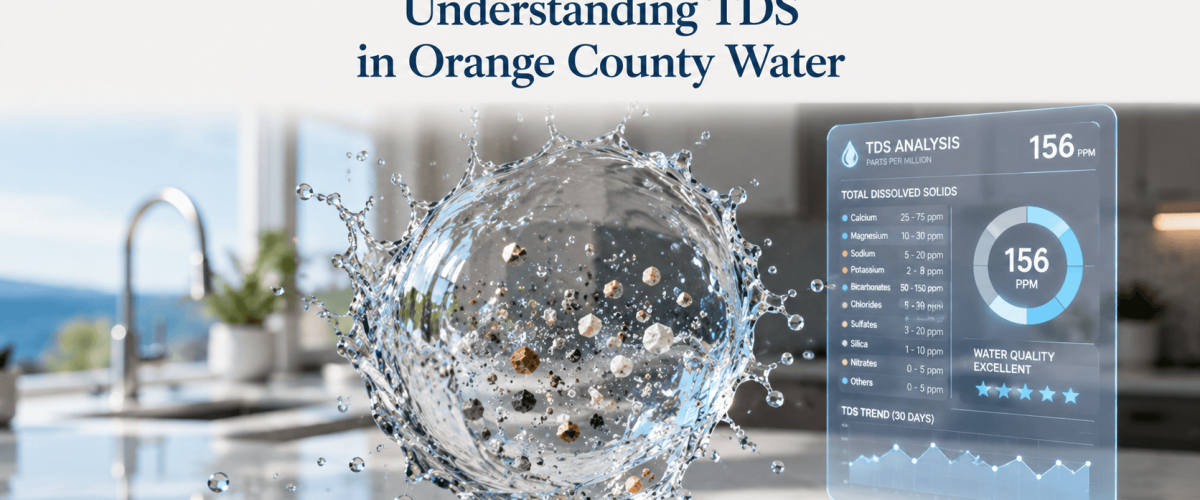

If you’re asking, “What is TDS in water in Orange County?”, TDS stands for Total Dissolved Solids. It’s a measurement of the dissolved minerals, salts, and other substances present in water. TDS itself isn’t a contaminant, it’s a measurement. Higher Total Dissolved Solids levels can affect water taste, appliance performance, and overall water quality perception. The best way to understand your home’s TDS level is through a professional water test that shows exactly what’s in your water.
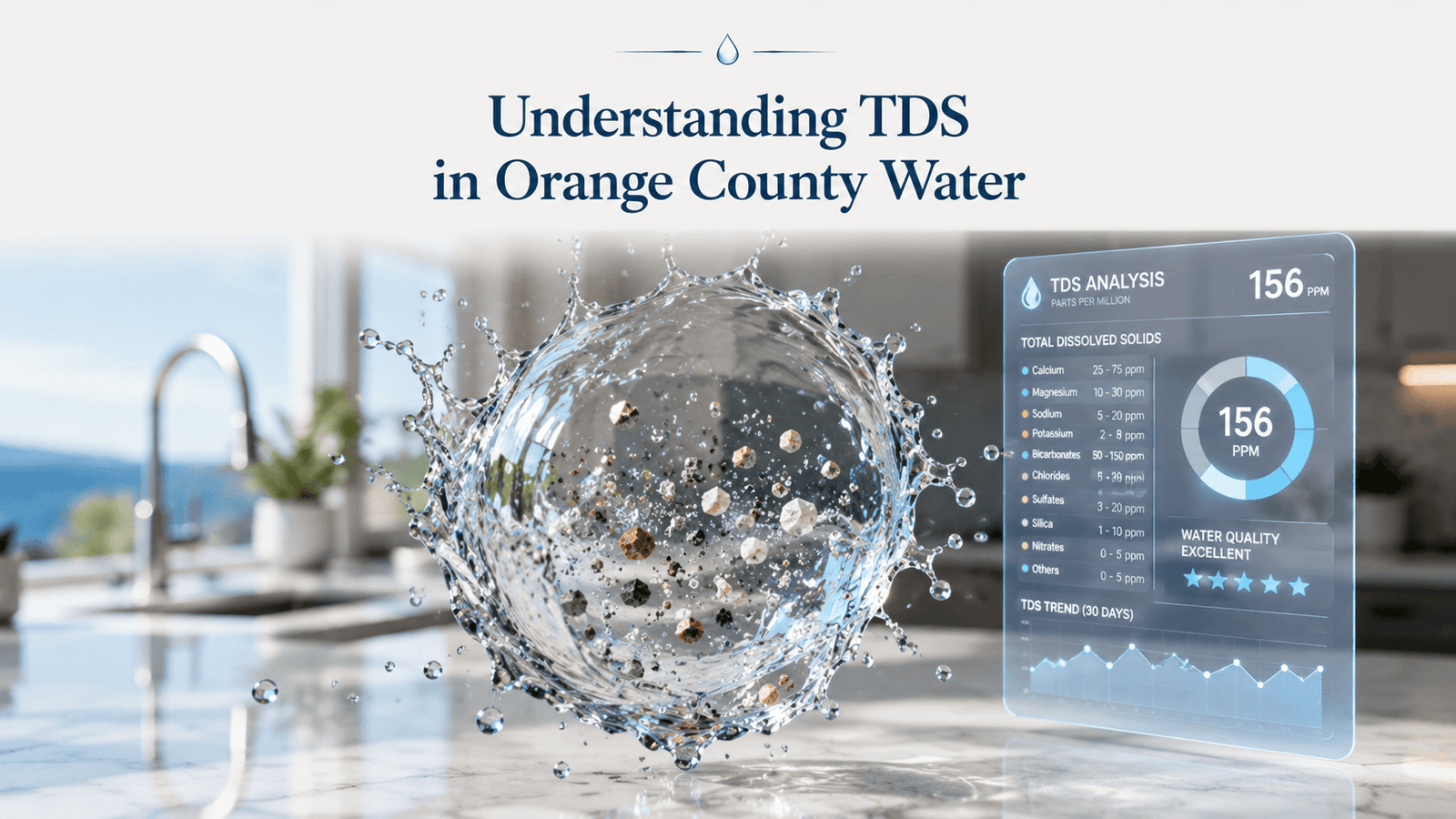
Here’s a truth that confuses homeowners every day: A high TDS number doesn’t automatically mean your water is bad. And a low TDS number doesn’t automatically mean your water is perfect.
I’m Brian McCowin. My family has been helping Orange County homeowners understand their water since 1972. And if I had a dollar for every homeowner who asked me: “Brian, my TDS is 500. Is that good or bad?” I’d probably have enough money to buy every bottled water company in California. The problem is that most people hear the term TDS without understanding what it actually means.
They see a number. Someone tells them it’s high while other insists that it’s normal. Then the confusion begins. But the truth is much simpler. Total Dissolved Solids isn’t a diagnosis. It’s a clue.
Think of it like your bathroom scale. The scale tells you your weight. But it doesn’t explain why you weigh that amount. TDS works the same way. The number tells us how much dissolved material is in the water. It doesn’t tell us exactly what those materials are.
Let’s break it down.
What does TDS mean in water?
TDS stands for Total Dissolved Solids. It’s a measurement of everything dissolved in water that is small enough to pass through a filter used during testing.
These dissolved substances can include:
- Calcium
- Magnesium
- Sodium
- Potassium
- Chlorides
- Sulfates
- Naturally occurring minerals
In simple terms, Total Dissolved Solids measures how much “stuff” is dissolved in your water. The result is usually expressed as parts per million (ppm).
Why is Total Dissolved Solids important?
Total Dissolved Solids can influence how water tastes, feels, and performs throughout the home.
Many homeowners first become interested in TDS because of:
- Drinking water taste
- Water spots
- Appliance concerns
- Reverse osmosis systems
- Water quality testing
TDS is not necessarily a problem. It’s simply an important measurement that helps us understand water quality. Think of it as one piece of the puzzle. Not the entire puzzle.
What causes high TDS in Orange County water?
Orange County water naturally contains dissolved minerals and other substances. This is normal.
Water travels through:
- Natural geological formations
- Treatment systems
- Distribution infrastructure
Along the way, minerals and dissolved compounds can become part of the water. That’s why TDS levels vary from one location to another. And sometimes from one neighborhood to another.
This is one reason professional testing is so valuable. Every home’s water is different.
Does high TDS make water taste different?
Yes, Total Dissolved Solids can affect water taste. This is often one of the first things homeowners notice.
Water with elevated dissolved solids may taste:
- More mineral-like
- Slightly salty
- Less crisp
- Different from bottled water
Taste is highly subjective. Two people can drink the same water and have completely different opinions.But in general, many homeowners prefer water with fewer dissolved solids because it often tastes cleaner and more neutral.
Is TDS the same thing as hard water?
No. Total Dissolved Solids and hard water are related, but they are not the same thing. This is one of the biggest misconceptions we encounter.
Hard water specifically refers to:
- Calcium
- Magnesium
Total Dissolved Solids includes:
- Calcium
- Magnesium
- Sodium
- Chlorides
- Sulfates
- Many other dissolved substances
Think of hard water as one chapter in a book. Total Dissolved Solids is the entire book. Hardness contributes to TDS, but TDS includes much more.
How does Total Dissolved Solids affect appliances and plumbing?
Higher levels of dissolved minerals can contribute to conditions that affect household systems.
Homeowners often ask about:
- Water heaters
- Dishwashers
- Ice makers
- Coffee machines
- Plumbing fixtures
The specific impact depends on what’s creating the TDS. That’s why the actual composition of the water matters just as much as the number itself. A TDS reading is useful. But understanding what’s behind the number is even more important.
How is TDS measured?
Total Dissolved Solids is measured using specialized water testing equipment.
Professional testing can provide insight into:
- Overall TDS levels
- Water hardness
- Chlorine
- Chloramines
- Additional water quality characteristics
The goal isn’t simply to produce a number. It is to understand what the number means. Context matters.
Can a reverse osmosis system reduce TDS?
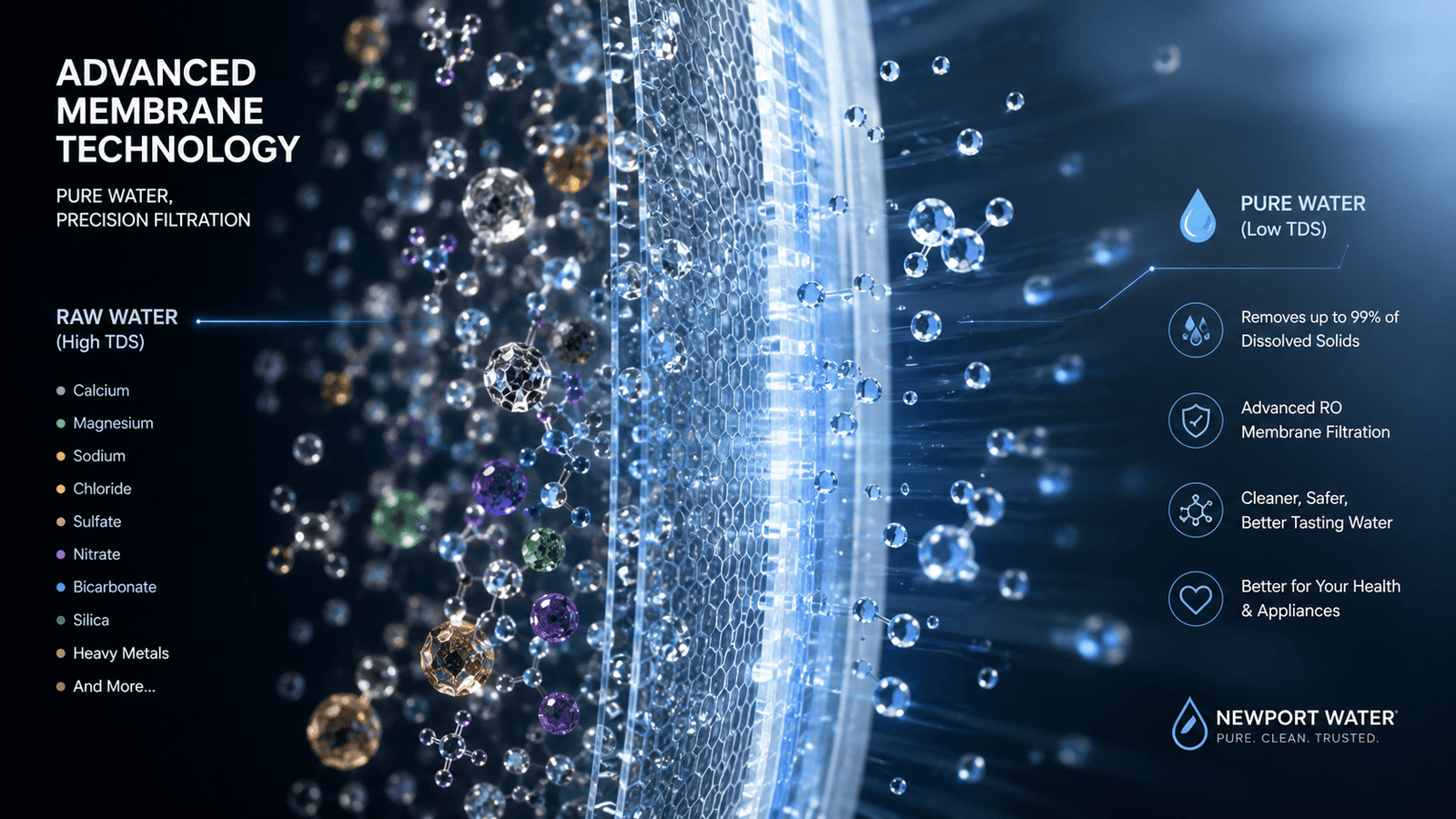
Yes. Reverse osmosis systems are commonly used when homeowners want to reduce dissolved solids in drinking water. Think of reverse osmosis like a highly selective security checkpoint.
Water molecules pass through a specialized membrane while many dissolved substances are left behind. This is one reason reverse osmosis remains one of the most popular drinking water treatment technologies available today.
Many homeowners notice improvements in:
- Drinking water taste
- Coffee flavor
- Tea flavor
- Ice quality
The cleaner and more neutral the water becomes, the more clearly you can taste everything else.
Why do different water companies recommend different solutions?
Many companies only sell one manufacturer’s products. That creates confusion.
At McCowin Water, we’re like an Auto Mall for water treatment.
We’re not tied to one manufacturer. We carry a broad range of premium technologies because every home’s water is different. That flexibility allows us to recommend solutions based on your water, not our inventory.
How do I know what my TDS level is?
The best way is through professional water testing. Without testing, homeowners are guessing.
A professional evaluation can help answer questions such as:
- What is my Total Dissolved Solids level?
- What is contributing to it?
- Is hard water involved?
- Would treatment improve my water?
Once you understand the answers, choosing the right solution becomes much easier.
What is the smartest first step if I’m concerned about Total Dissolved Solids?
The smartest first step is scheduling a professional in-home water test.
Don’t start by buying equipment, comparing product brochures, or guessing at solutions. Start with the facts. Because once you understand what’s in your water, you can make informed decisions about treatment options.
The McCowin Promise
For more than fifty years, we’ve helped Orange County homeowners understand their water before spending money on treatment solutions.
“If the system we install doesn’t perform the way we promised… If your water doesn’t taste, feel, or behave the way we said it would… We’ll pull the whole system out. And either replace it or make it right. No fine print. Because your trust is worth more than the sale.”
Schedule Your Free, In-Home Water Test
If you’re wondering what TDS in water means in Orange County, start by finding out your actual numbers.
We do NOT send tests out to a lab and make you wait.
We perform professional, on-site testing right at your kitchen sink. We’ll show you your TDS level, explain what it means, and provide honest recommendations with absolutely zero sales pressure.
Call us at (949) 569-5736 or Schedule a Free, In-Home Water Test today and get the facts about your water.
CSLB: C-55 #1022717