
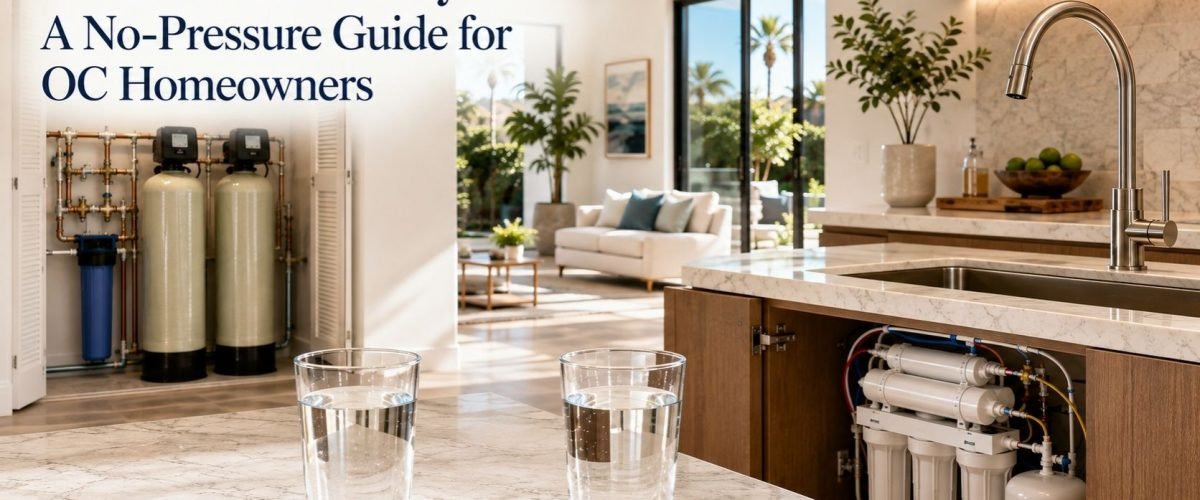

If you are comparing Whole-Home RO filtration with no pressure sales, start with your water not a product. Whole home reverse osmosis can treat water at the point where it enters a home, but it is more involved than a typical under sink RO system. In many homes, a combination of whole home filtration and point of use RO can be a more practical approach. I recommend testing your water first, understanding what you actually want treated, and comparing equipment, water use, maintenance, installation, and long term service before you buy.
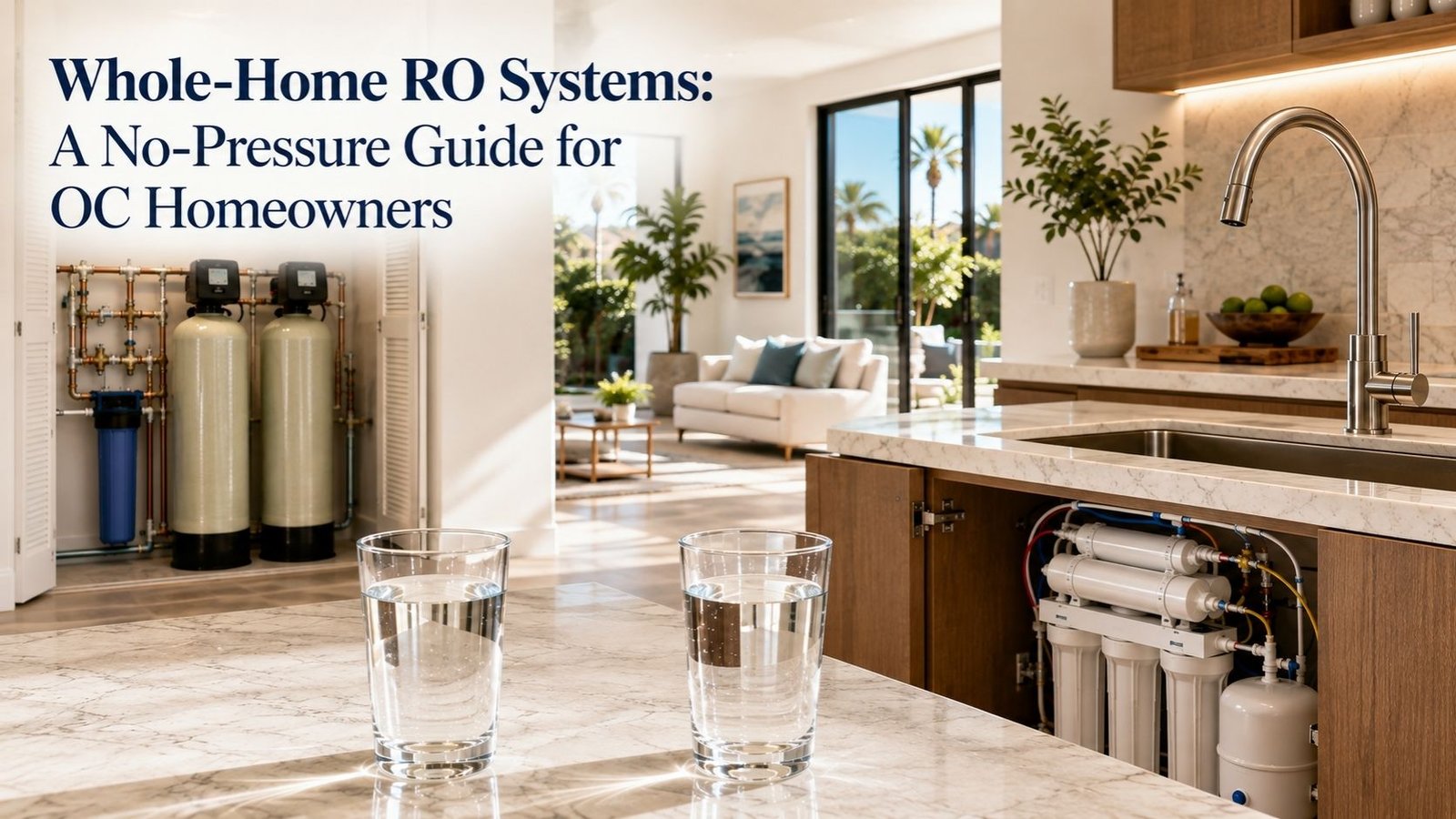
Is whole home RO the best choice for every OC home?
No. Whole home RO filtration with no pressure sales does not mean whole home RO is automatically the best choice for every Orange County home, even when a homeowner wants highly treated water throughout the house.
I’m Brian McCowin, and this is the first thing I want to clarify when someone searches for whole home RO filtration with no pressure sales. Reverse osmosis is a powerful treatment process, but “more filtration” does not automatically mean “better solution.” The right design depends on your water, your goals, your home’s plumbing, available space, flow requirements, and how much treated water your household actually needs.
EPA explains that RO uses pressure to move water through a semipermeable membrane and that the process creates treated water plus a reject-water stream. For point of use RO, the system is usually connected to a single fixture. A whole home point of entry RO setup is a much larger proposition because the system must handle the home’s water demand. That is why I do not want homeowners to choose whole home RO simply because the technology sounds more comprehensive.
Why is whole home RO more complicated than under sink RO?
Whole-home RO is more complicated because the system must be designed around the home’s total water demand, not just drinking and cooking water.
When I discuss whole home RO filtration with no pressure sales, I want homeowners to understand the difference between point of use and point of entry treatment. An under sink RO system may produce treated water for a kitchen faucet. A whole-home system has to supply water for showers, laundry, toilets, appliances, and other fixtures if those uses are included in the design.
That can mean more equipment, storage, pumping, pretreatment, plumbing considerations, and maintenance. EPA research on point of entry RO has noted the need for additional components such as storage and pumping equipment in whole home applications. For me, whole home RO filtration with no pressure sales means discussing those tradeoffs openly rather than presenting RO as a magic answer.
What should I compare before choosing a whole home RO system?
I recommend comparing the complete system design, not just the RO membrane or the price on the proposal.
When a homeowner asks me about whole-home RO filtration with no-pressure sales, I suggest putting these items side by side:
| What to compare | Why it matters |
|---|---|
| ➤ Water quality | Treatment should match the actual water conditions and goals. |
| ➤ Point of use vs. whole home | You may not need RO at every fixture. |
| ➤ Flow demand | Whole-home treatment must support household use. |
| ➤ Storage | RO production and household demand may require storage capacity. |
| ➤ Pretreatment | Pretreatment can help protect the RO membrane from fouling or plugging. |
| ➤ Reject water | RO produces a concentrate stream that must be managed. |
| ➤ Maintenance | Filters and membranes need routine replacement and service. |
| ➤ Certification/claims | Verify what a system is actually designed or certified to reduce. |
| ➤ Local service | You should know who will help after installation. |
This is what I mean by whole-home RO filtration with no-pressure sales: you should be able to compare the advantages and limitations before deciding.
Does a whole-home RO system waste water?
A whole-home RO system produces reject water, so water efficiency should be part of the buying conversation. EPA explains that RO and nanofiltration reject part of the feed water as concentrate and notes that water loss can be a disadvantage, particularly where water is scarce.
If a homeowner only wants highly treated water for drinking and cooking, it may make little sense to treat every gallon entering the home with RO. EPA’s Water Sense guidance similarly encourages homeowners to treat only what they need and consider more water efficient treatment where it meets the goal.
That is one reason I want whole home RO filtration with no pressure sales to begin with a needs assessment.
Could whole-home filtration plus drinking-water RO be a better option?
Yes, in some homes a combination of whole-home filtration and point of use RO can make more practical sense than putting RO on the entire home’s water supply. This is especially important for homeowners researching whole-home RO filtration with no-pressure sales because the phrase “whole-home RO” can make it sound as though every fixture needs reverse osmosis.
At McCowin Water, our current approach is typically to combine whole home filtration with reverse osmosis at a drinking-water point rather than automatically installing RO for the entire house. Our whole-home filtration can address broader household water concerns, while RO can be used where highly treated drinking water is wanted.
I want to be very clear about that because a no-pressure recommendation should include the option of not buying the most elaborate system. If your water test shows that whole home filtration addresses your household goals and point of use RO handles your drinking water needs, that may be the more sensible design.
What does “no-pressure sales” actually mean?
No pressure sales means you can understand the problem, the options, the limitations, and the cost without being pushed into a decision before you are ready. When I hear whole-home RO filtration with no-pressure sales, I think the homeowner should be able to ask uncomfortable questions.
What happens if I decide not to buy today? What does the system actually remove? What does it not remove? How much maintenance does it need? How much water does it reject? What happens if something breaks? Who services it?
Our free in home water test is designed to give us a starting point. We test the water, discuss the findings, and build recommendations around the home’s needs. Our current service information emphasizes testing before recommending a solution and customized system design.
A no pressure process does not mean I avoid recommending equipment when it is appropriate. It means the recommendation should be based on the problem, not the sales target.
What should an OC homeowner ask about maintenance?
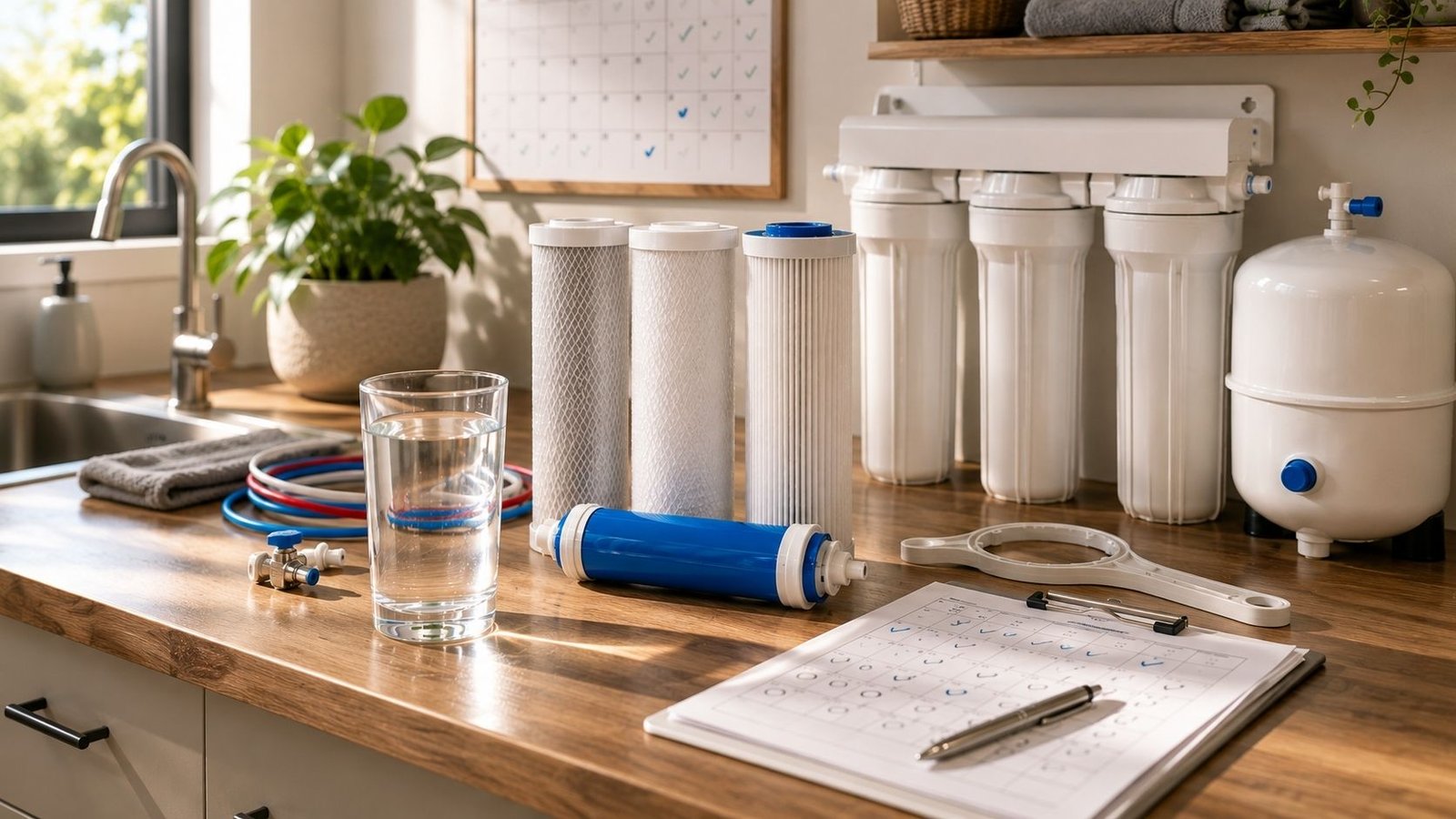
An OC homeowner should ask how often filters, membranes, and other serviceable components need attention and who will provide that service. This matters with whole-home RO filtration with no pressure sales because the purchase is only the beginning of ownership. EPA states that whole-home RO filtration systems require maintenance and that RO systems need filter and membrane replacement according to manufacturer instructions.
Ask these questions before signing:
- What routine maintenance does this system require?
- Which parts are consumables?
- Who performs service?
- What happens if flow changes?
- What happens if there is a leak?
- What does the warranty cover?
- What costs should I expect after installation?
Is whole-home RO filtration appropriate for drinking water, showers, and appliances?
It can be designed for broad household treatment, but that does not mean every household should treat every use with RO. This is another reason whole-home RO filtration with no pressure sales should focus on use cases. Drinking and cooking are different from bathing, laundry, and toilet flushing. Each use has different treatment goals and water volume demands.
EPA’s WaterSense guidance emphasizes treating only what you need and considering more water efficient treatment options where they can meet the household’s goal. If a simpler technology can address the concern, there is no reason to add unnecessary complexity just because RO is available.
How do I know whether a whole home RO recommendation is justified?
I recommend starting with a water test and asking the installer to explain exactly why whole-home RO is being proposed. When you are comparing whole-home RO filtration with no pressure sales, a good recommendation should connect three things: your water results, your household goals, and the capabilities of the proposed system.
You should be able to understand:
- What problem are we solving?
- Why does the treatment need to be whole-home?
- Could whole-home filtration handle the broader issue?
- Would point-of-use RO be enough for drinking water?
- What equipment will be installed?
- What maintenance will it require?
- What are the ongoing water and service considerations?
If those answers are unclear, I would pause before signing anything.
Why start with a free in-home water test?
A free in-home water test gives me information about your actual home before I recommend a treatment path. For homeowners searching whole-home RO filtration with no pressure sales, this is the step I consider most important. I do not want to design a system around a generic water profile or assume that your home’s needs are identical to the house next door.
Our free in home testing and system design process is built around testing first, then discussing appropriate treatment. If the results suggest a simpler whole-home filtration system plus drinking water RO is enough, I will explain that option. If a more extensive design deserves consideration, we can discuss why. The goal is not to sell the largest system. The goal is to solve the water problem you actually have.
The McCowin Promise
We believe homeowners deserve enough information to make a decision without being rushed. We test, explain, and recommend based on the home’s water and the treatment goal. If RO is not the right answer, I would rather say so than force a system that adds unnecessary cost or complexity.
“If the system we install doesn’t perform the way we promised… If your water doesn’t taste, feel, or behave the way we said it would… We’ll pull the whole system out. And either replace it or make it right. No fine print. Because your trust is worth more than the sale.”
Areas We Serve
As a trusted local water expert, we understand the unique water conditions across Southern California and provide solutions tailored to every home and business.
Anaheim · Santa Ana · Irvine · Huntington Beach · Costa Mesa · Orange County · Mission Viejo · Tustin · Lake Forest · Newport Beach · Yorba Linda · Laguna Niguel · San Clemente · Aliso Viejo · San Juan Capistrano
Whether you need water filtration, water softening, reverse osmosis, or another water-treatment solution, McCowin Water serves homeowners throughout these communities.
Get the Right RO Answer Before You Buy
If you are researching whole home RO filtration with no pressure sales in OC, do not start with a brand or a sales presentation. Start with your water. For me, whole home RO filtration with no pressure sales starts there.
Call us at (949) 569-5736 or Schedule a Free, In-Home Water Test and we can help you understand whether you actually need whole home RO, whether whole home filtration plus drinking water RO makes more sense, and what ongoing maintenance the system will require.
CSLB: C-55 #1022717
-
What is the difference between point-of-use and point-of-entry RO?
Point-of-use RO treats water at a specific fixture, such as a kitchen faucet. Point-of-entry RO is designed to treat water entering the home and therefore must be sized for broader household demand.”
-
Does reverse osmosis require regular maintenance?
Yes. RO systems require routine maintenance, including replacement of filters and membranes according to the system manufacturer’s instructions.
-
What should I ask before buying a whole-home RO system?
Ask what water problem the system is designed to address, why treatment needs to be whole-home, how much water the system rejects, what maintenance it requires, and who will provide service after installation.