

You turn on the shower expecting the usual flow, but instead of a strong stream, you get a weak spray. The kitchen faucet feels slower too. The problem may have started with one fixture and gradually appeared elsewhere. Low water pressure can be frustrating because the cause is not always obvious. A partially closed valve, a plumbing issue, a failing pressure regulator, or a problem with the local water supply can all affect pressure. Then you start questioning, ” Can mineral buildup cause low water pressure?”
Calcium and magnesium can leave deposits inside plumbing fixtures and pipes. As those deposits accumulate, they can restrict the space available for water to move through. The result can be reduced water flow and, in some situations, noticeably lower water pressure at a fixture. The important distinction is that mineral buildup is only one possible cause. Before replacing pipes or installing a new pressure system, it helps to determine whether the restriction is actually coming from your water.
How mineral buildup affects water flow
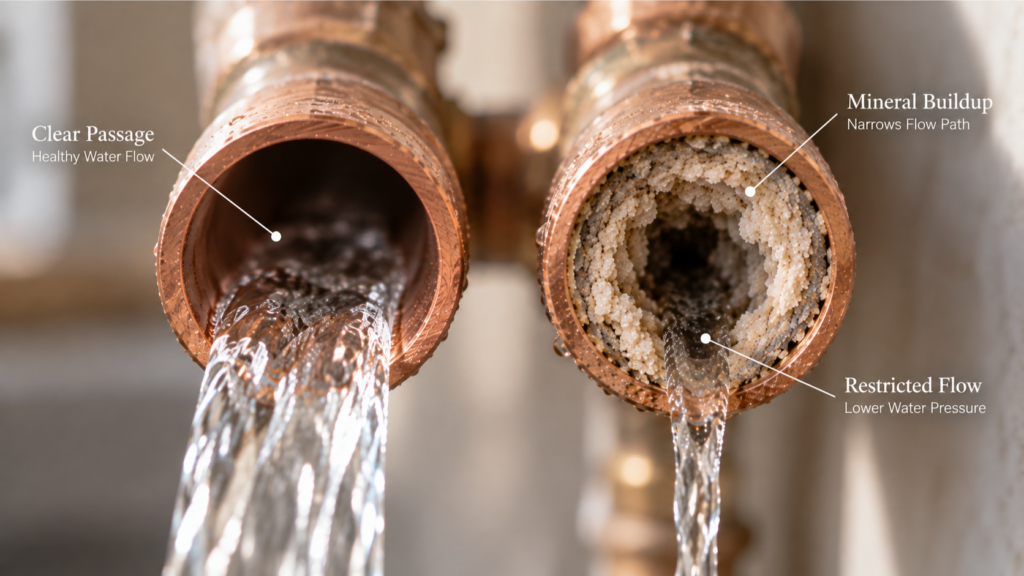
Hard water contains dissolved minerals, primarily calcium and magnesium. When water moves through your plumbing, some of those minerals can eventually form deposits on surfaces. You may have seen a similar buildup around a faucet aerator. A small white or chalky deposit can collect around the openings where water comes out. The opening becomes smaller, and the stream becomes weaker.
A similar process can happen inside plumbing components. As deposits accumulate, the passage through which water travels can become narrower. Water may still reach the fixture, but there is less room for it to move freely. The effect can be gradual. You may not notice a significant change after a few months. Over years, however, mineral deposits can become substantial enough to affect flow through certain fixtures or sections of plumbing.
Can mineral buildup cause low water pressure?
Hard water can contribute to low water flow when mineral deposits restrict plumbing components or passages. However, homeowners should be careful about assuming that every low-pressure problem is caused by hard water :
- If every faucet in your home suddenly has low pressure, mineral buildup may not be the first thing to investigate. A whole-home pressure problem can have several other causes.
- If only one shower or faucet has weak flow, a clogged aerator, showerhead, cartridge, or fixture screen may be more likely.
- If several fixtures on the same side of the home have reduced flow, the restriction may be somewhere in that section of plumbing.
The location and pattern of the problem can tell you a lot.
Why does one faucet have low pressure but the others are fine?
When one fixture has poor flow while everything else seems normal, start close to the fixture itself. Faucet aerators are small screens designed to control the stream of water. Over time, they can collect sediment and mineral deposits. The same thing can happen inside showerheads.
Removing and cleaning the aerator or showerhead may restore the flow if buildup is the problem. A faucet cartridge can also become restricted. In this situation, cleaning the visible part of the fixture may not solve the problem because the obstruction is deeper inside. If the same fixture repeatedly develops buildup after cleaning, it may be worth investigating the water quality rather than treating the symptom every few months.
What does mineral buildup look like?
Mineral deposits often leave clues around the home. Look at the areas where water regularly sits or evaporates. White spots around faucets, chalky residue on fixtures, crust around showerhead openings, and deposits around appliance connections can all be signs of mineral-rich water.
Glass shower doors can develop cloudy mineral spots that become increasingly difficult to remove. These signs do not directly prove that mineral buildup is restricting your pipes. They indicate that minerals are present in the water and may be depositing on surfaces throughout the plumbing system. If low water flow and visible mineral deposits are appearing together, testing the water can help connect the dots.
Can mineral buildup clog pipes?
Mineral deposits can accumulate inside plumbing over time. How significant the restriction becomes depends on the type of pipe, the age and condition of the plumbing, the water chemistry, and the amount of mineral exposure.
Older plumbing may be more susceptible to reduced internal diameter because years of deposits and corrosion can gradually change the inside surface. A pipe does not have to be completely blocked for flow to be affected. Even partial restriction can matter, particularly in smaller lines or fixtures where the available passage is already limited. In difficult situations, removing the mineral buildup from an individual fixture may not be enough. The underlying plumbing may need to be evaluated.
Why is my shower pressure getting weaker?

A gradual decline in shower flow can have several explanations.
The showerhead itself may be collecting mineral deposits. This is one of the easiest things to check because the restriction is visible or can be found by removing the fixture. If cleaning the showerhead restores strong flow, the issue may have been localized to the fixture.
If the shower remains weak after cleaning, look at whether other fixtures are experiencing the same problem. A whole-house change points toward a different category of issue. The home’s pressure regulator, shutoff valve, water supply, plumbing condition, or other equipment may need to be inspected. Hard water can be part of the picture, but it should not automatically be blamed for every pressure problem.
Can a water softener prevent mineral buildup?
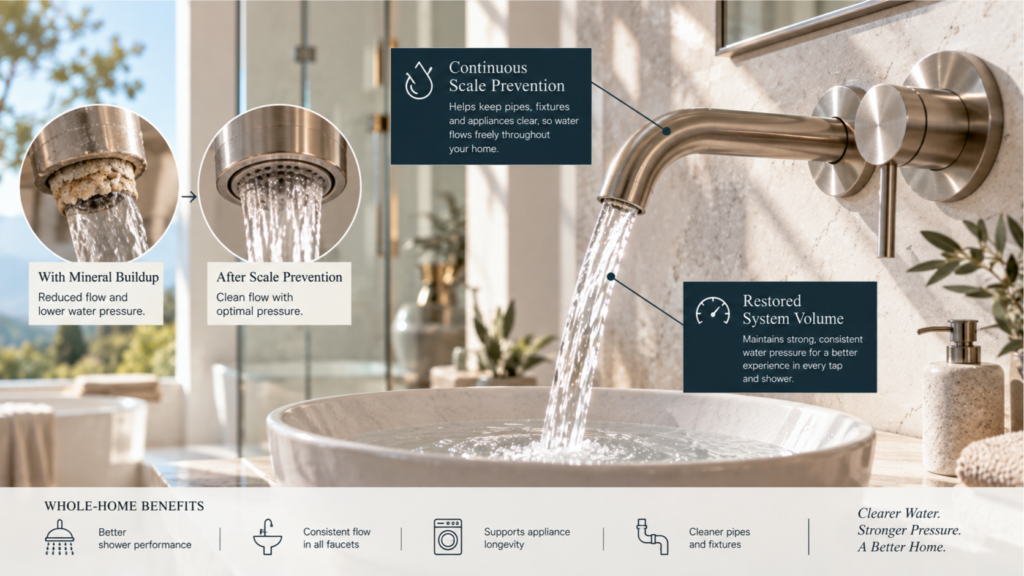
A water softener is designed to reduce the calcium and magnesium responsible for water hardness. When hardness is reduced, there are fewer of these minerals available to form scale on fixtures and plumbing surfaces. This can help reduce the ongoing buildup that homeowners see around faucets, showerheads, and water-using appliances.
A softener does not work like a pipe cleaner. If significant mineral buildup is already inside a plumbing system, installing a softener does not automatically remove everything that has accumulated over the years. Its role is primarily to address the hardness in the water going forward. This distinction matters when deciding what type of treatment your home needs. Preventing future scale and removing existing restrictions are related, but they are not exactly the same job.
What else can cause low water pressure?
Before focusing entirely on mineral buildup, consider how the pressure problem behaves:
- If pressure is low throughout the house, the cause could involve the main supply, a pressure regulator, a partially closed shutoff valve, or another plumbing issue.
- If pressure drops only when several fixtures are running, the home’s plumbing capacity or water demand may be involved.
- If pressure is strong at some fixtures but weak at others, the problem may be localized.
A sudden loss of pressure should also be treated differently from a gradual decline. A sudden change may point toward a valve problem, leak, equipment failure, or other plumbing issue that needs attention. The pattern gives you a starting point for finding the actual cause.
Should you test your water if you have low water pressure?
Water testing will not diagnose every low-pressure problem. It cannot tell you whether a pressure regulator has failed or whether a valve is partially closed. It can, however, tell you whether hardness and other water characteristics may be contributing to the conditions you are seeing around your plumbing. This becomes especially useful when low flow appears alongside recurring scale.
If your showerhead repeatedly clogs with white deposits, your faucets develop crusty buildup, and your water is confirmed to be hard, you have a clearer reason to consider how water hardness is affecting the home. The goal is not to install a treatment system simply because a pressure problem exists. The goal is to understand the water and determine whether treatment addresses an actual need.
Why Irvine homeowners have trusted the McCowin family since 1972
I’m Brian McCowin. My family has been solving water problems in Orange County since 1972, one home and one honest answer at a time. Low water pressure is a good example of why diagnosis matters. A homeowner may notice weak flow and assume the water needs to be filtered or softened. In another home, the same symptom may come from a plumbing problem unrelated to water quality.
We start with the water itself. A free, in-home water test can help identify hardness and other characteristics that may be contributing to mineral deposits around your home. If hard water is part of the problem, we can explain what treatment can realistically do and where it fits into the bigger picture. If the issue appears to be plumbing-related, the appropriate next step may be different.
We’re a licensed California water treatment contractor (CSLB C-55 #1022717), serving Irvine and the surrounding communities: Tustin, Santa Ana, Newport Beach, Costa Mesa, Lake Forest, Mission Viejo, Orange, Anaheim, Huntington Beach, Fountain Valley, Yorba Linda, Laguna Niguel, Laguna Hills, Aliso Viejo, Rancho Santa Margarita, San Juan Capistrano, and San Clemente.
The McCowin Promise
For more than fifty years, we’ve helped Orange County homeowners understand their water through professional testing, honest recommendations, and customized solutions.
“If the system we install doesn’t perform the way we promised… If your water doesn’t taste, feel, or behave the way we said it would… We’ll pull the whole system out. And either replace it or make it right. No fine print. Because your trust is worth more than the sale.”
Should I replace my pipes if I have mineral buildup?
Not automatically. The right solution depends on the severity and location of the restriction, the condition of the plumbing, and the cause of the buildup. A plumbing inspection can determine whether cleaning, repair, or replacement is appropriate. Low water pressure is a symptom, not a diagnosis. Mineral buildup can play a role, but so can fixtures, valves, regulators, leaks, plumbing condition, and water supply issues.
Book your free, in-home water test today, or call (949) 569-5736.
If your home has recurring scale and declining water flow, finding out what is actually in your water is a sensible place to start.
Frequently Asked Questions
Can mineral buildup cause low water pressure?
It can contribute to reduced water flow when calcium and magnesium deposits restrict faucets, showerheads, plumbing components, or sections of pipe. It is not the only possible cause of low pressure.
How do I know if hard water is affecting my plumbing?
Look for recurring white or chalky deposits around faucets, showerheads, fixtures, and appliances. If these signs appear alongside reduced water flow, testing your water can help determine whether hardness is involved.
Can hard water clog a showerhead?
Yes. Mineral deposits can accumulate around the small openings in a showerhead and gradually restrict the flow of water.
Will a water softener increase water pressure?
A water softener is not designed to increase household water pressure. It reduces hardness minerals in the water, which can help limit future scale formation. Existing plumbing restrictions may require separate attention.