
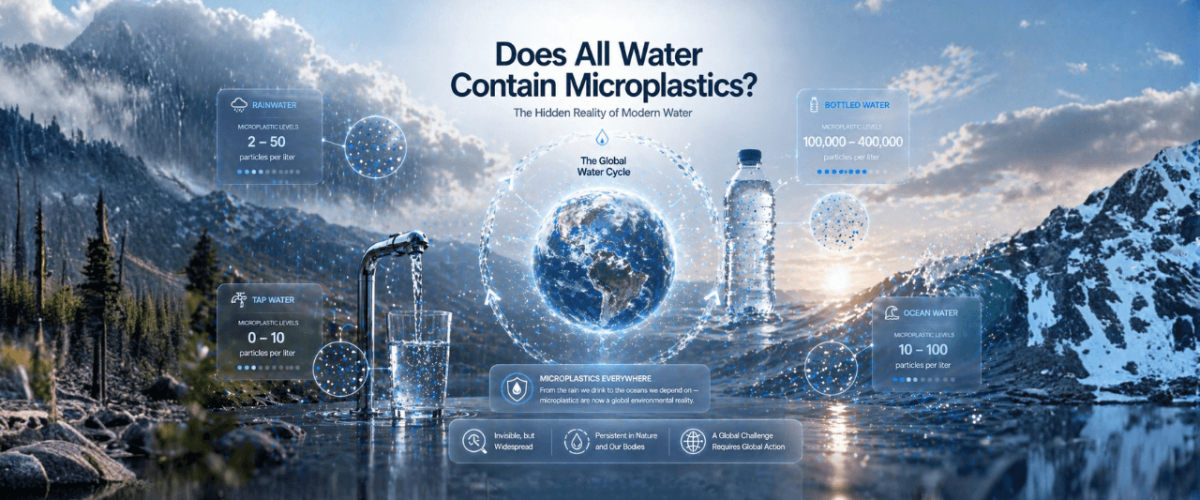

No, not all water contains microplastic in water, but most modern water sources do have some level of contamination. Tap water, bottled water, and even rainwater have been found to contain microplastics in recent studies. The levels vary, but exposure is now widespread. The safest approach is to assume risk exists and remove it with a properly designed home filtration system.
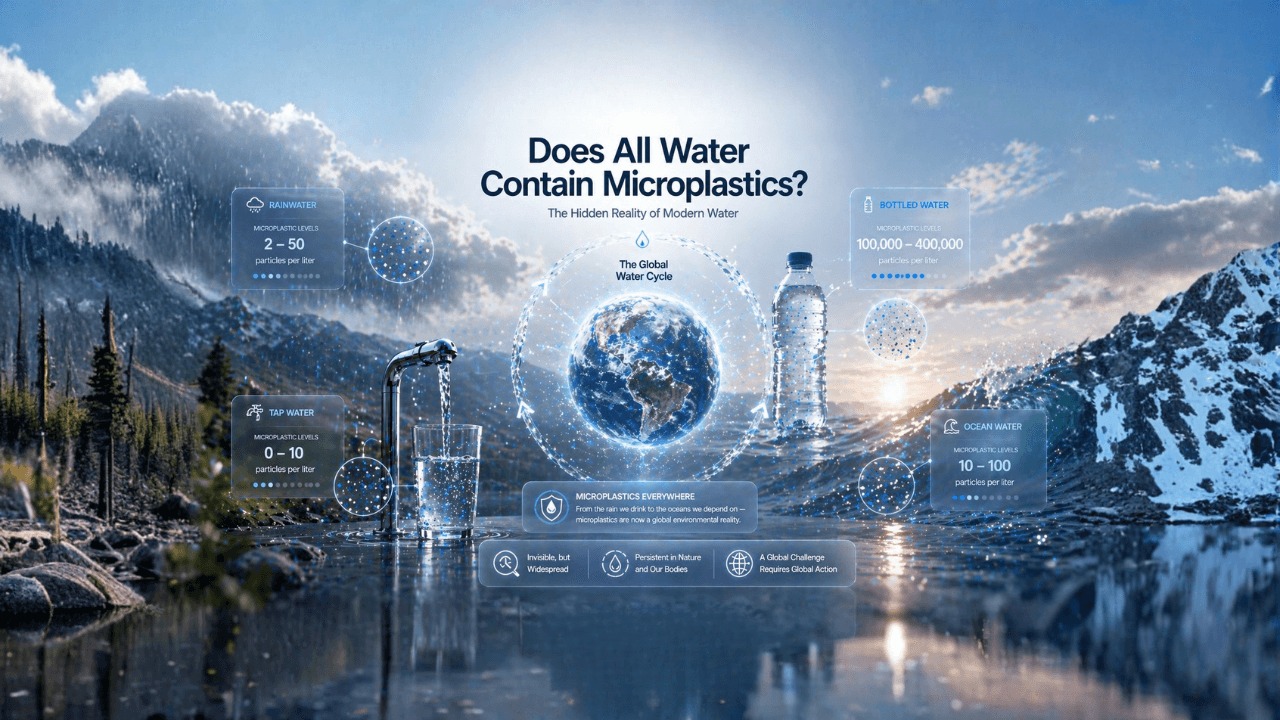
What’s the uncomfortable truth about water today?
If water existed in the wild today for the first time, we would not call it pure. That is how much things have changed.
I have been in this business since 1972. Back then, we worried about minerals and bacteria. Today, we are dealing with something entirely different.
Plastic has become part of the water cycle.
That is not theory. That is reality.
Does all water contain microplastic in water?
No, but most water sources today do. Microplastic in water is now found in a wide range of natural and treated water sources.
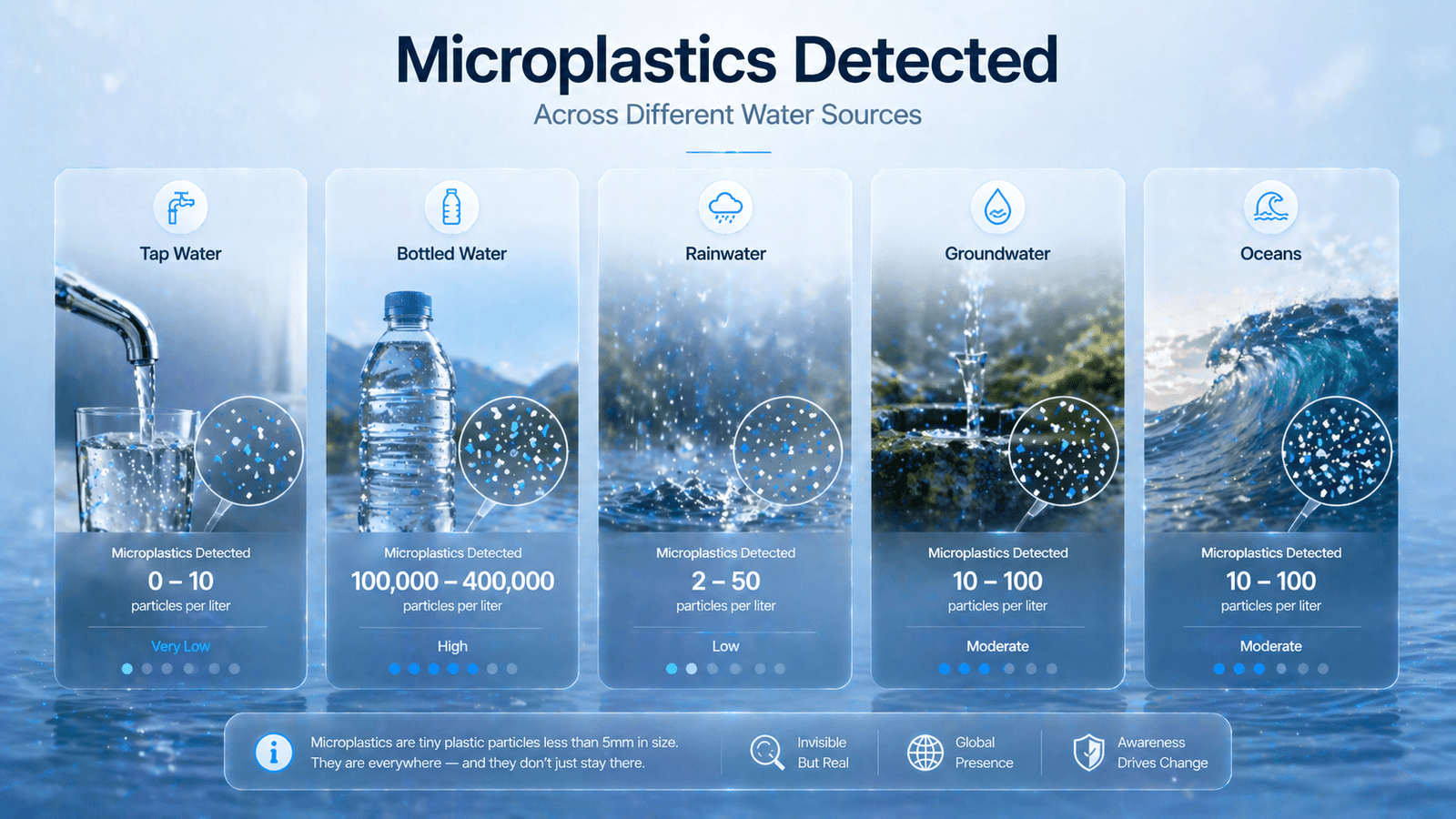
Recent findings from 2023 to 2025 show microplastics in:
- Tap water
- Bottled water
- Groundwater
- Oceans and rivers
- Even rainwater
That last one surprises most people.
When microplastics are in rain, it means they are in the air.
How did microplastic in water become so widespread?
Because plastic does not disappear.
It breaks down.
What happens over time:
- Plastic waste degrades into smaller particles
- These particles enter soil, air, and water
- Wind and rain spread them across environments
- Water systems pick them up and carry them forward Think of it like sand.
Once it is everywhere, you cannot contain it.
Does that mean your tap water definitely has microplastics?
In most cases, yes. Tap water often contains some level of microplastic in water, even in well-managed systems.
Here is why:
- Treatment plants were not designed to remove microplastics
- Particles are too small for standard filtration
- Environmental exposure is constant
In areas like Irvine, Newport Beach, and Huntington Beach, coastal conditions can increase exposure due to ocean-related microplastic cycles.
What about bottled water or canned water?
They are not immune.
Bottled water:
- Often contains higher levels due to plastic packaging
Canned water:
- Uses plastic lining inside aluminum cans
So switching containers does not remove the problem.
It just changes the source of exposure.
Is there any water that is completely free of microplastic in water?
In theory, yes. In practice, it is extremely rare.
Possible low-risk sources:
- Deep, isolated groundwater
- Highly controlled laboratory water
- Properly filtered home water
But for everyday use, most available water has some level of contamination.
Should you be worried about microplastics in water?
You should be aware, not overwhelmed.
What we know so far:
- Microplastics can accumulate in the body
- They can carry chemicals like PFAS
- Long-term effects are still being studied This is not about fear.
This is about making better decisions.
What actually removes microplastic in water?
You need to take control at the source.
Effective solutions:
- Reverse osmosis systems
- Multi-stage filtration
- Whole-home water systems
But here is the truth most companies skip.
Not all systems are built to handle microplastics properly.
That is where experience matters.
Why do most people get this wrong?
Because they trust labels instead of systems. I see this across Orange County all the time. Common mistakes:
- Switching between bottled brands
- Relying on basic filters
- Assuming “clean taste” means clean water
- Not testing their water Water is not one-size-fits-all.
How does McCowin Water approach this differently?
We do not sell one solution to everyone.
We are the Auto Mall of water treatment.
We carry multiple systems and match them to your exact water and home.
Because water in Laguna Niguel is not the same as water in Irvine or Huntington Beach.
How do you know what is in your water?
You test it the right way.
We offer a Free, In-Home Water Test where:
- We test your water on-site
- You see results immediately
- We explain everything clearly
- There is zero pressure
We do not send your water to a lab and leave you waiting. You get answers in real time.
What guarantee do you have that the solution will work?
We stand behind everything we install.
“If the system we install doesn’t perform the way we promised… If your water doesn’t taste, feel, or behave the way we said it would… We’ll pull the whole system out. And either replace it or make it right. No fine print. Because your trust is worth more than the sale.”
That is how we have done business for over 50 years.
What should you do next if you are concerned about microplastic in water?
Do not assume your water is clean. Verify it. Fix it.
Call us at (949) 569-5736 or Schedule a Free, In-Home Water Test Today.
You will:
- See exactly what is in your water
- Understand your options clearly
- Get expert guidance with no pressure
Because when it comes to your water, certainty matters.
Final Thought
Not all water starts with microplastics. But today, most of it carries them.
The question is not whether they exist.
The question is whether you are doing anything about it.
McCowin Water Solutions
222 Goddard, Irvine, CA 92618
(949) 569-5736
CSLB Licensed C-55 #1022717
Three generations of McCowin Water. Trusted Orange County water expertise since 1972.