

A free in home water test in Irvine can help me evaluate important characteristics of your household water, such as hardness, TDS, chlorine or chloramines, general water quality conditions, and how your water is being used in the home. But I would not present a routine in home test as a laboratory test for microplastics. Detecting and identifying microplastics requires specialized sampling and analytical methods. California has established standardized methods involving techniques such as infrared and Raman spectroscopy.
Can a free in-home water test detect microplastics?
A free in home water test in Irvine is not the same thing as specialized laboratory testing for microplastics. This is an important distinction, especially because microplastics have become a growing topic among homeowners.
I’m Brian McCowin, and I’ve spent decades helping Orange County homeowners understand their water. I don’t want you to schedule a water test expecting a technician to arrive with a simple field instrument that can tell you, on the spot, exactly how many plastic particles are in your water. That would be misleading.
A professional free in home water test in Irvine is designed to help me understand the water conditions affecting your home and to determine whether treatment may make sense. Microplastics require a different type of analytical approach. The California State Water Resources Control Board has established standardized procedures for extracting and analyzing microplastics in drinking water. Those procedures include infrared and Raman spectroscopy.
So if your main question is, “Are there microplastics in my water?” I want you to understand the difference between an in home water evaluation and specialized laboratory analysis before you make a decision.
Why are homeowners asking about microplastics?
Homeowners are asking about microplastics because plastic particles can be difficult to see, and ordinary appearance is not a reliable way to determine whether they are present.
The EPA describes microplastics as plastic particles ranging from 5 millimeters down to 1 nanometer and notes that their varied sizes, shapes, and compositions make characterization challenging. That is why I take a careful approach when someone asks me about them.
I don’t want to turn a legitimate question into a sales pitch. I also don’t want to make a claim that a routine water test has detected something it was not designed to measure. A free in home water test in Irvine has a different purpose: establishing a practical picture of your household water so we can understand the problems you are actually experiencing. (US EPA)
What does a free in-home water test in Irvine normally evaluate?
A free in home water test in Irvine can evaluate several useful characteristics of your household water and help put those results into context. Depending on the evaluation, I may look at factors such as:
- Water hardness
- Total Dissolved Solids, or TDS
- Chlorine or chloramines
- General water-quality characteristics
- Household water usage
- Existing plumbing
- Existing treatment equipment
- Your specific water concerns
My goal is not simply to produce numbers. Numbers without context don’t help much. For example, a hardness reading can help explain scale related concerns. TDS can provide information about the amount of dissolved material in water. Chlorine or chloramines can help explain certain taste or odor concerns.
A free in home water test in Irvine gives us a starting point for understanding those conditions before discussing filtration or other treatment.
What is the difference between water screening and microplastics testing?
The biggest difference is the analytical method used to identify what is actually in the sample. When I conduct a free in home water test in Irvine, I am evaluating practical water characteristics that can help us understand your home’s treatment needs. That is different from collecting a sample specifically for microplastics identification and sending it through a specialized laboratory process.
The EPA notes that microplastics analysis can involve time and resource intensive laboratory techniques, and that researchers still face challenges in reliably identifying and quantifying different particles. California’s standardized procedures also show why this is not simply a matter of looking at water through a basic field test.
The state’s methods use extraction and analytical techniques designed to identify plastic particles and distinguish them from potential false positives. That distinction matters.
A free in home water test in Irvine can tell us useful things about your water, but I will not call it a microplastics test unless the appropriate specialized sampling and analysis have actually been performed.
What should I expect during my free in-home water test in Irvine?
When you schedule a free in-home water test in Irvine, I want you to expect a conversation as well as testing. Before we talk about equipment, I want to understand what you are noticing.
Are you seeing white scale? Do you dislike the taste or smell of your water? Are you concerned about hardness? Do you already have filtration equipment? Are you researching contaminants such as microplastics?
Those questions matter because water treatment should be based on your actual situation. I also want to understand your household water usage and existing plumbing. Our current water testing information explains that we evaluate characteristics such as hardness, TDS, chlorine or chloramines, water usage, plumbing, and existing treatment equipment.
That is what makes an in home evaluation different from simply buying a test strip online. (McCowin Water Solutions)
Can a normal water test prove that my water has no microplastics?
No. A routine free in home water test in Irvine should not be used to claim that microplastics are absent. This is one of the most important points I want homeowners to understand.
A negative result for one water characteristic does not automatically mean that every possible contaminant is absent. Different substances require different analytical methods, detection limits, sample handling, and laboratory procedures. The EPA explains that an analytical method is designed to collect, preserve, separate, identify, and measure specific contaminants within defined limits. (US EPA)
Microplastics are no different in that respect. So if someone tells you that a quick general water test has proven your water is completely free of microplastics, I would ask exactly what method was used. A free in home water test in Irvine can be valuable without pretending to answer questions it was never designed to answer.
What should I do if microplastics are my main concern?
If microplastics are your primary concern, I recommend separating the testing question from the treatment question.
First, determine whether you need specialized laboratory analysis. California has established methods for drinking water microplastics analysis, so the laboratory and analytical approach matter. Second, ask what the proposed filtration system is actually designed to reduce.
Do not assume that because a filter is called “advanced” or “multi stage,” it automatically addresses every particle or contaminant.
Third, ask about the filter’s specifications, maintenance requirements, and intended application. A free in home water test in Irvine can still be useful at this stage because it helps establish your broader household water profile. It may identify other water quality concerns that are easier to address through residential treatment.
Can filtration help with particles and microplastics?
Some filtration technologies can reduce certain particles, but I would not make a blanket claim that every whole-home filter removes every type or size of microplastic. Particle size, filter design, media, flow rate, installation, maintenance, and the manufacturer’s tested performance all matter. This is another reason I prefer a free in home water test in Irvine before recommending equipment.
If you are concerned about particles, I want to understand what you are trying to accomplish. Are you concerned about visible sediment? General particulate matter? A specific contaminant? Microplastics specifically? Those are not automatically the same problem. The EPA’s research also highlights the difficulty of characterizing microplastics because they vary widely in size and composition. (US EPA)
What should I ask before buying a filtration system?
Before purchasing a system, I recommend asking these questions:
- What exactly is the system designed to reduce?
- What testing supports that recommendation?
- What particle sizes or contaminants has the equipment been tested against?
- What are the filter replacement requirements?
- What happens if maintenance is skipped?
- Is the system treating the whole home or only drinking water?
- What will the system not remove?
- Is specialized laboratory testing needed for my specific concern?
A free in home water test in Irvine should help you ask better questions, not pressure you into buying equipment immediately. That is the standard I believe homeowners deserve.
What can my water test tell me about choosing treatment?
A free in home water test in Irvine can help connect your water conditions with possible treatment options.
For example:
| Water concern | What I may evaluate | Treatment discussion |
|---|---|---|
| ➤ Hardness | Mineral-related hardness | Water softening |
| ➤ Dissolved material | TDS and related readings | Filtration or RO, depending on the goal |
| ➤ Chlorine or chloramines | Disinfectant characteristics | Appropriate filtration media |
| ➤ Sediment | Visible or measurable particulate concerns | Sediment filtration |
| ➤ Microplastics | Requires specialized analytical testing | Discuss separately from routine screening |
This table is intentionally simple. I don’t believe homeowners benefit from being told that one piece of equipment fixes every water issue. A free in home water test in Irvine gives us information. The treatment decision should come after we understand what that information means.
Why does the test matter even if I am worried about microplastics?
A free in home water test in Irvine can still be worthwhile because your microplastics question may be only one part of your home’s water quality picture. You may also be dealing with hardness, chlorine, sediment, dissolved solids, or other concerns. Understanding those conditions gives you a better basis for deciding whether whole home filtration, reverse osmosis, softening, or no treatment change is appropriate.
We would rather help you understand what you actually need than sell you equipment based on the most alarming word in the conversation. That is especially important with emerging contaminants, where testing methods and scientific understanding continue to develop.
What happens after my water test?
After a free in-home water test in Irvine, We want you to understand the results before you decide whether to do anything.
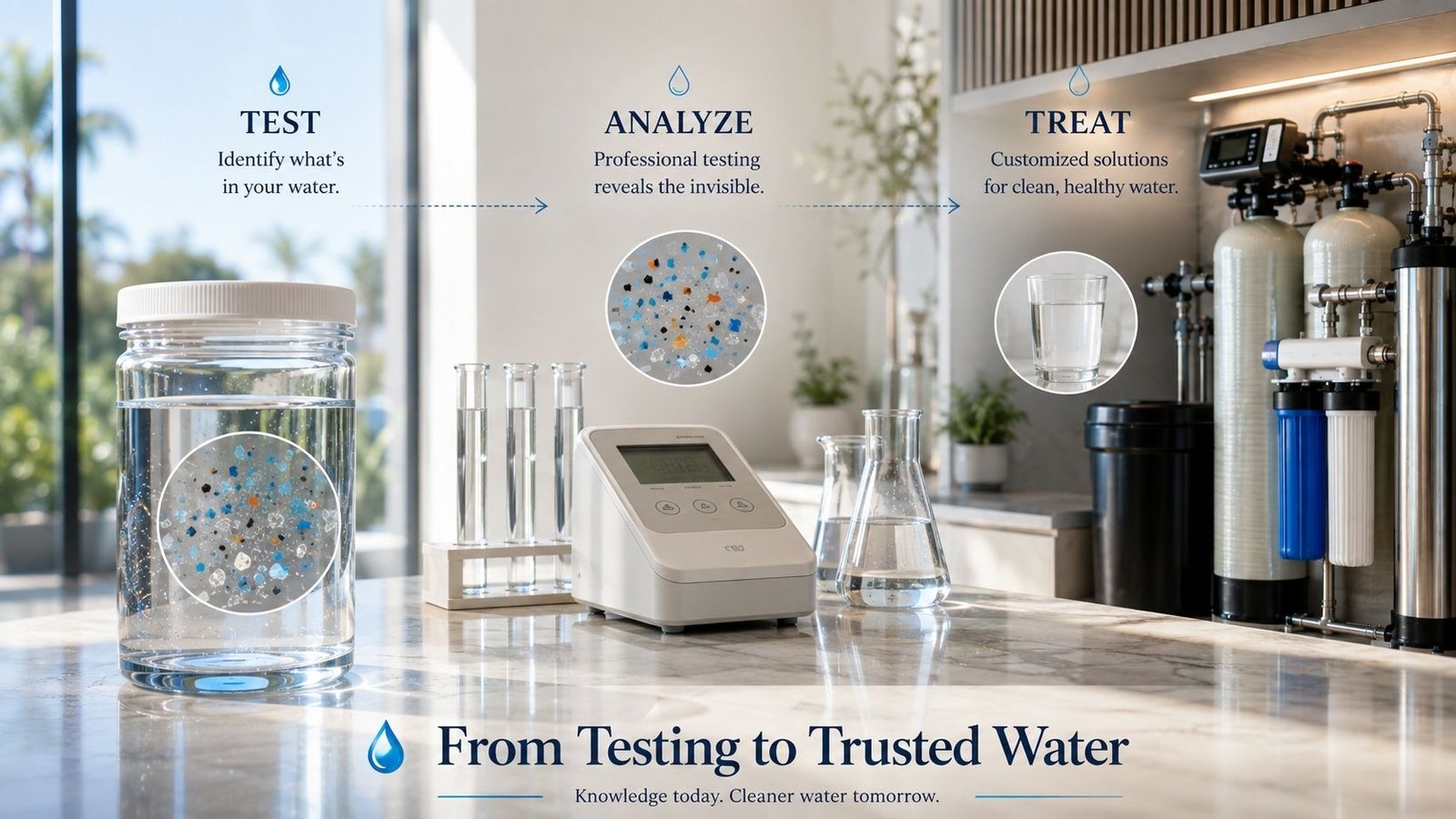
Our approach is to explain the findings, discuss your concerns, and determine whether a treatment solution genuinely makes sense. Our published testing information describes the same basic philosophy: test first, explain the results, and recommend customized solutions only when appropriate.
If your concern is specifically microplastics, we will also keep the limits of routine testing clear. A specialized laboratory question should be treated as a specialized laboratory question. That honesty is more valuable than an impressive sounding answer.
The McCowin Promise
We believe water treatment should begin with facts, honest explanations, and a clear understanding of what a system can and cannot do. We should never make a homeowner believe a basic water evaluation is something it is not.
“If the system we install doesn’t perform the way we promised… If your water doesn’t taste, feel, or behave the way we said it would… We’ll pull the whole system out. And either replace it or make it right. No fine print. Because your trust is worth more than the sale.”
Areas We Serve
As a trusted local water expert, we understand the unique water conditions across Southern California and provide solutions tailored to every home and business.
Anaheim · Santa Ana · Irvine · Huntington Beach · Costa Mesa · Orange County · Mission Viejo · Tustin · Lake Forest · Newport Beach · Yorba Linda · Laguna Niguel · San Clemente · Aliso Viejo · San Juan Capistrano
Whether you need water filtration, water softening, reverse osmosis, or another water-treatment solution, McCowin Water serves homeowners throughout these communities.
Get Answers Before You Buy
If you are wondering what a free in home water test in Irvine can actually tell you about your home’s water, start with the test rather than a sales pitch.
Call us at (949) 569-5736 or Schedule a Free, In-Home Water Test today and we can help you understand the practical water quality characteristics in your home and explain where a routine evaluation ends and specialized laboratory testing begins. If microplastics are your concern, that distinction matters.
CSLB: C-55 #1022717
-
Does a water filter automatically remove microplastics?
No. Filtration performance depends on the specific technology, filter design, particle size, operating conditions, and tested claims. A filter should not be assumed to remove every type or size of microplastic.
-
Why do microplastics require specialized testing?
Microplastics vary in size and composition, and identifying them can require specialized sampling, extraction, and analytical techniques. California has standardized drinking-water methods that include infrared and Raman spectroscopy.
-
Should I choose a water treatment system before testing my water?
I recommend understanding your water conditions before choosing treatment. Testing provides information that can help determine whether filtration, softening, reverse osmosis, or another approach is appropriate for the home’s specific needs.