

Summary
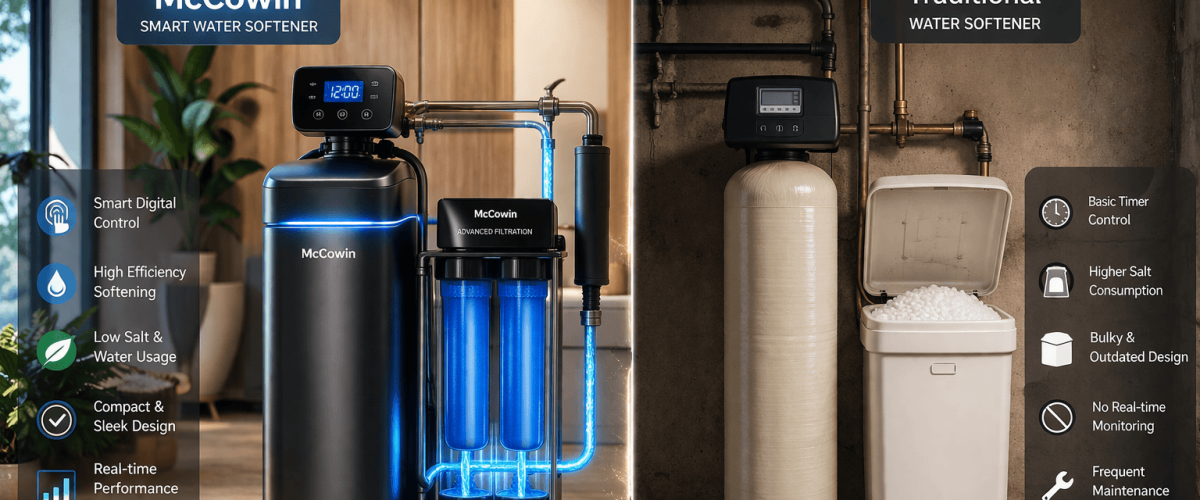
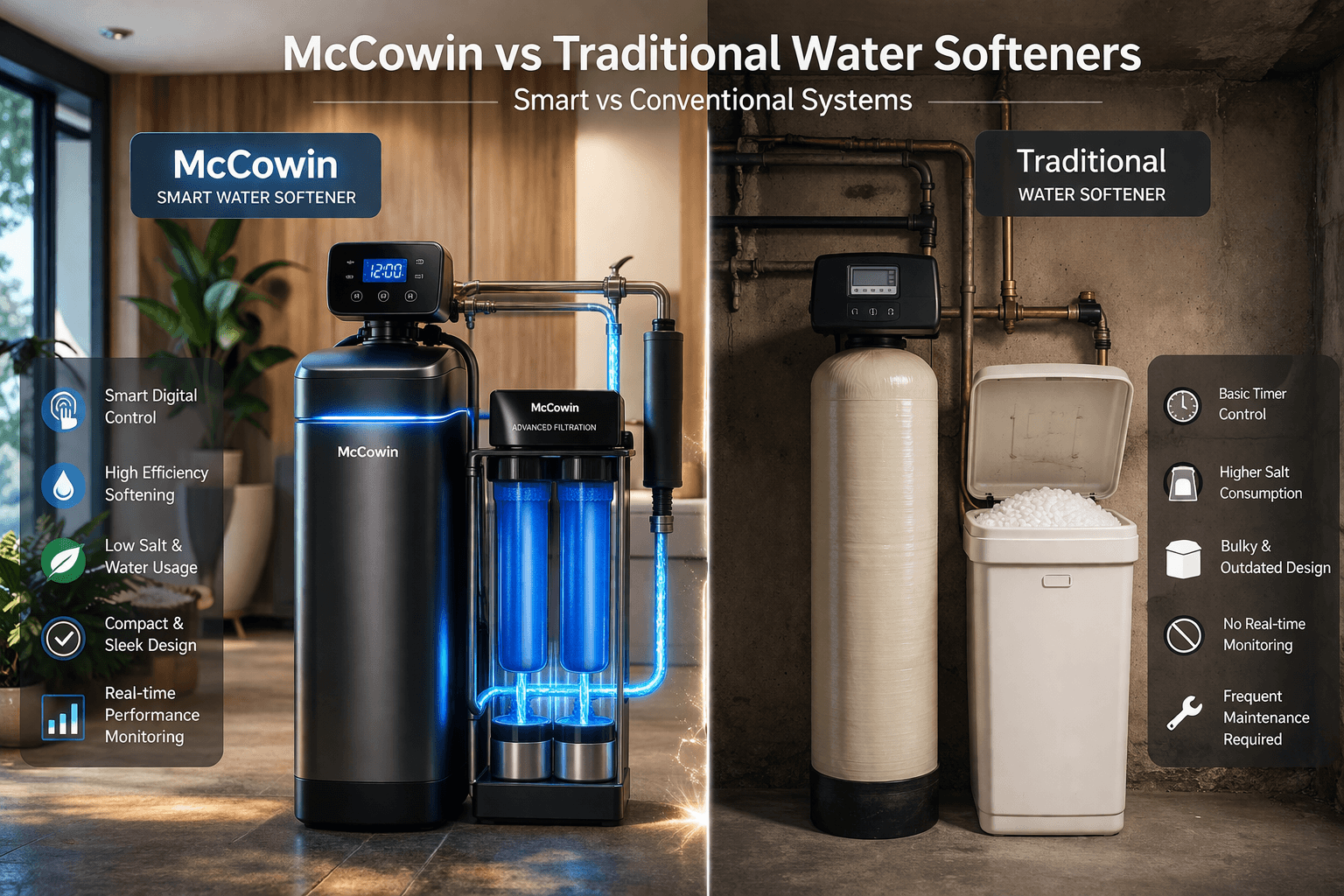
Water softeners are essential for tackling hard water, but not all systems deliver the same efficiency and long-term value. Traditional water softeners rely on basic ion exchange technology and often operate on fixed cycles, leading to higher salt and water consumption. In contrast, modern solutions like McCowin Water softeners focus on efficiency, customization, and smart performance based on actual water usage. This blog compares traditional and advanced softening systems in terms of performance, cost, maintenance, and sustainability. If you are choosing between a conventional setup and a smarter solution, this guide will help you make the right decision.
Introduction
Hard water can silently damage your home and health by causing:
- Limescale buildup
- Appliance wear and tear
- Dry skin and dull hair
While traditional water softeners have been used for decades, newer, more advanced systems like those offered by McCowin Water are changing the game.
The key question is: Are traditional water softeners still enough, or is it time for a smarter solution?
What is a Traditional Water Softener?
Traditional water softeners typically use ion exchange technology to remove hardness minerals like calcium and magnesium.
- Water passes through resin beads charged with sodium
- Hard minerals are replaced with sodium ions
- The system periodically regenerates using salt
This method has been widely used because it effectively removes hardness minerals.
Limitations of Traditional Water Softeners
While effective, traditional systems come with several drawbacks:
- High Salt Consumption: They require frequent regeneration, often leading to high salt usage.
- Excess Water Usage: Older systems use large amounts of water during regeneration cycles. Traditional units can consume 50–75 gallons per cycle
- Fixed Regeneration Cycles: Many systems regenerate on a schedule, not based on actual usage, leading to waste.
- Limited Efficiency: They are less optimized for modern households and changing water conditions.
What Makes McCowin Water Softeners Different?
McCowin Water softeners are designed with a modern, efficiency-first approach that improves upon traditional systems.
Key Advantages:
- Customized System Design: Built based on your water hardness and usage
- Smart Regeneration Technology: Operates based on real-time demand instead of fixed schedules
- High Efficiency Performance: Uses less salt and water while delivering better results
- Integrated Water Treatment: Can be combined with filtration for complete water improvement
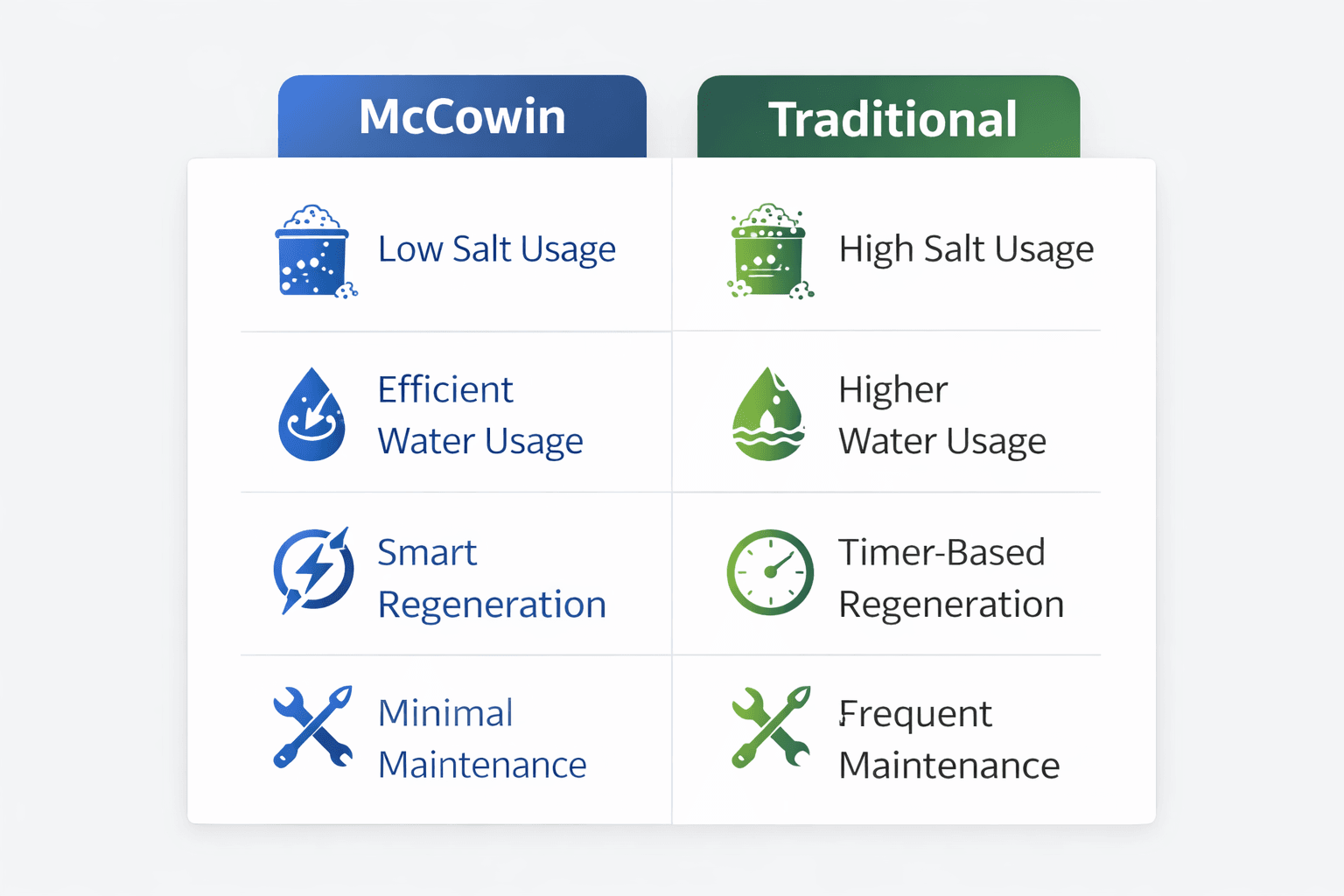
McCowin Water vs Traditional Softeners: Comparison Table
| Feature | McCowin Water Softener | Traditional Water Softener |
| ➤ Technology | Advanced, demand-based | Basic ion exchange |
| ➤ Salt Usage | Low (optimized) | High |
| ➤ Water Usage | Efficient | Higher consumption |
| ➤ Regeneration | Smart/on-demand | Fixed schedule |
| ➤ Customization | Fully tailored | Standard sizing |
| ➤ Maintenance | Lower | Higher |
| ➤ Performance | Consistent & optimized | Varies |
Efficiency Comparison
Modern high-efficiency systems significantly outperform traditional models:
- Use 20–40% less salt annually
- Reduce water usage by up to 60% during regeneration
- Lower maintenance costs over time
This makes advanced systems like McCowin Water a more sustainable and cost-effective option.
Cost Comparison: Short-Term vs Long-Term
Traditional Water Softeners
- Lower upfront cost
- Higher ongoing expenses (salt, water, maintenance)
McCowin Water Softeners
- Higher initial investment
- Lower operational costs
- Better long-term savings
Over time, efficient systems often pay for themselves within a few years due to reduced maintenance and resource usage.
Performance & Reliability
Traditional Systems
- Reliable for basic softening
- May struggle with efficiency in high usage homes
McCowin Water Systems
- Designed for consistent, high-performance output
- Handles varying water conditions effectively
- Delivers optimized results across all household uses
Environmental Impact
Traditional systems:
- Waste more water
- Discharge more salt into wastewater
Modern systems like McCowin:
- Reduce salt discharge
- Conserve water
- Support eco-friendly living
This makes a significant difference in long-term sustainability.
Which One Should You Choose?
Choose a Traditional Water Softener if:
- You want a basic, low-cost solution
- Your water hardness is moderate
- You don’t mind higher maintenance
Choose McCowin Water Softener if:
- You want long-term efficiency and savings
- Your water hardness is high
- You prefer a customized, high-performance solution
- You want lower environmental impact
Why McCowin Water is the Better Choice
At McCowin Water, we don’t believe in one-size-fits-all solutions.
We provide:
- Tailored water softening systems
- Advanced, efficient technology
- Expert installation and ongoing support
Our goal is not just to soften your water but to optimize it for your home and lifestyle.
Final Thought
Traditional water softeners still work, but they are no longer the most efficient option.
They remove hardness effectively
But they consume more salt, water, and require more maintenance
McCowin Water softeners deliver smarter, more efficient, and long-term performance, making them the better choice for modern households.
Upgrade Your Water Quality Today
Stop relying on outdated water softening systems. Upgrade to a smarter, more efficient solution designed for your specific water needs with McCowin Water.
Experience better performance, lower costs, and long-term reliability with a customized system.
Call us at (949) 569-5736 or schedule your free water test today.