


By Brian McCowin, McCowin Water. Serving Irvine and Orange County since 1972.
Mineral buildup in water pipes can gradually restrict water flow, affect fixtures, and contribute to plumbing problems, especially in homes with hard water. Calcium and magnesium are the main minerals involved, and over time they can leave deposits inside pipes, faucets, showerheads, and other water-using fixtures. The buildup happens slowly, which is why many homeowners don’t notice it until water flow changes or recurring scale becomes hard to ignore.
A few white spots around a faucet may not seem like a plumbing concern. But when similar deposits keep appearing throughout the house, they can be a sign that the water is leaving minerals behind wherever it travels. Understanding how this happens can help you decide whether you are dealing with a simple fixture problem or a larger water quality issue.
How mineral buildup starts inside water pipes
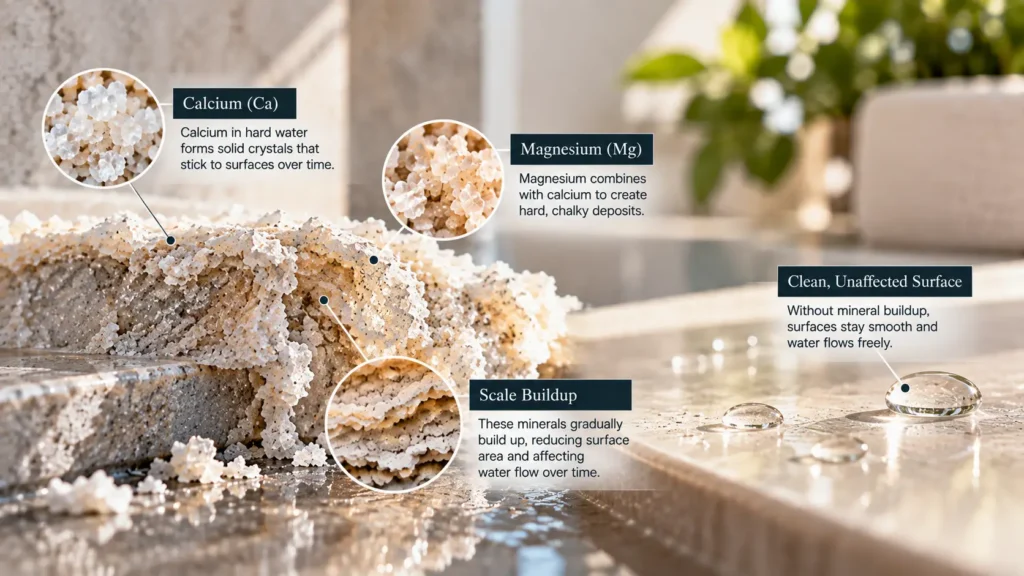
Hard water contains dissolved calcium and magnesium. When the water moves through your plumbing, these minerals remain dissolved under normal conditions. Changes in temperature, pressure, and evaporation can encourage some of them to come out of the water and settle onto surfaces.
This is why mineral deposits are often easier to spot around places where water is heated or allowed to evaporate. A faucet aerator is a simple example. Water passes through tiny openings, and minerals can gradually collect around those openings. The same basic process can occur on the inside of plumbing components and pipes. It does not happen overnight. A small amount of mineral accumulation may have little noticeable effect. Years of exposure can be a different story.
What does mineral buildup in water pipes look like?
You cannot normally see the inside of your pipes, so the first signs often appear somewhere else in the home. White or chalky deposits around faucet openings are common. Showerheads may develop crust around their small spray holes. Glass shower doors can develop cloudy spots that become increasingly difficult to clean.
You might also notice deposits around appliance connections or on fixtures that regularly come into contact with water. These signs do not automatically mean your pipes are heavily restricted. They do tell you that minerals are present in the water and are depositing on surfaces. If the same pattern appears throughout the house, it is worth looking beyond individual fixtures and considering the condition of the water itself.
Can hard water clog water pipes?
Hard water can contribute to mineral deposits inside plumbing, but “clog” can be misleading. A pipe does not necessarily become completely blocked. Instead, deposits can gradually reduce the available space through which water travels.
Imagine a drinking straw with a thin layer forming along the inside walls. The opening is still there, but there is less room for water to pass through. The actual impact depends on the type and age of the plumbing, the water chemistry, the amount of mineral exposure, and how much buildup has accumulated. Older plumbing may have additional factors such as corrosion or sediment that can combine with mineral deposits and make restrictions more significant.
Why is my water pressure getting lower?
Mineral buildup is one possible explanation for declining water flow, but it is not the only one. If one faucet suddenly has weak flow, the problem may be a clogged aerator or faucet cartridge. A showerhead can also become restricted by mineral deposits.
If several fixtures throughout the house experience reduced flow, the issue may be farther upstream. A partially closed valve, pressure regulator problem, leak, plumbing restriction, or another issue could be responsible. The pattern matters. A gradual change accompanied by visible scale can make water hardness worth investigating. A sudden, whole-house loss of pressure may require a plumbing inspection instead. Water treatment should not be used as a substitute for diagnosing a plumbing problem.
Which parts of the home are most affected by mineral buildup?
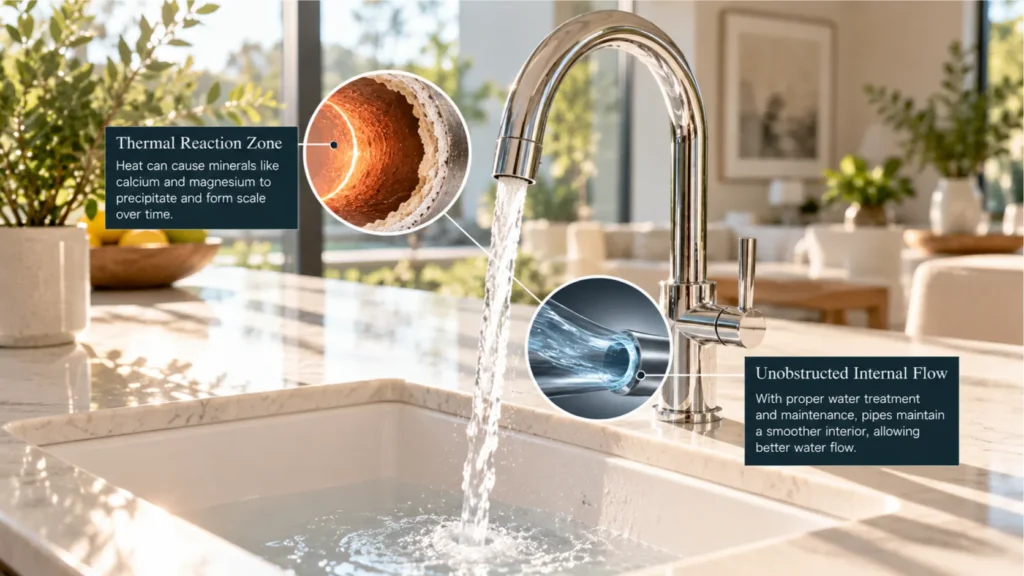
Not every part of your plumbing experiences the same conditions. Fixtures with small openings tend to show buildup quickly because even a small amount of residue can affect the available opening. Showerheads, faucet aerators, valves, and appliance connections are common places to notice deposits.
Hot water equipment can also be affected because heating water can encourage mineral deposits to form. Water heaters, dishwashers, washing machines, and other appliances that regularly use water may experience the effects of hard water over time. The visible fixture is often only the part you can see. The broader question is whether the same water is carrying hardness minerals through the rest of the home’s plumbing.
Can mineral buildup damage plumbing?
Mineral deposits can contribute to plumbing problems, but it is important not to blame every plumbing failure on hard water. Pipes can have problems because of age, corrosion, installation issues, freezing, leaks, high pressure, shifting, or other conditions. Hard water is more accurately viewed as one factor that can contribute to scale formation and restricted flow. This distinction matters because the solution depends on the cause.
If a faucet aerator is clogged, cleaning or replacing the aerator may be all that is needed. If the water itself is consistently hard and contributing to repeated scale throughout the home, addressing the water may be a more appropriate long-term consideration.
Can you remove mineral buildup from water pipes?
The answer depends on where the buildup is and how severe it has become. For a removable showerhead or faucet aerator, cleaning may remove accumulated deposits. Some fixtures can be serviced or replaced when buildup becomes excessive.
Internal plumbing is different. If deposits have accumulated significantly inside older pipes, removing them may require professional plumbing work. Aggressive cleaning is not always appropriate, particularly when the existing plumbing is old or already compromised.
This is why prevention deserves attention too. If hard water is causing recurring scale, reducing the hardness of incoming water can help limit the amount of new calcium and magnesium available to form deposits.
Does a water softener remove mineral buildup from pipes?
A water softener does not work like a drain cleaner, so installing one does not instantly remove existing deposits from your plumbing. Its job is to reduce the hardness minerals in the water before that water travels through the home.
When calcium and magnesium levels are reduced, there is less hardness available to form new scale on plumbing fixtures and water-using appliances. This can make a softener part of a long-term strategy for homes affected by hard water. However, not every water quality problem calls for a softener. If the concern is sediment, chlorine, taste, odor, or another contaminant, a different treatment approach may be appropriate. The best system depends on what is actually present in the water.
How do you know if hard water is causing the buildup?
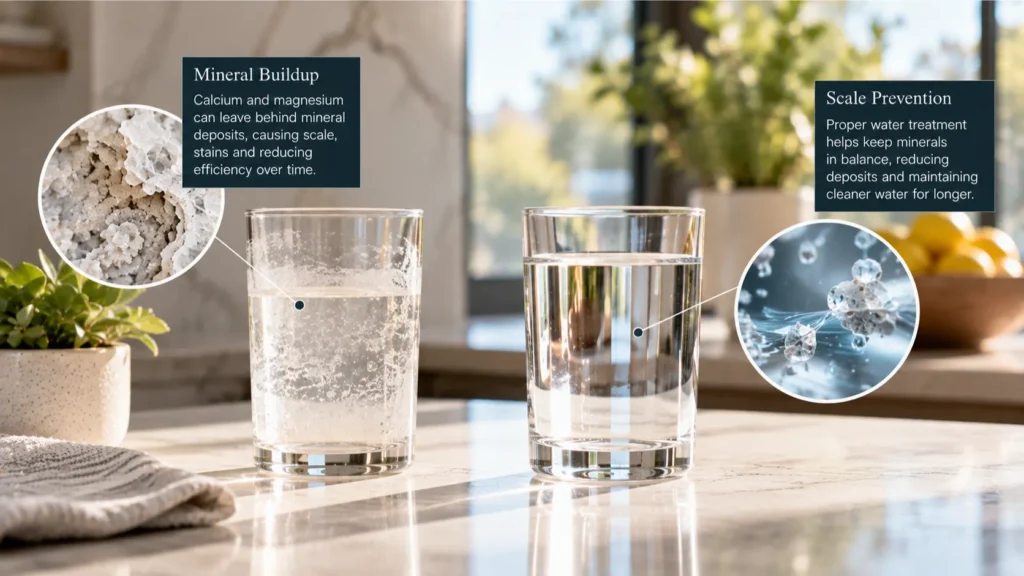
Start with the water rather than guessing from the appearance of one fixture. A water hardness test can show how much calcium and magnesium are present. Comparing that information with the condition of your fixtures and plumbing can give you a clearer picture of what is happening. This is particularly useful when several symptoms appear together. You may have recurring white deposits, difficult-to-clean shower glass, restricted faucet flow, and scale around appliances.
None of these symptoms alone proves that your plumbing has significant internal buildup. Together, they may be a reason to investigate the water more closely. Testing also prevents you from choosing a treatment system based only on assumptions.
Why Irvine homeowners have trusted the McCowin family since 1972
I’m Brian McCowin. My family has been solving water problems in Orange County since 1972, one home and one honest answer at a time. Mineral buildup is a good example of why diagnosis matters. Seeing white residue around a faucet does not automatically mean the entire plumbing system needs to be replaced. It also does not automatically mean a water softener is the answer. We start by looking at the water.
A free, in-home water test can help identify whether hardness is present and give you a better understanding of the conditions moving through your plumbing. From there, we can discuss whether water softening, filtration, maintenance, or another approach is appropriate for your home. The goal is not to sell you equipment simply because you have mineral deposits. The goal is to understand the cause and recommend treatment when there is a genuine need.
We’re a licensed California water treatment contractor (CSLB C-55 #1022717), serving Irvine and the surrounding communities: Tustin, Santa Ana, Newport Beach, Costa Mesa, Lake Forest, Mission Viejo, Orange, Anaheim, Huntington Beach, Fountain Valley, Yorba Linda, Laguna Niguel, Laguna Hills, Aliso Viejo, Rancho Santa Margarita, San Juan Capistrano, and San Clemente.
The McCowin Promise
For more than fifty years, we’ve helped Orange County homeowners understand their water through professional testing, honest recommendations, and customized solutions.
“If the system we install doesn’t perform the way we promised… If your water doesn’t taste, feel, or behave the way we said it would… We’ll pull the whole system out. And either replace it or make it right. No fine print. Because your trust is worth more than the sale.”
A good place to start is your water
If mineral deposits keep returning after you clean your fixtures, the problem may not be the fixtures themselves. Your home’s water could be supplying the minerals that keep leaving those deposits behind.
Book your free, in-home water test today, or call (949) 569-5736.
Testing gives you a clearer starting point. You can find out whether hardness is present, understand what is happening in your water, and then decide whether treatment makes sense for your home.
Frequently Asked Questions
What causes mineral buildup in water pipes?
Hard water containing dissolved calcium and magnesium can contribute to mineral deposits inside plumbing. The buildup can become more noticeable over long periods, particularly around fixtures and areas where water is heated or evaporates.
Can mineral buildup reduce water flow?
Yes. Significant deposits can reduce the available space inside certain plumbing components or sections of pipe, potentially contributing to lower water flow. Other plumbing problems can cause similar symptoms.
How can I tell if I have hard water?
Recurring white or chalky deposits around faucets, showerheads, glass, and appliances can be signs of hard water. A water hardness test provides a more reliable way to determine whether calcium and magnesium are present at elevated levels.
Will a water softener remove existing mineral buildup?
A water softener is designed to reduce hardness in incoming water. It does not automatically dissolve existing scale inside pipes or fixtures. Existing deposits may need to be cleaned, serviced, or addressed separately.
Can hard water damage household appliances?
Hard water can contribute to scale formation in water-using appliances such as water heaters and dishwashers. The effect depends on the appliance, water hardness, usage, and how long the equipment is exposed to the water.
Should I replace my pipes because of mineral buildup?
Not necessarily. Pipe replacement depends on the condition of the plumbing and the severity and location of the restriction. A plumbing professional can determine whether cleaning, repair, or replacement is appropriate.