
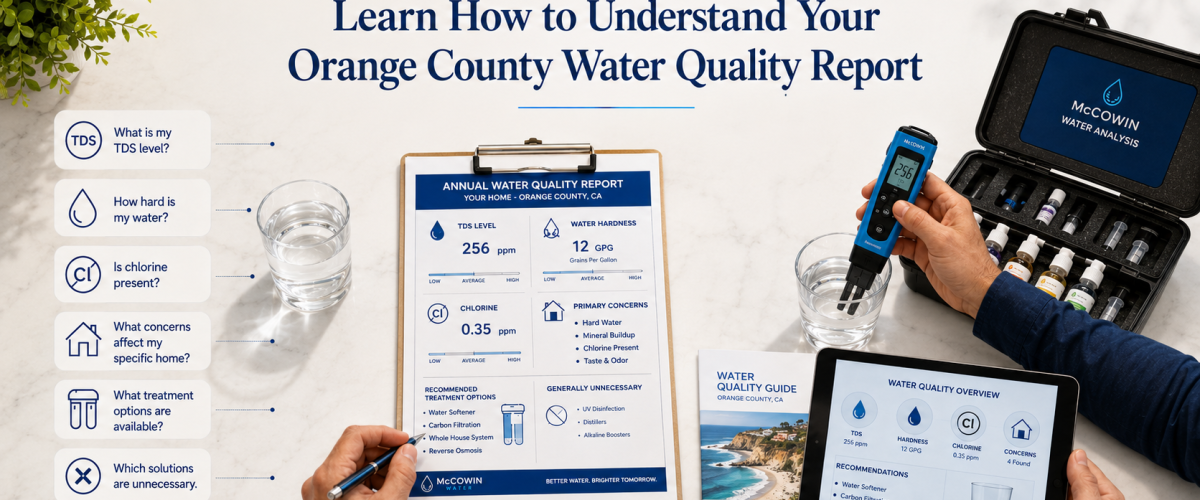

If you’re trying to evaluate different whole-home filtration options using your Orange County water report, the first thing to understand is this: your annual water quality report tells you what the utility is delivering to your neighborhood, but it doesn’t tell you what is actually coming out of your kitchen faucet. Water reports contain valuable information about chlorine, minerals, total dissolved solids, and regulated contaminants, but they can also be confusing. The smartest first step is comparing your local report to an in-home water test so you understand both your community water supply and your home’s actual water conditions.
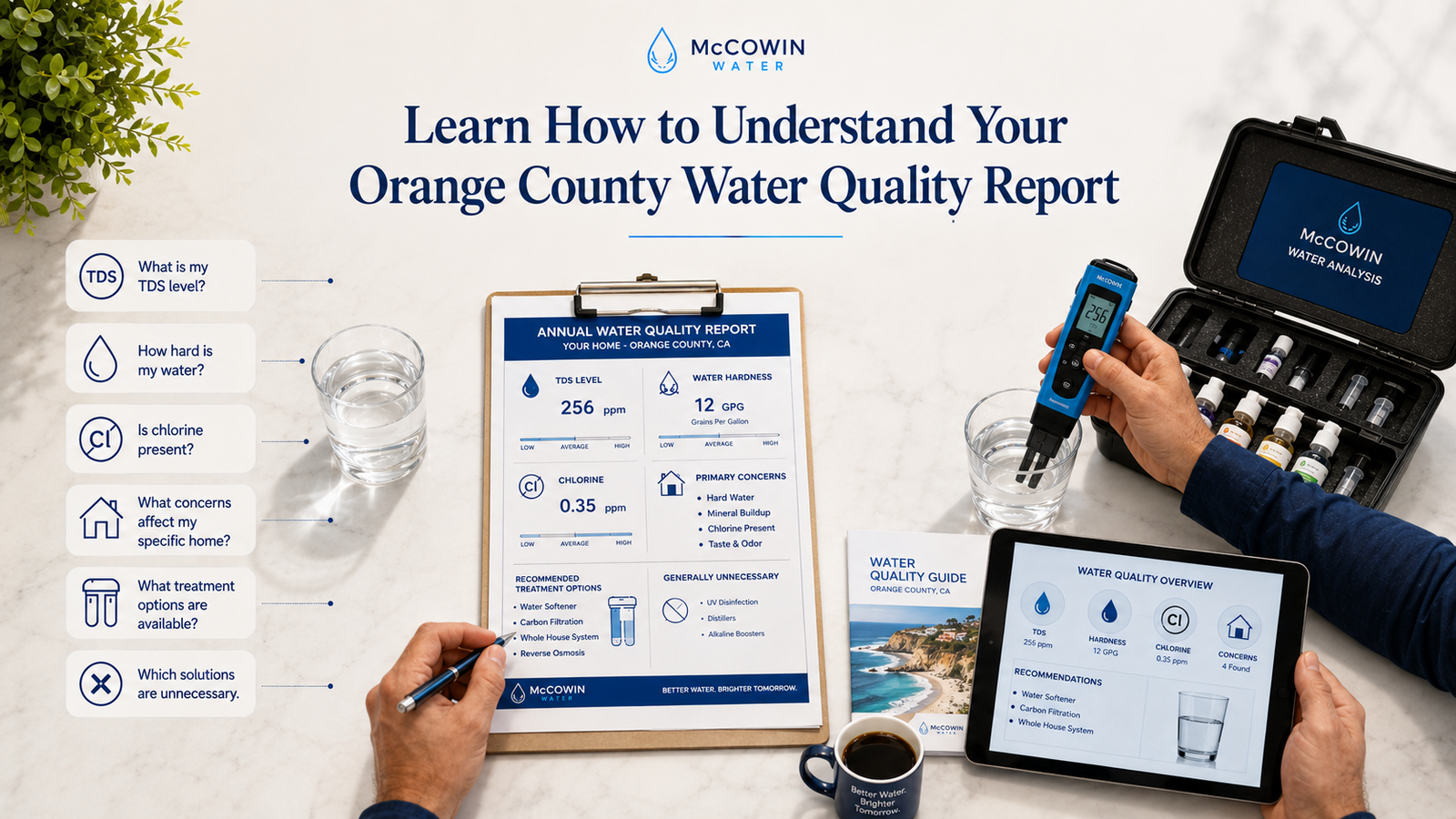
Here’s a truth most water companies won’t tell you: Your water quality report is a little like a weather forecast. It tells you what conditions are expected. It doesn’t tell you whether it’s raining in your backyard.
I’m Brian McCowin. My family has been helping Orange County homeowners understand their water since 1972. Every year, homeowners download their local water quality report. They open a forty-page PDF.
They see words like:
- Maximum Contaminant Level
- Action Level
- Treatment Technique
- Parts Per Billion
- Total Organic Carbon
Ten minutes later, their eyes glaze over. Then they call me and ask: “Brian, is my water good or bad?” The honest answer? The report is useful. But it’s only part of the story. Think of it like a vehicle history report. It tells you where the car has been. It doesn’t tell you what condition it’s in today.
Let’s talk about how to actually read your Orange County water report and use it to make smart decisions about whole-home filtration.
What is an Orange County water quality report?
A water quality report is an annual document that describes the quality of water supplied by your local utility. Federal regulations require water providers to publish these reports.
They often include information about:
- Water sources
- Treatment processes
- Mineral levels
- Disinfectants
- Regulated contaminants
- Water quality standards
The report helps homeowners understand the water entering their neighborhood.
But here’s the important part: It does not always describe the exact water coming out of your faucet.
Why doesn’t the water report tell me everything about my home’s water?
Because your home’s plumbing is part of the system.
Water travels through:
- Municipal treatment facilities
- Distribution systems
- Neighborhood pipelines
- Service lines
- Your home’s plumbing
Think about ordering a pizza.
The restaurant may make a perfect pizza. But if it sits in traffic for forty-five minutes, the experience changes. Water works similarly. Your home’s plumbing, fixtures, and pipes may influence what ultimately reaches your tap. That’s why in-home testing matters.
What does TDS mean on my water quality report?
TDS stands for Total Dissolved Solids.
It measures dissolved substances in the water, including:
- Calcium
- Magnesium
- Sodium
- Chlorides
- Sulfates
- Minerals
TDS is not necessarily a contaminant. It’s a measurement.
Higher TDS levels may affect:
- Taste
- Water spots
- Appliance performance
- Drinking water preferences
Think of TDS as the ingredient list. The number tells us how much is present. Testing helps determine exactly what those ingredients are.
What do chlorine and chloramines mean?
Chlorine and chloramines are disinfectants used to help protect public water supplies. Their purpose is important. They help maintain water quality as water moves through the distribution system.
However, some homeowners notice:
- Taste changes
- Odor concerns
- Drinking water preferences
This is one reason some homeowners explore filtration options. Not because the disinfectants are doing something wrong. But because they want water that tastes and smells different.
Why does my water report mention contaminants if my water is considered safe?
This is one of the biggest misunderstandings homeowners have. The presence of a substance in a report does not automatically mean the water is unsafe.
Water reports often list:
- Detection levels
- Regulatory limits
- Testing results
- Compliance standards
The purpose is transparency. Think of it like a blood test. Your doctor gives you all the numbers. The numbers themselves aren’t the diagnosis. But rather, it is the context that matters.
That’s why understanding the report is more important than simply reading it.
How do I use my water report to evaluate whole-home filtration options?
This is where things become practical.
Your report can help identify concerns such as:
- Hard Water: Minerals that contribute to scale buildup.
- Chlorine or Chloramines: Potential taste and odor concerns.
- TDS Levels: Overall dissolved solids.
- Regional Water Characteristics: Understanding local water conditions.
Once you understand these factors, you can begin discussing treatment options. The report provides clues. And the testing provides answers.
Which whole-home filtration systems address common Orange County water concerns?
Different water concerns often require different solutions.
| Water Concern | Possible Treatment Approach |
|---|---|
| ➤ Hard water | Water softening |
| ➤ Chlorine taste | Carbon filtration |
| ➤ High TDS | Reverse osmosis |
| ➤ Scale buildup | Water conditioning or softening |
| ➤ Drinking water taste | Reverse osmosis or filtration |
| ➤ Multiple concerns | Customized whole-home treatment |
This is why one-size-fits-all recommendations often fail. The right solution depends on the actual water.
Why do different water companies recommend different filtration systems?
Many companies only sell one brand. That creates a problem.
At McCowin Water, we’re like an Auto Mall for water.
We aren’t tied to one manufacturer. We carry a broad range of premium equipment because every home’s water is different. That flexibility allows us to customize solutions based on your water and not on our inventory.
Why is an in-home water test still necessary?
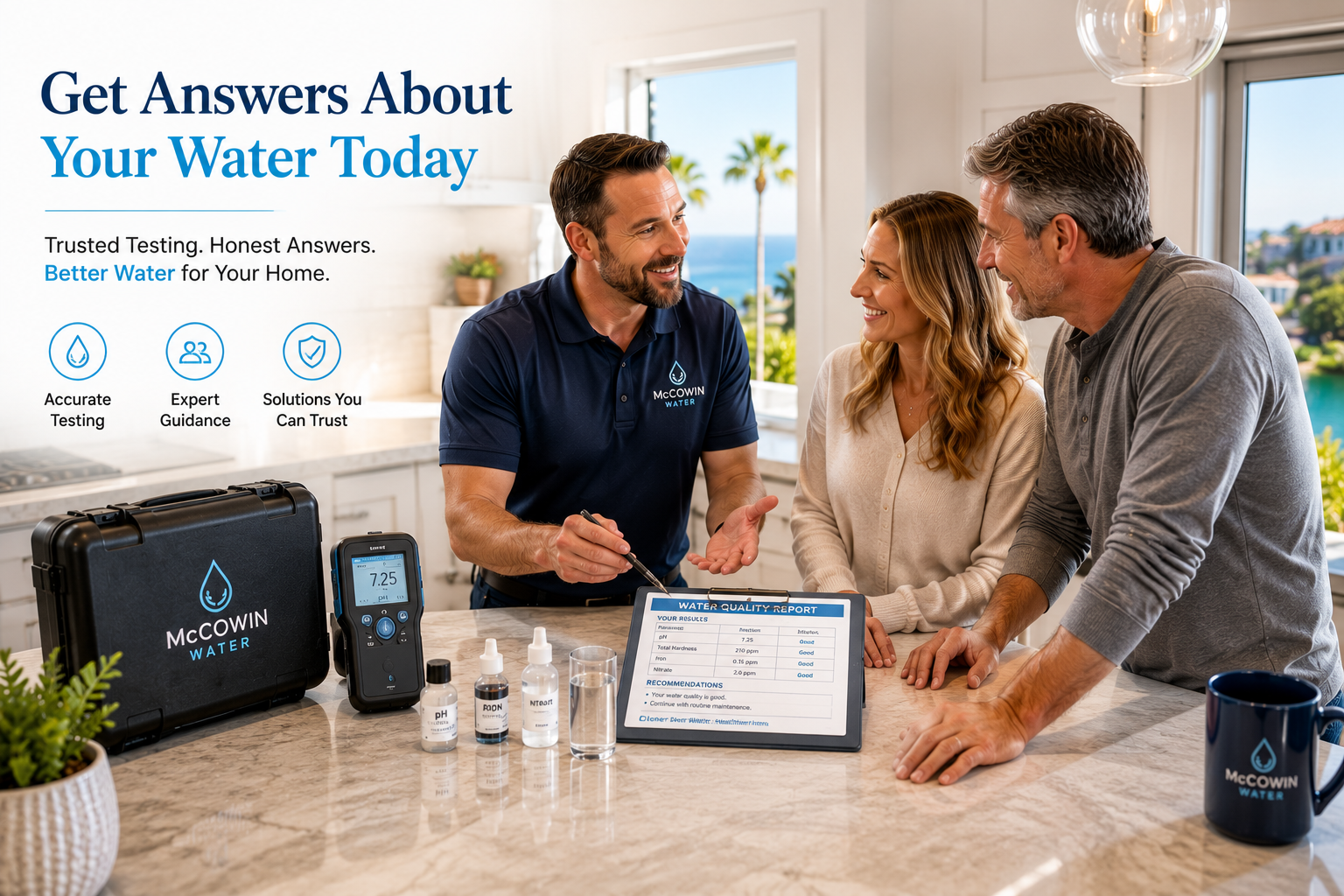
Here’s the insider secret from fifty years in the business: The water report tells you about the neighborhood and the test tells you about your house.
A professional in-home test can help identify:
- Actual hardness levels
- TDS at the faucet
- Chlorine levels
- Plumbing influences
- Taste concerns
- Household-specific issues
This is the information that determines whether treatment makes sense. Without testing, you’re making decisions based on averages. With testing, you’re making decisions based on facts.
What questions should I ask when reviewing my water report?
Ask questions such as:
- What is my TDS level?
- How hard is my water?
- Is chlorine present?
- What concerns affect my specific home?
- What treatment options are available?
- Which solutions are unnecessary?
Good questions lead to good decisions. And good decisions usually save money.
What is the smartest first step after reading my water report?
The smartest first step is comparing your local report with an in-home water test. The report tells you what the utility supplies. The test tells you what your family actually uses.
When you combine both pieces of information, you can make confident decisions about whole-home filtration. That’s when the confusion disappears and clarity begins.
The McCowin Promise
For more than fifty years, we’ve helped Orange County homeowners understand their water before recommending treatment solutions.
“If the system we install doesn’t perform the way we promised… If your water doesn’t taste, feel, or behave the way we said it would… We’ll pull the whole system out. And either replace it or make it right. No fine print. Because your trust is worth more than the sale.”
Schedule Your Free, In-Home Water Test
If you’re trying to evaluate different whole-home filtration options using your Orange County water report, start by understanding your actual water.
We perform professional, on-site testing right at your kitchen sink. We’ll compare your home’s water to your local water report, explain everything in plain English, and provide honest recommendations with absolutely zero sales pressure.
Call us at (949) 569-5736 or Schedule a Free, Water Test today and finally understand what your water report means for your home.
CSLB: C-55 #1022717