


By Brian McCowin, McCowin Water. Serving Irvine and Orange County since 1972.
If you have a slow reverse osmosis system, the most common causes are a clogged prefilter, an aging RO membrane, low water pressure, a full or poorly pressurized storage tank, or a restricted flow path. An RO system naturally produces water more slowly than a regular faucet because water has to pass through a very fine membrane. However, a noticeable change from the way your system used to perform usually deserves attention. Before replacing the entire system, it is worth finding out whether the problem is a simple filter issue or something affecting the membrane, pressure, or storage tank.
A slow RO faucet is not necessarily a sign that the system is failing. Sometimes the solution is as simple as replacing a filter. Other times, the system needs a closer inspection.
How fast should a reverse osmosis system produce water?
Reverse osmosis is naturally slower than conventional filtration. A standard faucet can deliver water directly from the home’s plumbing. An RO system has to push water through several treatment stages and then through a semipermeable membrane. The purified water is collected in a storage tank, so you have a supply available when you open the drinking water faucet. This means you should not expect an RO faucet to behave like a regular kitchen faucet.
The more useful question is whether the system has become slower than it used to be. If a glass takes noticeably longer to fill, the storage tank takes hours longer than normal to recover, or the flow has gradually weakened, something may have changed within the system.
A clogged filter may be slowing everything down
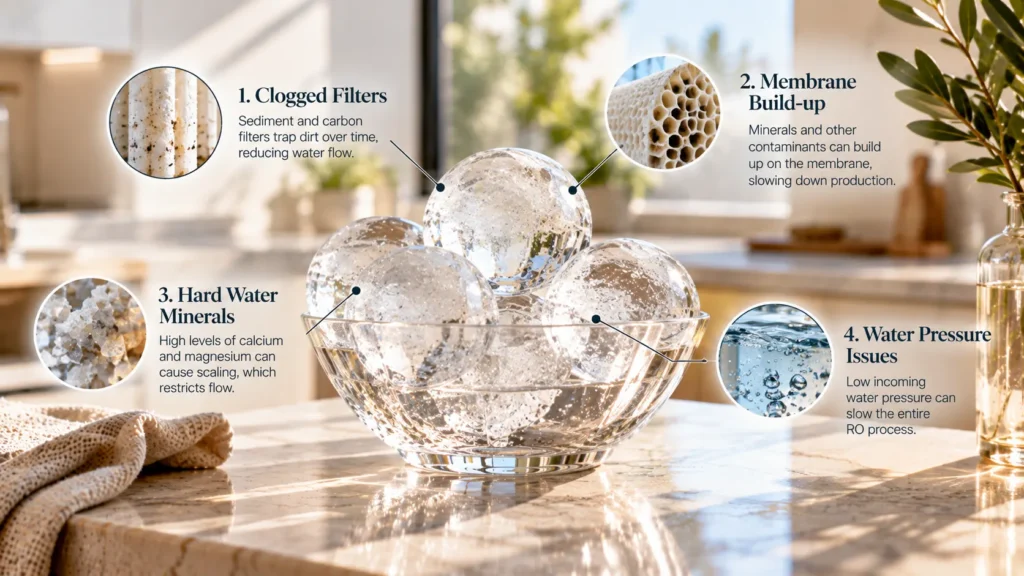
The easiest place to start is often the prefilters. Sediment and carbon filters protect the RO membrane by treating the water before it reaches it. Over time, sediment can collect in the sediment filter, while the carbon filters become loaded with the substances they are designed to reduce.
As a filter becomes restricted, less water reaches the membrane. The result can be lower production and slower filling of the storage tank. This is one reason regular filter replacement matters. A system can continue producing water even when a filter is overdue for replacement, so waiting for the system to stop completely is not a reliable maintenance strategy. If you cannot remember the last time your RO filters were changed, that is a sensible place to begin.
Could low water pressure make an RO system slow?
Yes. Reverse osmosis depends on adequate water pressure to push water through the membrane. If pressure entering the system is too low, the membrane may produce treated water more slowly. Low pressure can have several causes. The home’s incoming pressure may have changed, a pressure regulator may have an issue, or another plumbing condition may be affecting the supply.
The RO system itself may also have a pressure-related problem. This is why replacing filters without checking pressure does not always solve a slow RO system. If the system does not have the pressure it needs, even a new membrane may not produce water at the expected rate.
Your storage tank may be the real reason it feels slow
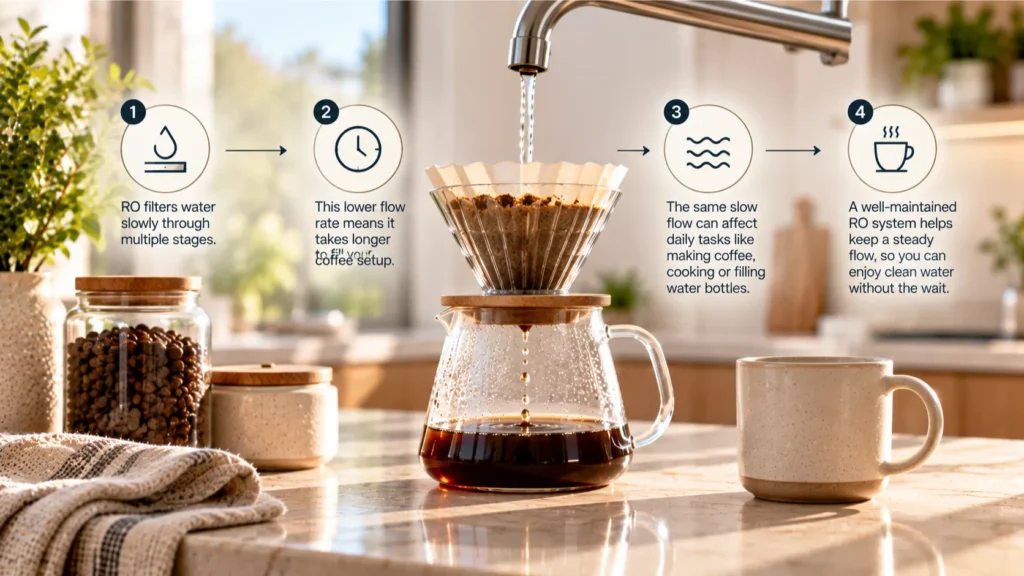
Many homeowners assume the RO faucet produces drinking water directly through the membrane. In a typical residential system, the membrane produces water gradually and stores it in a tank. When you open the faucet, water from that tank provides the flow.
If the tank is not holding the right amount of water or its air pressure is incorrect, the faucet may feel weak even if the membrane is still working. You may notice a strong flow for a short time followed by a significant drop, or you may get only a small amount of water before the flow becomes very weak. A tank problem can therefore look like a filtration problem. Checking the tank and the system’s pressure conditions can help separate these two issues.
An old RO membrane can reduce water production
The membrane is the part of the system responsible for removing many dissolved substances from the water. Like other treatment components, it does not last forever. As a membrane ages, its ability to produce water efficiently can decline. Scale, fouling, poor pretreatment, high water hardness, and normal wear can all affect its performance.
If your filters have been replaced regularly but the system continues to produce water very slowly, the membrane deserves attention. Replacing the membrane without checking the rest of the system is not always the best approach. A new membrane can also become inefficient if the underlying pressure, pretreatment, or water quality problem remains.
Hard water can slow an RO system
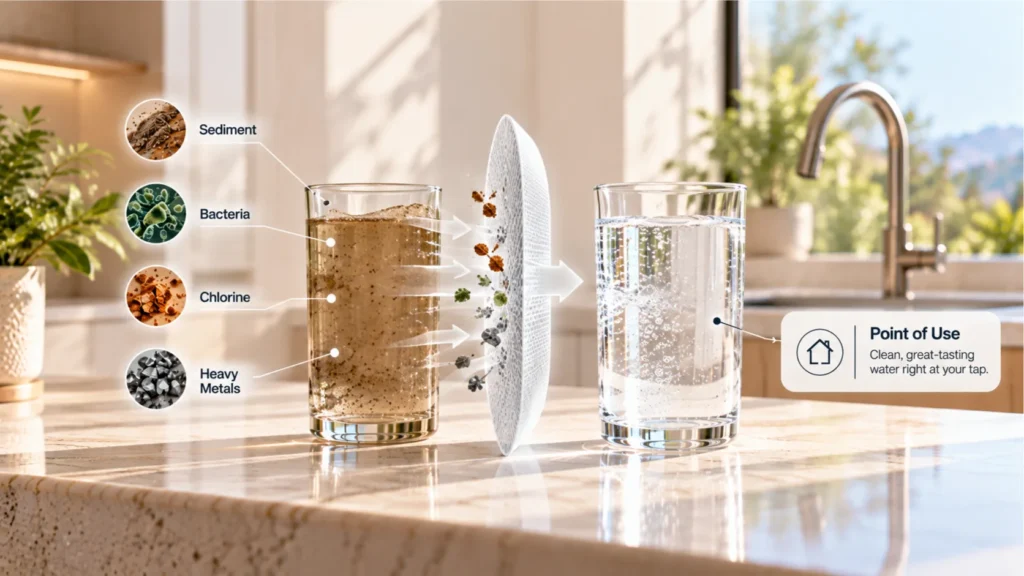
Hard water contains calcium and magnesium. Under the right conditions, these minerals can contribute to scale forming on the RO membrane. As scale accumulates, water has a harder time passing through the membrane. Production can decrease even though the system continues to operate.
This is one reason water quality matters when diagnosing a slow reverse osmosis system. If your home has significant hardness, the RO system may benefit from appropriate pretreatment. In some homes, a water softener can reduce the hardness reaching the RO system and help protect the membrane.
The correct solution depends on the water entering the system. Not every slow RO system needs a softener, and not every home needs the same combination of treatment.
A restricted faucet can make the RO system seem slow
Sometimes the problem is much closer to the glass than the membrane. The dedicated RO faucet, tubing, shutoff valve, or flow restrictor can develop a restriction. When this happens, the system may be producing water normally while the faucet delivers less than expected.
This is an important distinction because replacing an expensive membrane will not fix a restricted faucet. Look at the pattern of the problem. If the storage tank fills normally but the faucet flow is weak, the issue may be on the delivery side of the system. If both production and faucet flow are slow, the membrane, filters, pressure, or tank may deserve closer attention.
How do you know what is actually causing the slow flow?
Start with the timeline:
- If the RO system has always been slow, the issue may be related to its original design, water pressure, storage capacity, or installation.
- If it became slow gradually, filter condition, membrane age, scale, and water quality become more relevant.
- If the change happened suddenly, a valve, pressure issue, leak, restriction, or component problem may be involved.
Testing the water can also provide useful information. Dissolved solids and hardness can help show whether the membrane is dealing with conditions that may affect its performance. The point is to diagnose before replacing parts.
Why Irvine homeowners have trusted the McCowin family since 1972
I’m Brian McCowin. My family has been solving water problems in Orange County since 1972, one home and one honest answer at a time. When an RO system becomes slow, we look beyond the faucet. The membrane, filters, pressure, storage tank, water quality, and plumbing connections can all play a role.
A free, in-home water test can help us understand the water entering the system and determine whether hardness or dissolved solids may be contributing to the problem. We can also look at how the existing RO system is performing rather than assuming it needs to be replaced. Sometimes a filter is simply overdue. Sometimes the membrane has reached the end of its useful life. In other cases, the issue is pressure, the tank, or another component.
We’re a licensed California water treatment contractor (CSLB C-55 #1022717), serving Irvine and the surrounding communities: Tustin, Santa Ana, Newport Beach, Costa Mesa, Lake Forest, Mission Viejo, Orange, Anaheim, Huntington Beach, Fountain Valley, Yorba Linda, Laguna Niguel, Laguna Hills, Aliso Viejo, Rancho Santa Margarita, San Juan Capistrano, and San Clemente.
The McCowin Promise
For more than fifty years, we’ve helped Orange County homeowners understand their water through professional testing, honest recommendations, and customized solutions.
“If the system we install doesn’t perform the way we promised… If your water doesn’t taste, feel, or behave the way we said it would… We’ll pull the whole system out. And either replace it or make it right. No fine print. Because your trust is worth more than the sale.”
Before you replace the whole RO system
A slow reverse osmosis system does not automatically mean you need a new system.
Book your free, in-home water test today, or call (949) 569-5736.
The better first step is to determine whether the restriction is coming from the filters, membrane, water pressure, storage tank, plumbing, or the water itself. Once you know what is actually slowing the system down, you can address the right component instead of replacing equipment unnecessarily.
Frequently Asked Questions
Why is my reverse osmosis system so slow?
A slow RO system can be caused by clogged filters, low water pressure, an aging membrane, incorrect storage tank pressure, hard water scale, or a restriction in the faucet or tubing.
How long should it take for an RO system to fill a tank?
The time varies by system, water pressure, membrane capacity, temperature, water quality, and tank size. A noticeable change from the system’s previous performance is more important than a universal filling time.
Can low water pressure make reverse osmosis slow?
Yes. RO membranes need sufficient pressure to produce treated water efficiently. Low pressure can significantly reduce the amount of water the membrane produces.
Can hard water affect RO membrane performance?
Yes. Calcium and magnesium can contribute to scale formation on the membrane, which may reduce water production over time.
Should I replace my RO membrane if the system is slow?
Not automatically. Filters, pressure, the storage tank, faucet, tubing, and other components should be checked first. A membrane replacement makes sense when testing or inspection indicates that the membrane is no longer performing properly.
Why is my RO faucet slow but the tank seems full?
A restriction in the faucet, tubing, valve, or delivery side of the system can reduce flow even when the storage tank contains water. The problem may not be the membrane. A reverse osmosis system is designed to work slowly, but it should still perform consistently. When a system that once filled your glass normally starts taking noticeably longer, the change is worth investigating.