


You have a water softener installed, but the signs of hard water have not disappeared. The shower glass still develops white spots. Faucets collect chalky residue. Soap does not seem to rinse away as easily as expected. Maybe you have even tested the water and found that the water is still hard after a water softener.
If you are wondering why your water is still hard after installing a softener, do not assume the system has failed. There are several reasons this can happen, and some are much simpler to correct than others. A softener has to be properly sized, programmed, supplied with salt, and maintained. It also needs to be treating the water you are actually using. When one part of that equation is wrong, hard water can make its way back into your home.
What should a water softener do?
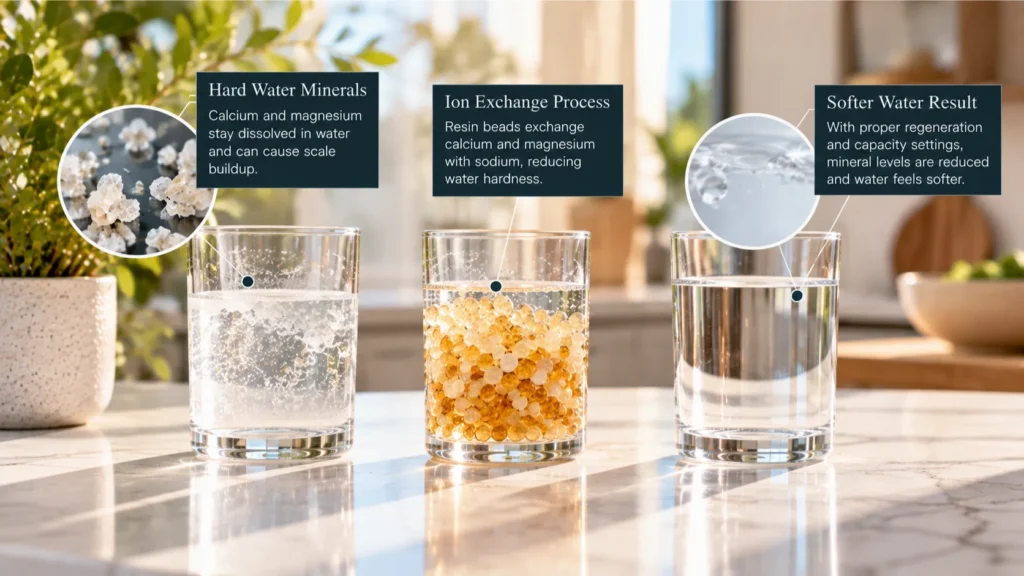
A traditional water softener is designed to reduce calcium and magnesium, the minerals responsible for water hardness. Inside the softener is a resin bed. As hard water passes through it, the resin attracts the hardness minerals and releases a different ion in exchange. Over time, the resin becomes loaded with calcium and magnesium.
The regeneration cycle restores the resin so it can continue doing its job. When everything is working properly, the water leaving the softener should contain substantially less hardness than the water entering it.
What to check if water is still hard after a water softener
It is important to understand what a softener does not do. A water softener is not a general-purpose water purifier, and it is not designed to remove every substance that may be present in water. If you are noticing a taste, odor, chlorine, sediment, or another water quality issue, you may be dealing with a separate concern.
1. The softener may not be regenerating properly
Regeneration is one of the most important parts of softener operation. The system needs to periodically clean the resin bed so it can continue removing hardness minerals. If regeneration does not happen correctly, the resin can become exhausted and allow harder water through.
There are several reasons regeneration may not be happening as expected. The control settings could be incorrect, the system could have experienced a mechanical issue, or the regeneration schedule may not match your household’s actual water use.
You may notice the problem after several days rather than immediately. The water can initially be soft after regeneration and gradually become harder as the resin becomes exhausted. If your water seems softer at certain times and harder at others, the regeneration cycle deserves attention.
2. Your hardness setting may be wrong
A water softener needs to know how hard the incoming water is. If the hardness setting is too low, the system may underestimate how much calcium and magnesium it needs to remove. The result can be hard water reaching the house even though the softener is technically running. This is one reason a water softener should not simply be programmed using a generic number.
Water conditions can vary between homes. Household water use can vary too. The correct setting depends on the actual water and the capacity of the equipment. If the softener was installed without a proper water hardness test, checking the current hardness is a useful place to start.
3. The system may be undersized for your home
A water softener needs enough capacity to handle your household’s water demand. A small system serving a large household may reach its treatment capacity faster than expected. If the system cannot keep up with the amount of hard water passing through it, you may experience periods of hard water even though the equipment appears to be operating normally.
Household size is only part of the calculation. Bathrooms, laundry, showers, guests, and other water use all contribute to demand. An increase in household water use can expose a sizing problem that was not obvious when the system was first installed.
4. There may be a problem with the salt or brine system
Salt plays an important role in regenerating many traditional water softeners. Simply seeing salt in the tank does not necessarily mean the system is creating the right brine or using it correctly. A problem with the brine tank, salt level, brine line, float assembly, injector, or related components can interfere with regeneration.
Salt bridges can also create problems. A salt bridge is a hardened layer of salt that forms inside the brine tank. It can make the tank appear to contain plenty of salt while preventing the system from using it properly. Low salt is not always the problem either. Constantly adding more salt without finding the underlying issue will not necessarily make the water softer.
5. The resin may be exhausted or damaged
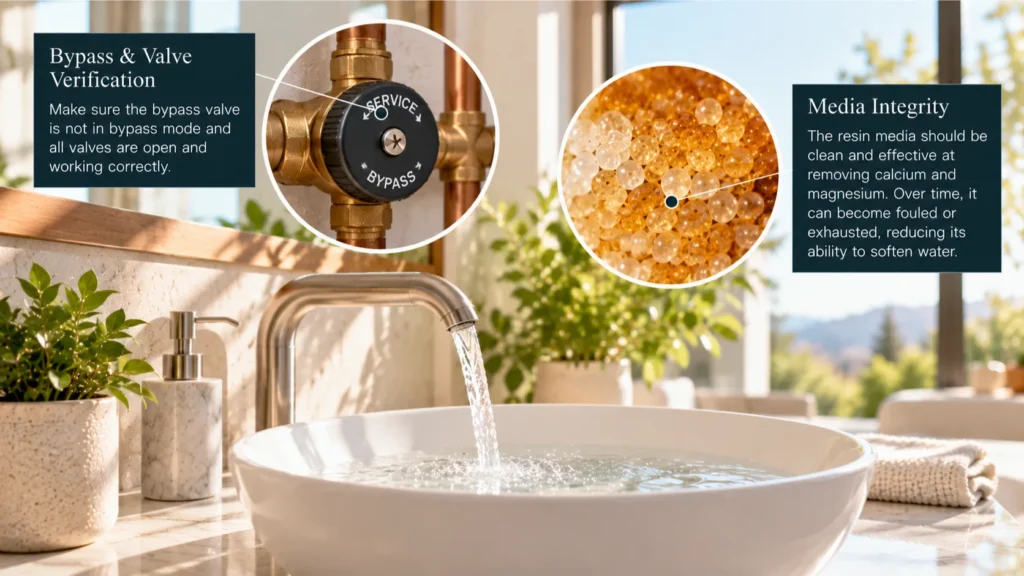
The resin inside a water softener is responsible for exchanging the hardness minerals. Over time, resin can lose effectiveness. Its condition can be affected by age, water chemistry, improper operation, or other conditions.
If a softener has been operating for many years and suddenly begins producing harder water, the resin bed may be one of the things worth evaluating. This is different from simply changing the salt level or adjusting a setting. If the treatment media itself is no longer performing properly, changing the programming may not solve the problem.
6. Some water may be bypassing the softener
Your home may have a bypass valve that allows water to flow around the softener. A bypass can be useful when the equipment needs to be serviced. The problem occurs when it is accidentally left partially or completely open.
In that situation, some or all of the water entering your home may avoid the resin bed altogether. This can create a confusing situation because the softener itself may appear to be running normally. The control panel may show no obvious error, and the salt tank may look fine. If the system has recently been serviced, moved, or adjusted, the bypass position is worth checking.
7. You may be seeing old mineral deposits, not new hard water
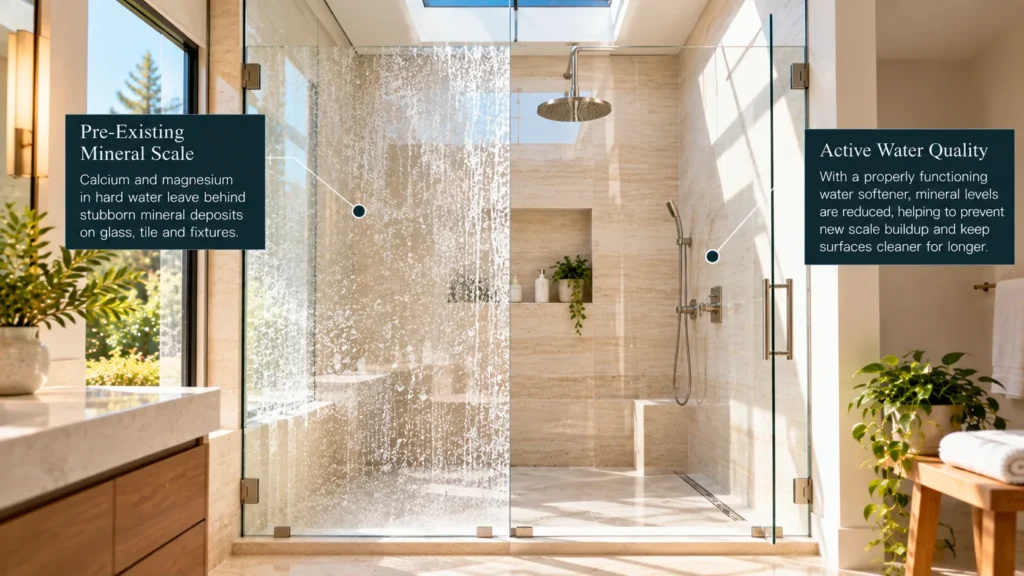
This is an important distinction. Suppose you install a properly working softener today. You may still see white spots on a shower door tomorrow. The softener cannot remove mineral deposits that have already accumulated on your fixtures, glass, faucets, and plumbing surfaces.
Old scale can remain until it is cleaned. This means visible residue is not always proof that the softener is failing. A homeowner may install a treatment system, continue seeing existing buildup, and assume nothing has changed. Testing the water after the softener gives you a much better indication of whether the system is actually reducing hardness.
How can I tell if my water softener is working?
The most reliable approach is to test the water rather than relying only on what you see around the house. Take a sample from water that has passed through the softener and compare its hardness with the incoming water. The difference can help show whether the equipment is reducing calcium and magnesium as intended.
Pay attention to when the sample is taken as well. A system that has just completed regeneration may produce different results from one that is nearing the end of its capacity. You can also look at the system itself. Check whether it is regenerating, whether the salt level is changing normally, and whether any warning or error messages are present. If the results do not make sense, professional testing can help identify whether the problem is with the water, the equipment, or its settings.
Should you add more salt if your water is still hard?
Not automatically. Adding salt may be appropriate when the system is genuinely low on salt, but more salt is not a universal solution to hard water. If the actual problem is incorrect programming, a bypass valve, a failed component, exhausted resin, or insufficient system capacity, adding more salt will not fix it.
In fact, repeatedly adding salt without understanding the problem can increase operating costs while leaving the original issue untouched. The better approach is to find out why the system is not producing the expected result.
Why Irvine homeowners have trusted the McCowin family since 1972
I’m Brian McCowin. My family has been solving water problems in Orange County since 1972, one home and one honest answer at a time. When someone tells us their water is still hard after installing a softener, we do not start by assuming they need another system. We look at the water and the equipment together.
A free, in-home water test can help determine the actual hardness level and whether the existing softener is reducing it properly. We can also look at the system’s setup and discuss factors such as capacity, regeneration, and household water use. Sometimes a setting needs to be corrected. Sometimes the equipment needs service. In other cases, the system may not be properly matched to the home’s water conditions. The important part is finding the reason before spending money on another solution.
We’re a licensed California water treatment contractor (CSLB C-55 #1022717), serving Irvine and the surrounding communities: Tustin, Santa Ana, Newport Beach, Costa Mesa, Lake Forest, Mission Viejo, Orange, Anaheim, Huntington Beach, Fountain Valley, Yorba Linda, Laguna Niguel, Laguna Hills, Aliso Viejo, Rancho Santa Margarita, San Juan Capistrano, and San Clemente.
The McCowin Promise
For more than fifty years, we’ve helped Orange County homeowners understand their water through professional testing, honest recommendations, and customized solutions.
“If the system we install doesn’t perform the way we promised… If your water doesn’t taste, feel, or behave the way we said it would… We’ll pull the whole system out. And either replace it or make it right. No fine print. Because your trust is worth more than the sale.”
Can a water softener be too small for a house?
Yes. If the system does not have enough capacity for the home’s water hardness and usage, it may reach its treatment capacity too quickly and allow harder water through before the next regeneration.
A water softener that is not producing soft water is worth investigating, but it does not automatically mean the system needs to be replaced. The first question should be simple: Is the water actually still hard, and if it is, why? Once you know the answer, the next step becomes much clearer.
Book your free, in-home water test today, or call (949) 569-5736.
Frequently Asked Questions
Why is my water still hard after installing a softener?
The softener may have an incorrect hardness setting, be regenerating incorrectly, be undersized, have a salt or brine problem, have exhausted resin, or have water bypassing the system. Existing mineral deposits can also make it appear that hard water is still present.
How do I know if my water softener is working?
Testing the hardness of water before and after the softener is one of the clearest ways to evaluate performance. The system’s regeneration cycle, settings, salt use, and physical condition can also provide useful clues.
Can a water softener stop working because of old resin?
Yes. Resin can become less effective over time or under certain water conditions. If an older softener is consistently producing hard water despite correct settings and regeneration, the resin should be evaluated.
Does adding more salt make water softer?
No. A softener needs the appropriate amount of salt for regeneration, but adding extra salt does not compensate for every equipment or programming problem.
Why do I still have white spots after installing a water softener?
Existing mineral deposits do not disappear automatically when a softener is installed. They may need to be cleaned separately. Testing the treated water can help determine whether new hardness is still entering the home.