


By Brian McCowin, McCowin Water. Serving Irvine and Orange County since 1972.
Most homeowners think about water filtration when they notice something unpleasant. Maybe the kitchen tap smells like chlorine, the shower leaves your skin feeling dry, or mineral spots keep appearing on bathroom fixtures. The usual response is to look for a filter that fixes that one problem.
But what about the rest of the house?
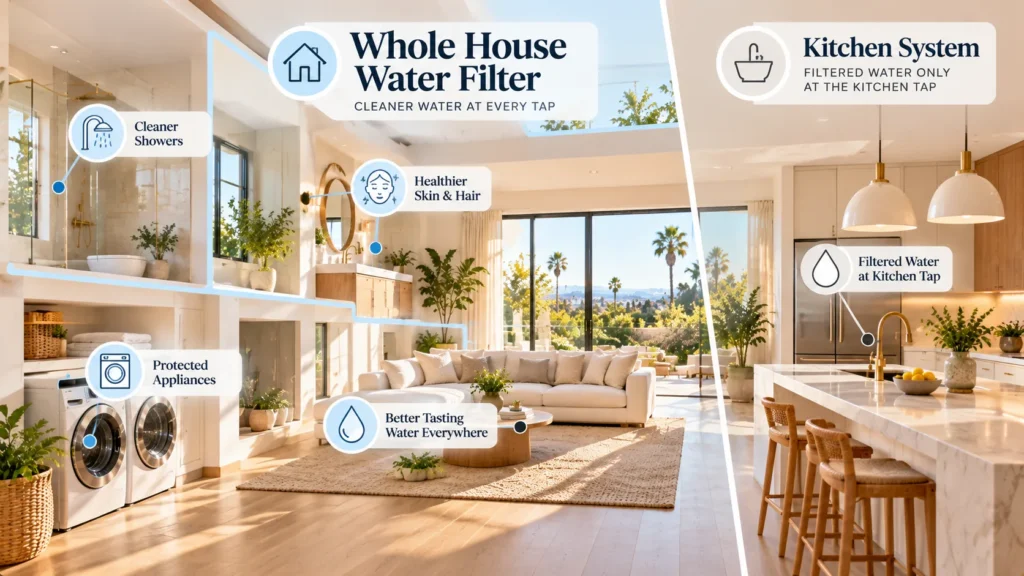
A kitchen filter only treats the water coming from the kitchen tap. Water flowing through your showers, bathroom sinks, laundry room, and other fixtures remains unchanged. A whole-house filtration system takes a different approach. It treats water as it enters your home, so filtered water is available at every tap.
The whole house water filter benefits go beyond having better-tasting drinking water. Depending on your water quality and the system selected, whole-house filtration can help reduce certain unwanted substances, improve water quality for everyday household use, and make water more consistent throughout your home.
What changes when every tap has filtered water?
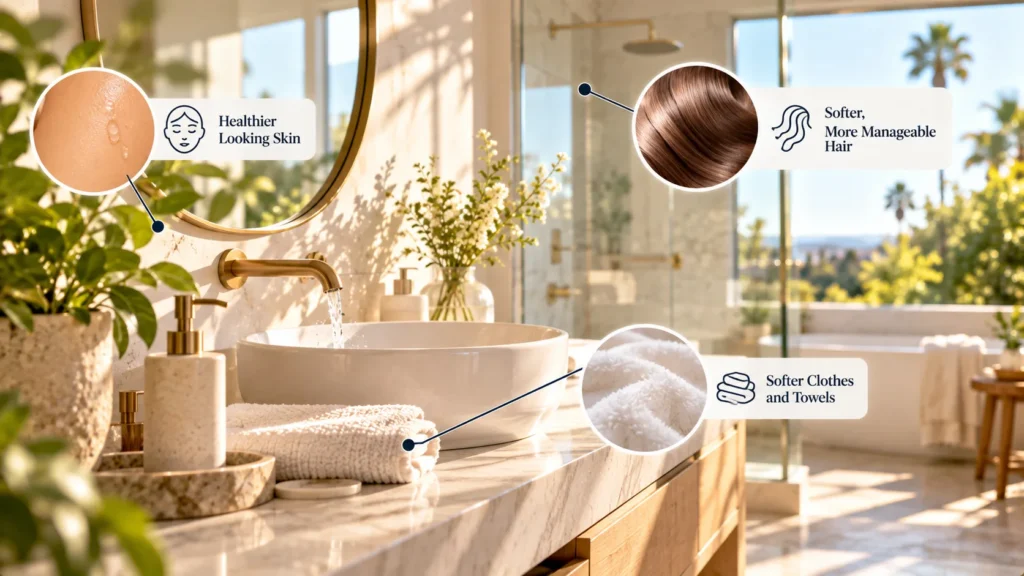
Think about how many times you use water in a day. You fill a glass, wash vegetables, brush your teeth, take a shower, run the washing machine, and clean your kitchen counters. Water is part of nearly every household routine. A filter installed under the kitchen sink can improve the water you drink and cook with. However, it does not treat the water used elsewhere.
A whole-house system is installed where the main water supply enters your home. All the water moving through your home’s plumbing passes through the treatment system before reaching individual fixtures. This means the water coming from your bathroom sink, shower, kitchen tap, and laundry connection receives the treatment the system is designed to provide.
It is important to understand that not every whole-house filter removes the same things. Some systems focus on chlorine and taste, while others are designed for specific contaminants or water conditions. The right system depends on what is actually present in your water.
Better water quality in your showers and bathrooms
You may spend more time thinking about drinking water than shower water, but your skin and hair come into contact with household water every day.
Municipal water supplies commonly use disinfectants such as chlorine to help control harmful microorganisms. This treatment is important for keeping public water supplies safe. However, some homeowners notice a chlorine smell when showering or washing their face.
A suitable whole-house carbon filtration system can reduce chlorine and certain other substances, depending on its design and certification. This can make shower water more pleasant to use and reduce the noticeable chlorine smell.
There is one distinction worth making. Chlorine, hard water minerals, and other dissolved substances are different water-quality issues. A carbon filter does not automatically soften water, and a water softener does not remove every contaminant. If hard water is contributing to mineral deposits or soap residue, a separate softening system may be needed. The goal is not to install one filter and expect it to solve every water problem. It is to identify what needs treatment and choose equipment accordingly.
More consistent water throughout your home
One of the practical whole house water filter benefits is consistency. Without whole-house treatment, water quality can differ depending on which fixture has a filter installed. Your kitchen drinking water may pass through several stages of filtration, while the water in your bathroom and laundry room receives no additional treatment.
A properly selected whole-house system treats the incoming supply before it branches out through your plumbing. This gives you a more consistent level of treatment at the fixtures connected to that supply. It can be particularly useful in homes where several people use water throughout the day and where filtration is wanted beyond the kitchen.
However, filtration does not necessarily mean every tap produces drinking-quality water for every possible use. The system must be designed for the substances you want to reduce, and the treated water should be tested when appropriate.
Can whole-house filtration help protect household fixtures?
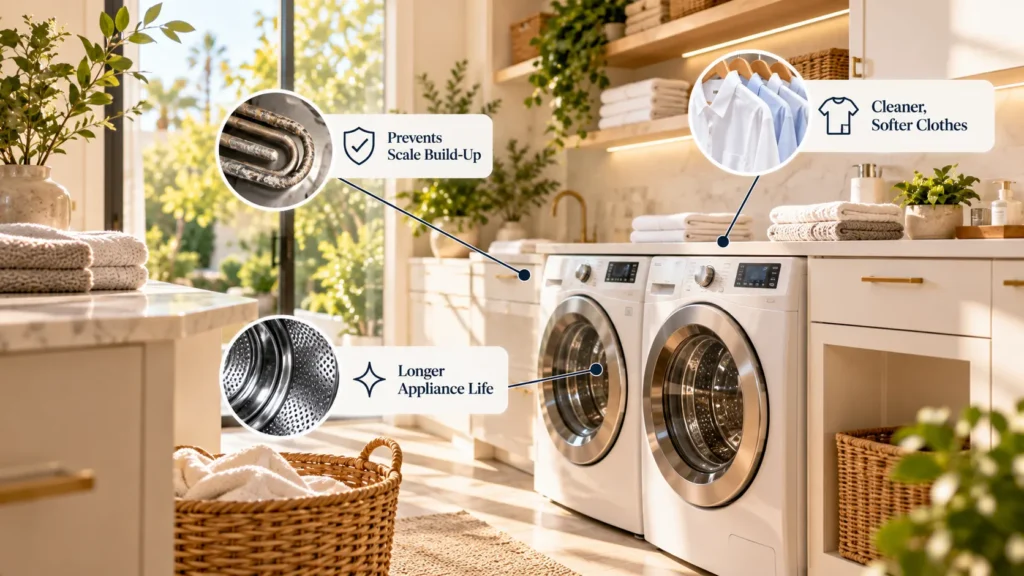
Water quality can affect more than what comes out of your glass. Certain substances in water can contribute to staining, deposits, unpleasant odours and other maintenance concerns. For example, iron and manganese can leave visible stains on sinks, toilets, and laundry. Sediment can also collect in plumbing components and affect equipment.
The right filtration system can reduce specific substances before they travel through your home’s plumbing. This may help reduce related staining or buildup, depending on the source and concentration of the problem.
Hard water requires a separate conversation. Calcium and magnesium are responsible for hardness, and they can form scale on fixtures, heating elements, and appliances. A whole-house filter designed mainly for chlorine reduction will not necessarily remove these minerals.
If scale is your main concern, a water softener may be more appropriate. If your home has several water-quality issues, filtration and softening may work together as part of a treatment plan.
Do you need a whole-house system or a kitchen filter?
It depends on how much of your home you want to treat.
An under-sink reverse osmosis system is designed to provide highly treated drinking and cooking water at a dedicated tap. It is a practical choice when your main concern is the water you consume. A whole-house filtration system treats water entering the property, so treatment is available at multiple fixtures. It may be a better fit when chlorine, odour, sediment or another treatable issue affects water throughout the home.
Some homeowners benefit from both. Whole-house filtration can address selected water-quality concerns across the property, while reverse osmosis provides an additional level of treatment for drinking water. There is no reason to assume every home needs both systems. The decision should come from your water test, household needs, plumbing setup, and the specific contaminants you want to address.
What should you check before installing a system?
Before choosing equipment, find out what is actually in your water. A system that works well for one home may not be the right choice for another. Start with a water test.
Depending on your source and concerns, testing may look at hardness, chlorine, pH, total dissolved solids, iron, sediment, and other relevant parameters. If you are concerned about a particular contaminant, the test should be selected to measure it. A basic reading cannot identify everything in water.
Next, consider your home’s water usage. The system needs to be sized for the number of people living in the house and the amount of water used at busy times. An undersized system may struggle to keep up with demand.
You should also understand the maintenance involved. Filters have a service life, and replacement schedules depend on the media, water conditions, and usage. A system that is not maintained can lose performance over time. These details matter more than choosing a system simply because it has more filtration stages or a bigger advertised capacity.
Why Irvine homeowners have trusted the McCowin family since 1972
I’m Brian McCowin. My family has been solving water problems in Orange County since 1972, one home and one honest answer at a time. Water treatment is not a one-size-fits-all purchase. We have seen how water conditions and household needs can vary from one Orange County home to another. A system that makes sense for one property may be unnecessary or unsuitable for the next.
Our approach starts with understanding the water. We test it, explain what the results mean, and recommend treatment based on the actual problem. If a home needs filtration, softening, or reverse osmosis, we explain what each system is designed to do before discussing installation. The objective is to help homeowners make an informed decision, not sell equipment they do not need.
We’re a licensed California water treatment contractor (CSLB C-55 #1022717), serving Irvine and the surrounding communities: Tustin, Santa Ana, Newport Beach, Costa Mesa, Lake Forest, Mission Viejo, Orange, Anaheim, Huntington Beach, Fountain Valley, Yorba Linda, Laguna Niguel, Laguna Hills, Aliso Viejo, Rancho Santa Margarita, San Juan Capistrano, and San Clemente.
The McCowin Promise
For more than fifty years, we’ve helped Orange County homeowners understand their water through professional testing, honest recommendations, and customized solutions.
“If the system we install doesn’t perform the way we promised… If your water doesn’t taste, feel, or behave the way we said it would… We’ll pull the whole system out. And either replace it or make it right. No fine print. Because your trust is worth more than the sale.”
Start with your water
If you are considering whole-house filtration, start by finding out what is in your water and which treatment options make sense for your home. We can help you understand the results and decide whether a whole-house system, a water softener, reverse osmosis, or a combination is appropriate.
Book your free, in-home water test today, or call (949) 569-5736.
Frequently Asked Questions
Is whole-house water filtration worth it?
It can be worthwhile if you want to treat specific water-quality concerns throughout your home rather than only at one tap. Whether it makes sense depends on your water test results, household needs and the cost of installation and maintenance.
Does a whole-house water filter make tap water safe to drink?
Not automatically. Different filters target different substances. A system must be selected for the contaminants present in your water, and appropriate testing is needed to confirm whether the treated water meets your drinking-water requirements.
Does whole-house filtration remove hard water?
Most standard whole-house carbon filters do not remove the calcium and magnesium minerals that cause hard water. A water softener is generally used to address hardness.
Can I have whole-house filtration and reverse osmosis together?
Yes. They serve different purposes. Whole-house filtration treats water entering the property, while reverse osmosis provides additional treatment at a dedicated drinking-water tap. The combination depends on your water quality and household requirements.
How often should a whole-house water filter be replaced?
There is no single replacement schedule for every system. Filter life depends on the media, incoming water quality, water usage, and manufacturer’s recommendations. Regular servicing helps keep the system performing as intended.