
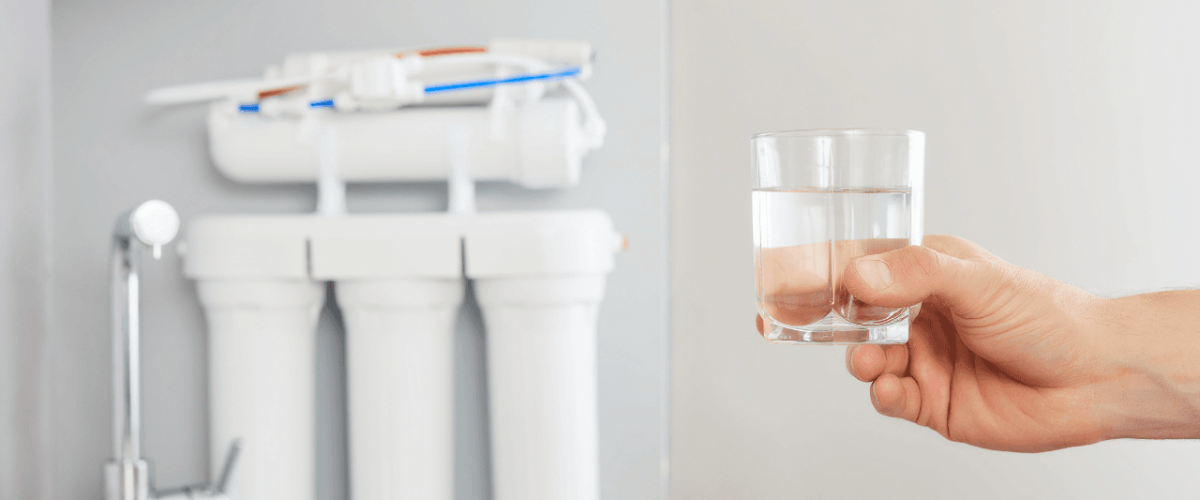

Reverse osmosis sounds like a lab term, and the physics behind it is genuinely clever. But the idea is simple enough to explain over a cup of coffee. Here’s how it works, and the full list of what it actually pulls out of your water.
The short answer: Reverse osmosis forces water through a membrane with pores so small that water molecules pass but dissolved contaminants can’t. It’s effective at reducing lead, arsenic, fluoride, nitrate, PFAS, chromium-6, sodium, and total dissolved solids, plus chlorine taste and odor when paired with a carbon stage.
Osmosis, then reverse osmosis
In ordinary osmosis, water naturally moves from a less concentrated solution to a more concentrated one across a membrane, trying to balance the two sides. Reverse osmosis does exactly what the name says: it uses pressure to push water the other way, from the contaminant-heavy side to the clean side. The membrane lets water molecules through and holds the dissolved junk back. That rejected material rinses to the drain, and clean water collects on the other side.
The full contaminant list
Because the membrane filters by size at a near-molecular scale, it catches a remarkably wide range of dissolved substances. Here’s what reverse osmosis is recognized as effective at reducing, and why each one matters.
| Contaminant | What it is / where it comes from | Why you care |
|---|---|---|
| Lead | Leaches from older pipes, solder, and fixtures | A serious health risk, especially for kids |
| Arsenic | Naturally occurring in some groundwater | A known long-term health hazard |
| Fluoride | Added to some supplies, natural in others | Many households want it out of drinking water |
| Nitrate | Farm, lawn, and septic runoff | Regulated because of infant health risk |
| PFAS | Forever chemicals from industry and products | Persistent, and increasingly regulated |
| Chromium-6 | Industrial and natural sources | The contaminant made famous in California |
| Sodium | From softening and natural sources | Matters for taste and low-sodium diets |
| Total dissolved solids | Everything dissolved, added up | Drives taste, clarity, and spotting |
Pair the membrane with a carbon pre-filter and post-filter, which every complete system does, and you also knock down chlorine taste and odor. That’s the combination that turns questionable tap water into water you actually want to drink.
The stages inside a real system
- Sediment pre-filter. Catches grit and rust so it doesn’t clog the membrane.
- Carbon pre-filter. Strips chlorine, which protects the membrane and improves taste.
- The RO membrane. The heart of the system, where dissolved contaminants get rejected.
- Storage tank. Holds the clean water so it’s ready when you turn the tap.
- Carbon post-filter and remineralization. Polishes taste and adds good minerals back.
Why this matters in Orange County: our water is a blend of local groundwater and imported supply, and it’s hard, averaging well above the “very hard” line. RO handles the dissolved contaminants at the kitchen tap, while a softener or whole-house filter handles hardness and chlorine for the rest of the house. They solve different problems, which is why a test comes first.
Vertex IsoTwist reverse osmosis
A five-stage under-sink reverse osmosis system that gives you bottled-quality water at the kitchen tap, with an optional remineralization stage that puts good minerals back for taste.
LC Reverse Osmosis
A commercial-grade reverse osmosis platform built for restaurants, cafes, and businesses that need high-purity water at volume.
Keep learning about your water. Start with whether reverse osmosis water is healthy Then the best water filter for drinking. If hardness is your real issue, start with the signs you have hard water.
How reverse osmosis works: your questions
What does reverse osmosis remove from water?
Reverse osmosis reduces a broad range of dissolved contaminants, including lead, arsenic, fluoride, nitrate, PFAS, chromium-6, sodium, and total dissolved solids, along with chlorine taste and odor when paired with a carbon filter. It’s one of the most thorough home treatments available.
Does reverse osmosis remove bacteria and viruses?
The RO membrane blocks particles far smaller than bacteria, so it reduces microbial contaminants as well. For water that’s biologically unsafe we’d add disinfection, but Orange County’s treated tap water is already disinfected.
Does reverse osmosis remove fluoride?
Yes. Fluoride is one of the dissolved substances an RO membrane is effective at reducing. If removing fluoride is a goal for your household, RO is the practical home method.
Does reverse osmosis remove PFAS forever chemicals?
Reverse osmosis is recognized by the EPA as one of the most effective home treatments for reducing PFAS. That’s a big reason interest in RO has climbed as PFAS has stayed in the news.
Put a real number on what’s in your water
A free in-home test measures your dissolved solids and more, so you know which contaminants you’re actually dealing with before you choose a system.
Book your free in-home water test
Prefer to talk it through first? Call us at (949) 569-5736. Family owned in Irvine since 1972, licensed and insured, California CSLB C-55 #1022717, serving all of Orange County.