
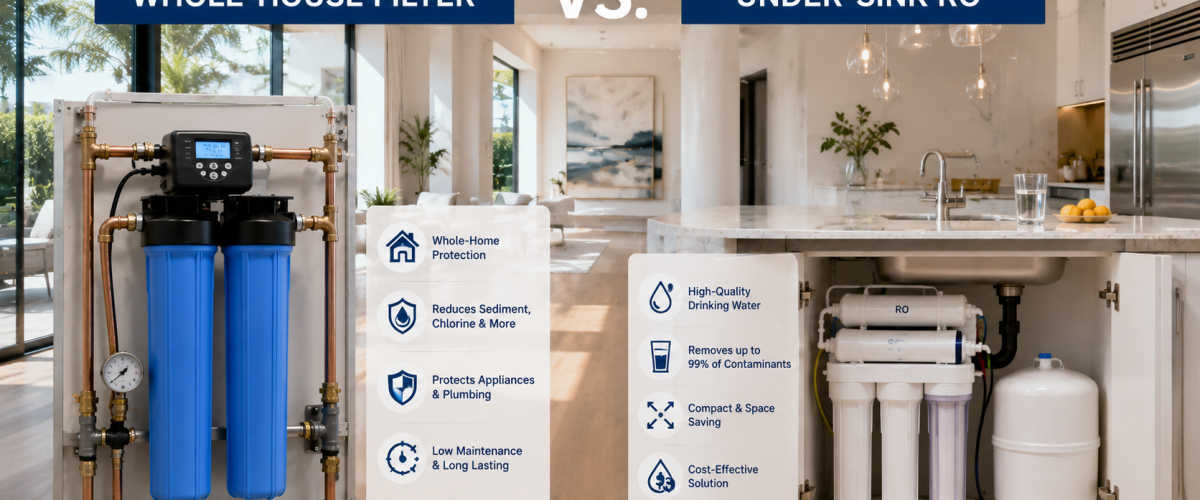

Two systems, two price tags, and a salesperson for each swearing theirs is the one that matters. It’s enough to make you put the whole decision off for another year and keep buying bottled water by the case. Here’s the thing nobody tells you plainly: they aren’t rivals. They do two completely different jobs, and once you see which job you actually need done, the choice makes itself.
The short answer: A whole-house filter treats every drop entering your home for the problems you feel everywhere, chlorine, sediment, and scale-related wear. An under-sink reverse osmosis system treats one tap and removes a far wider range of dissolved contaminants for drinking and cooking. One is broad protection; the other is deep purification. Many Orange County homes are best served by both, and a test tells you which.
What each one is built to do
Think of a whole-house filter as the bodyguard at the front door. Every gallon that enters your home passes through it, so it knocks down the chlorine you smell in the shower, catches the grit that wears out valves, and eases the load on your plumbing and appliances. It works everywhere, quietly, all day.
An under-sink RO system is the specialist in the back office. It treats only the water at your kitchen tap, but it treats it deeply, pushing it through a membrane fine enough to turn away a long list of dissolved contaminants that whole-house filters let pass. That’s the water you want in your glass, your baby’s bottle, your coffee, and your ice.
Here’s how they line up.
| What you want | Whole-house filter | Under-sink RO |
|---|---|---|
| Treats every tap | Yes | One tap |
| Chlorine taste and smell | Yes, everywhere | Yes, at the tap |
| Sediment and scale wear | Yes | No |
| Wide range of dissolved contaminants | Limited | Yes, deep reduction |
| Best for drinking water | Good | Best |
| Best for whole-home protection | Best | No |
Why so many homes end up with both
Once you see the split, the pattern is obvious. The whole-house filter protects the house, your pipes, your water heater, your skin in the shower. The under-sink RO perfects the water you actually drink. They don’t overlap; they finish each other’s sentence. A well-built pair means the water is gentler everywhere and genuinely pure where it counts most. Want the mechanism behind RO? Read how reverse osmosis actually works.
What this means at your Orange County tap
Orange County water arrives hard and chlorinated, which is exactly the one-two punch this pairing was made for. But your home isn’t an average. Your street, your plumbing, and your priorities decide whether you need the bodyguard, the specialist, or both. The only way to spend smart is to measure first and buy second.
Our honest take: if you can only do one thing today, let a test point the way. If drinking water is the priority, start with under-sink RO. If it’s protecting the whole home from chlorine and wear, start whole-house. Then add the other when you’re ready. We won’t upsell you into both if your water only needs one.
Vertex IsoTwist reverse osmosis
A five-stage under-sink reverse osmosis system that gives you bottled-quality water at the kitchen tap, with an optional remineralization stage you can add if you like a few good minerals put back for taste.
Keep learning about your water. Start with how reverse osmosis actually works Then the best water filter for drinking Then whether reverse osmosis water is healthy.
Whole-house vs under-sink RO: your questions
What is the difference between a whole-house filter and an under-sink RO system?
A whole-house filter treats all the water entering your home, so it targets problems you feel everywhere: chlorine smell, sediment, and scale-related wear. An under-sink reverse osmosis system treats just the water at one tap, removing a far wider range of dissolved contaminants for drinking and cooking. Whole-house is broad protection; under-sink RO is deep purification.
Do I need both a whole-house filter and reverse osmosis?
Many homes benefit from both, because they solve different problems. A whole-house system protects your plumbing and improves every shower and load of laundry, while under-sink RO gives you bottled-quality drinking water at the kitchen tap. Whether you need one or both depends on what a test finds in your water.
Can reverse osmosis be used for the whole house?
It can, but it is a bigger investment with larger membranes, a storage tank, and a re-pressurizing pump. Whole-home RO makes sense for specific water problems, not as a default. For most homes, an under-sink RO for drinking water paired with a whole-house filter covers more ground for less.
Which should I install first?
Start with a water test. The results tell you whether your priority is broad protection (whole-house), pure drinking water (under-sink RO), or both. Buying either one before you know your numbers is guessing with real money.
Let a test settle the whole debate
A free in-home water test reads your Orange County water right at the tap and shows you exactly which system, or which pair, your home actually needs. You keep every number, with no obligation. Stop guessing between two good tools. The water isn’t going to test itself.
Book your free in-home water test
Prefer to talk it through first? Call us at (949) 569-5736. Family owned in Irvine since 1972, licensed and insured, California CSLB C-55 #1022717, serving all of Orange County.