
• Home /
  • Blog /
  • Best Commercial Water Filtration for Irvine Breweries
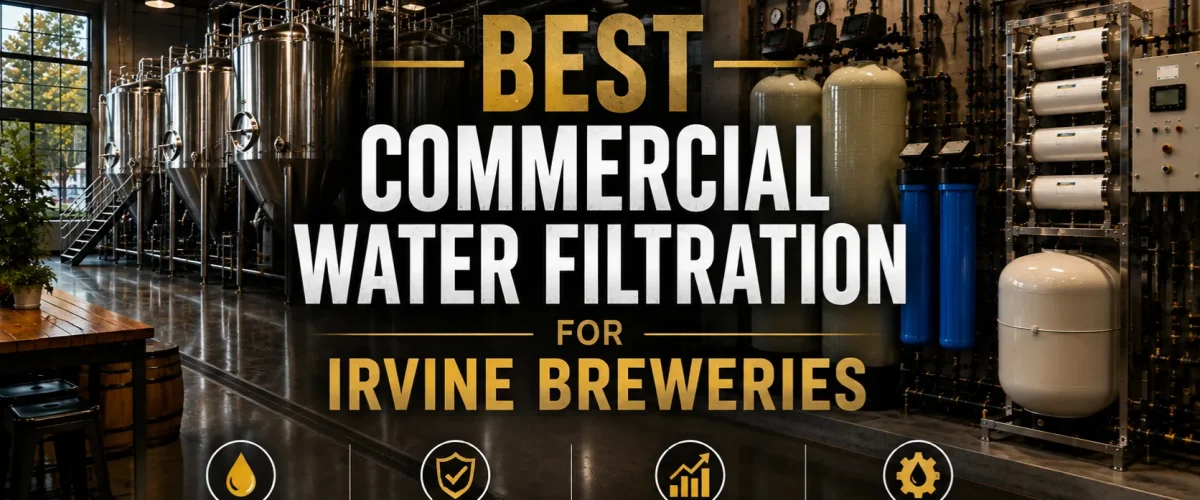
Custom industrial equipment representing the Best Commercial Water Filtration for Irvine breweries installed in a modern facility.

Best Commercial Water Filtration for Irvine Breweries

Table of Contents

For a brewery, water is part of the production process, not simply a utility. The best commercial water filtration for Irvine breweries should be based on the facility’s water quality, production requirements, equipment, flow rates, and treatment goals. A customized evaluation can help determine whether filtration, softening, reverse osmosis, or a combination of technologies makes sense. The objective is not to install the biggest system available. It is to create a treatment approach that supports consistent operations while protecting water-using equipment.


Why Does Water Quality Matter to an Irvine Brewery?

Custom industrial equipment representing the Best Commercial Water Filtration for Irvine breweries installed in a modern facility.

Water quality matters because breweries use water throughout production, cleaning, and other daily operations, making its characteristics relevant to both brewing and equipment.

A brewery is not simply using water to fill a glass. Water can become part of the brewing process itself, while water is also used for cleaning, rinsing, boilers, ice production, and other operational needs.

That makes untreated or poorly treated water a potential operational concern.

Minerals, sediment, chlorine, chloramines, and other characteristics can affect the suitability of water for different applications. The specific concern depends on the brewery, its source water, equipment, and production process.

This is why the best commercial water filtration for Irvine businesses should begin with understanding the water rather than choosing equipment from a standard catalog.


Should Every Irvine Brewery Use the Same Filtration System?

No. Two breweries can have completely different treatment requirements even if they operate in the same city.

The appropriate system depends on factors such as:

  • Source-water characteristics
  • Hardness
  • Chlorine or chloramines
  • Total dissolved solids
  • Sediment
  • Production volume
  • Peak flow requirements
  • Brewing equipment
  • Cleaning requirements
  • Desired water characteristics

McCowin Water’s commercial guidance similarly emphasizes testing water quality, understanding usage volume, and designing systems for each facility rather than using a one-size-fits-all package.

For a brewery, that customized approach is particularly important because water requirements can vary significantly from one operation to another.


What Should a Brewery Test Before Choosing a Filtration Method?

Professional water testing should be the starting point because treatment equipment should solve an identified problem.

Depending on the application, an evaluation may consider characteristics such as:

  • Water hardness
  • Total dissolved solids
  • Chlorine or chloramines
  • pH
  • Water chemistry
  • Sediment
  • Available pressure
  • Flow requirements

McCowin Water specifically describes professional testing as a way to identify hardness, TDS, chlorine or chloramines, water chemistry, and operational priorities before designing a commercial solution.

That information helps answer a more important question: What does this brewery actually need its water-treatment system to accomplish?

Without that answer, selecting equipment becomes guesswork.


How Can Commercial Water Filtration Support Brewery Operations?

Pipe cutaway showing equipment scale protection with the Best Commercial Water Filtration for Irvine breweries.

A properly designed commercial system can help address water-quality concerns that may otherwise affect equipment, processes, or the consistency of water used throughout a facility.

For example, scale prevention can be important for water-using equipment because mineral buildup can contribute to maintenance problems and reduced equipment efficiency. McCowin Water specifically describes its commercial filtration solutions as being designed for higher demand and continuous use, with scale prevention intended to reduce mineral buildup that can damage equipment.

But filtration should not be viewed as a universal solution to every brewery problem. The system needs to match the specific water chemistry and application.

A brewery may require filtration for one purpose, softening for another, or a different treatment technology for a particular production or equipment requirement.


What Commercial Water Treatment Options Should Irvine Breweries Consider?

There is no single best technology for every brewery.

Depending on the water analysis and application, a customized commercial system may incorporate:

Sediment Filtration

Sediment filtration can help address suspended particles and protect downstream equipment from unwanted particulate matter.

Carbon Filtration

Carbon-based treatment can be useful for certain taste, odor, chlorine, or related water-quality concerns depending on the specific system and water conditions.

Water Softening

Softening can reduce hardness minerals that contribute to scale. This can be particularly relevant where water-using equipment is vulnerable to mineral buildup.

Reverse Osmosis

Reverse osmosis can provide a more extensive level of purification when the application calls for it. Commercial RO is available as one of several treatment approaches for commercial facilities.

Combination Systems

Some facilities may benefit from multiple treatment technologies working together rather than relying on one filter.

The key is to determine why each component is being recommended. A brewery shouldn’t pay for treatment technology that does not serve a useful purpose.


Why Does Flow Rate Matter for Brewery Filtration?

Flow rate matters because commercial facilities can demand considerably more water than residential homes.

A system that works adequately under light demand may not be appropriate when multiple water-using processes operate simultaneously.

Before choosing the best commercial water filtration for an Irvine brewery, owners should consider both average and peak water demand.

Important questions include:

  • How much water does the facility use daily?
  • What is the peak flow requirement?
  • Which equipment operates simultaneously?
  • Where does treated water need to be delivered?
  • What pressure is available?
  • Does the system need continuous service?

McCowin Water’s commercial materials emphasize designing systems around operational requirements and high-demand environments rather than treating commercial facilities like residential applications.

The system therefore needs to be sized around the brewery’s actual operation.


Should a Brewery Choose Filtration Based Only on the Water Test?

Not necessarily. Water quality is essential, but it is only one part of system design.

The installer should also understand:

  • How the brewery uses water
  • What equipment is connected
  • Where treatment is needed
  • Peak flow
  • Available installation space
  • Maintenance access
  • Production priorities

That is why a professional commercial water evaluation is more useful than simply taking a sample and immediately recommending a filter.

The best commercial water filtration for Irvine should connect the water analysis to the brewery’s actual operating environment.


Why Should Irvine Breweries Choose Custom Filtration?

Water flow rate diagnostic roadmap for selecting the Best Commercial Water Filtration for Irvine breweries.

Custom filtration allows the treatment system to be designed around the facility rather than forcing the facility to adapt to a preconfigured package.

McCowin Water says it works with multiple commercial technologies rather than being tied to a single manufacturer’s solution, allowing systems to be designed around a business’s operational requirements.

That flexibility can matter when a brewery has unusual water requirements, high flow rates, specialized equipment, or multiple treatment goals. The goal is not complexity for its own sake. A good custom system should actually make sense.

Every component should have a reason for being there, and the brewery should understand what each component is intended to accomplish.


What Should Breweries Ask a Commercial Water Filtration Installer?

Before investing in a system, brewery owners should ask practical questions rather than focusing only on equipment brands.

1. Will you test our water first?

The provider should understand the water before recommending treatment.

2. How did you determine the system size?

The answer should account for actual flow and operational demand.

3. Why are you recommending these specific technologies?

You should understand what problem each component is designed to address.

4. How will the system affect our existing equipment?

The treatment approach should be evaluated alongside the brewery’s water-using equipment.

5. What maintenance will be required?

Ask about filter changes, inspections, replacement components, and service responsibilities.

6. Can the system be serviced without disrupting operations?

Maintenance access should be considered during installation and not after the system is already in place.

7. What happens if our water requirements change?

A brewery may expand production or add equipment. The provider should be able to explain how the treatment system can accommodate future needs.


Why Is Maintenance Important for Commercial Water Filtration?

Installation is only the beginning of a commercial water-treatment system’s life.

Filters and other components have service requirements, and a commercial facility can put substantially more demand on equipment than a typical household.

A maintenance plan should explain:

  • What needs regular inspection
  • Which components require replacement
  • How performance is evaluated
  • Who performs service
  • What happens during an equipment issue
  • How maintenance fits around business operations

McCowin Water describes ongoing support and maintenance as part of its commercial approach rather than treating installation as the end of the relationship.

For a brewery, that matters because water treatment is supporting an active business. The system needs to remain practical to operate and maintain.


What Does the Right Brewery Water Treatment Approach Look Like?

The right approach starts with the brewery rather than the equipment.

First, evaluate the water and then understand the brewery’s production and equipment requirements. Next, determine which treatment technologies are actually appropriate, and after that, size and install the system correctly.

Finally, establish a maintenance plan that keeps the system performing as intended. That process is more useful than asking which commercial filter is “the best” in isolation.

The best commercial water filtration for Irvine breweries is ultimately the system that fits their water, production demands, equipment, and long-term operating needs.


The McCowin Promise

McCowin Water approaches commercial water treatment by evaluating the facility’s water and operational requirements before recommending a customized solution. The company says it has been helping Orange County businesses with water systems since 1972 and focuses on professional testing, customized design, installation, and ongoing support.

“If the system we install doesn’t perform the way we promised… If your water doesn’t taste, feel, or behave the way we said it would… We’ll pull the whole system out. And either replace it or make it right. No fine print. Because your trust is worth more than the sale.”


Areas We Serve

As a trusted local water expert, we understand the unique water conditions across Southern California and provide solutions tailored to every home and business.

Anaheim · Santa Ana · Irvine · Huntington Beach · Costa Mesa · Orange County · Mission Viejo · Tustin · Lake Forest · Newport Beach · Yorba Linda · Laguna Niguel · San Clemente · Aliso Viejo · San Juan Capistrano

Whether you need water filtration, water softening, reverse osmosis, or another water-treatment solution, McCowin Water serves homeowners throughout these communities.


Find the Best Commercial Water Filtration for Irvine Brewery

Component callout diagram detailing the Best Commercial Water Filtration for Irvine brewery applications.

If your Irvine brewery is dealing with scale, inconsistent water quality, equipment concerns, or simply wants to understand whether its current treatment setup is appropriate, start with the water and not a generic equipment package.

McCowin Water can perform a professional commercial water evaluation, assess your facility’s water quality and operational requirements, and help determine what type of customized treatment makes sense for your business.

The goal is a system designed around your brewery and not a system chosen simply because it is what someone happens to sell. Call us at (949) 569-5736 or Schedule a Free, In-Home Water Test to start the conversation and ask the McCowin Water team about a commercial water evaluation for your Irvine brewery.

CSLB: C-55 #1022717


  1. What type of water filtration does an Irvine brewery need?

    The appropriate treatment depends on the brewery’s water chemistry, production volume, equipment, flow requirements, and treatment goals. Options may include sediment filtration, carbon filtration, softening, reverse osmosis, or combinations of technologies.

  2. Why should a brewery test its water before choosing a filtration system?

    Testing helps identify the water characteristics that the treatment system needs to address. Combining those results with the brewery’s operational requirements allows the system to be designed around the actual facility rather than assumptions.

  3. Can commercial filtration help protect brewery equipment?

    A properly designed commercial water treatment system can address water-quality issues such as hardness and sediment that may contribute to scale, buildup, or other equipment concerns. The appropriate treatment depends on the brewery’s water and equipment.

  4. How is the best commercial water filtration for Irvine sized for a brewery?

    Sizing should consider factors such as water quality, daily usage, peak flow requirements, available pressure, connected equipment, and the brewery’s operational needs.

  5. Does a brewery need ongoing water filtration maintenance?

    Yes, commercial treatment systems require appropriate maintenance based on their technology, usage, water conditions, and component requirements. A maintenance plan should identify inspections, replacements, and service responsibilities.

What You’ll Notice Within
24 Hours
of the Right System