
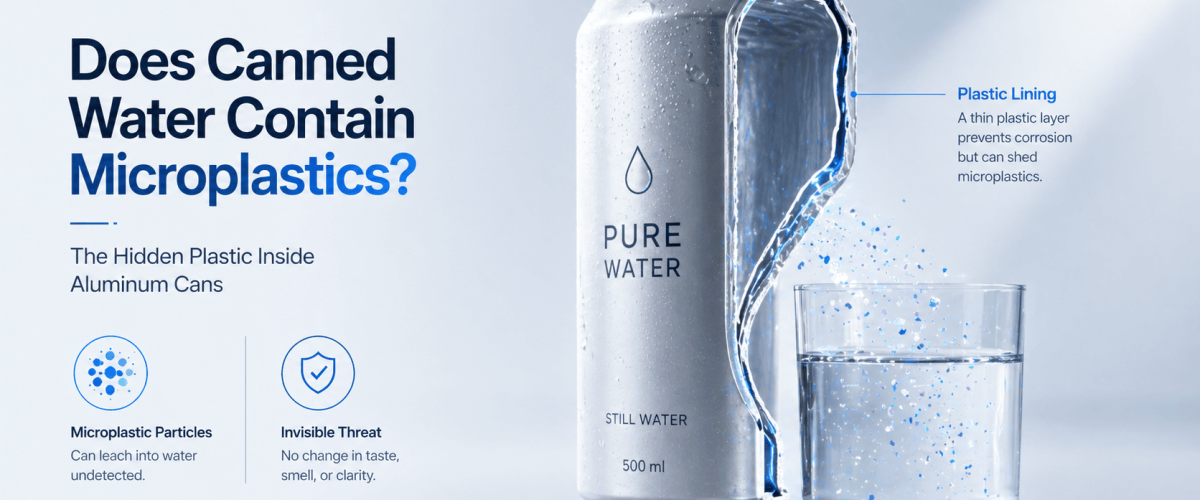

Canned water markets itself as the clean, plastic-free alternative. Aluminum, recyclable, no plastic bottle. But look inside the can and the story gets more complicated, because that metal isn’t touching your water directly. Here’s what’s actually in there.
The short answer: Cans are lined with a thin epoxy or polymer coating so the metal doesn’t react with the water, and that lining is a potential source of chemical migration. So canned water isn’t automatically free of plastic-related concerns. The cleanest route is to skip packaging entirely with a point-of-use reverse osmosis system at your tap.
The lining you don’t see
Here’s the part the “plastic-free” label glosses over. Aluminum reacts with water, so cans are coated on the inside with a thin epoxy or polymer lining to keep the metal and the water apart. That means your canned water isn’t touching aluminum, it’s touching a plastic-family coating. It solves the metal problem and introduces a chemical-migration question in its place.
Trading one concern for another
Plastic bottles raise microplastic questions. Can linings raise chemical-migration questions. Glass avoids both but is heavy, breakable, and still something you buy and haul. The common thread is that every packaged water asks you to trust someone else’s process and packaging. That’s the real limitation, not any single material.
The fix: skip the packaging
The way to sidestep the whole debate is to stop buying packaged water and make your own. A point-of-use reverse osmosis system produces clean water right at your kitchen tap. There’s no bottle, no can, no lining, and no label to trust, because you control it. RO reduces a broad range of dissolved contaminants, so you’re not filtering packaging problems after the fact, you’re avoiding them entirely.
Bottom line: canned, bottled, or boxed, packaged water always comes with a packaging question attached. A tap you filter yourself doesn’t. See what reverse osmosis removes in how reverse osmosis actually works, and the bottled comparison in our reverse osmosis versus bottled guide.
Vertex IsoTwist reverse osmosis
A five-stage under-sink reverse osmosis system that gives you bottled-quality water at the kitchen tap, with an optional remineralization stage that puts good minerals back for taste.
Keep learning about your water. Start with how reverse osmosis actually works Then whether reverse osmosis water is healthy Then the best water filter for drinking.
Canned water and microplastics: your questions
Does canned water contain microplastics or chemicals?
Cans are usually lined with a thin epoxy or polymer coating to keep the metal from reacting with the water. That lining is a potential source of chemical migration, so canned water isn’t automatically free of plastic-related concerns just because there’s no plastic bottle.
Is canned water better than bottled water?
It trades one packaging concern for another. Plastic bottles raise microplastic questions; can linings raise chemical-migration questions. Neither gives you the control that home filtration does.
How do I avoid packaging contaminants entirely?
Skip the packaging. A point-of-use reverse osmosis system makes clean water at your tap, so there’s no bottle and no can lining in the equation at all.
Does reverse osmosis remove these packaging-related contaminants?
Reverse osmosis reduces a broad range of dissolved contaminants at the tap. By making your own water at home, you sidestep packaging-migration questions entirely rather than trying to filter them out after the fact.
Make your own clean water, no packaging required
A free in-home test shows what’s in your tap water, and we’ll show you how a point-of-use reverse osmosis system gives you clean water with no bottle or can involved.
Book your free in-home water test
Prefer to talk it through first? Call us at (949) 569-5736. Family owned in Irvine since 1972, licensed and insured, California CSLB C-55 #1022717, serving all of Orange County.