


By Brian McCowin, McCowin Water. Serving Irvine and Orange County since 1972.
Choosing a reverse osmosis system can seem simple until you start comparing the options. One model has four stages. Another has five. Some include a storage tank, while others promise faster water delivery without one. You may also come across systems with mineral filters, extra carbon filters, special membranes, and features you have never heard of before. The more you look, the easier it becomes to focus on the product instead of the water.
Many homeowners end up choosing a system because it has the most stages, the highest price, or the longest list of features. However, a reverse osmosis system should not be selected that way. Your home has its own water conditions, your family has its own habits, and your concerns may be very different from those of the next household. If you want to choose a reverse osmosis system with confidence, start by understanding what you need the system to do.

Begin with the water coming into your home
Before comparing brands or reading product descriptions, take a closer look at your water. Perhaps your drinking water has a strong taste. Maybe you are concerned about dissolved minerals, certain metals, or the quality of the water you use for cooking. You may simply want a more reliable source of drinking water without constantly buying bottled water.
Each concern can lead you toward a different treatment approach. Clear water is not necessarily water without dissolved substances. Likewise, water that tastes better is not automatically free from every contaminant you may be concerned about. Taste, appearance, and water quality are related, but they are not the same thing.
A water test can help you understand what is present and whether reverse osmosis is the right solution. It also helps prevent you from paying for treatment that your home does not need. At McCowin Water, we believe the conversation should begin with your water, not with a sales pitch.
Understand what reverse osmosis actually does
Reverse osmosis is a water treatment process that uses pressure to push water through a very fine membrane. The membrane allows water to pass through while reducing many dissolved substances. Depending on the system and the water being treated, reverse osmosis can help reduce certain salts, minerals, metals, and other unwanted substances. This makes it different from a basic filter that mainly improves taste or catches particles.
However, reverse osmosis is not designed to solve every water problem. It also does not mean that every system removes the same substances at the same level. When you choose a reverse osmosis system, you should know which concerns it is designed to address. If you are worried about a particular substance, ask whether the system has been tested to reduce it. The name of the technology is only the starting point. The details of the system matter.
Choose the right number of stages
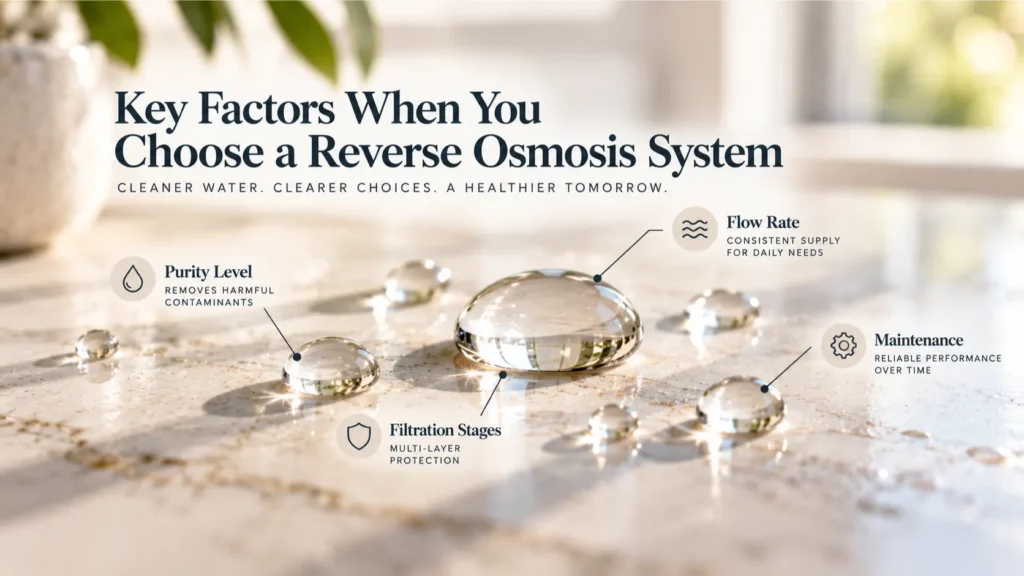
You may see reverse osmosis systems described as four-stage, five-stage, six-stage, or even seven-stage systems. Most household systems use a combination of filters to prepare the water, protect the main membrane, and improve the final taste. An early filter may catch dirt and fine particles. Carbon filters may help reduce chlorine and unpleasant smells. The main reverse osmosis membrane handles many dissolved substances. A final filter may improve the taste before the water reaches your faucet.
Some systems include additional stages for specific purposes. One may add extra protection for the membrane. Another may add selected minerals back into the treated water to change its taste. More stages do not automatically mean better water. A system with five useful stages may be a better fit than a seven-stage system filled with features you do not need. Before choosing, ask what each stage does and why it is included. The goal is not to collect filters but to treat your water properly.
Think about how your family uses water
Your daily habits should influence the system you choose. A couple who mainly uses filtered water for coffee and drinking may have different needs from a family that fills several bottles every day, cooks regularly, and wants a steady supply of treated water. Consider how much water your household uses and when you use it most. If several people need water at the same time, the system should be able to keep up with those demands.
Storage capacity can also matter. Many household RO systems use a storage tank so treated water is available when you open the faucet. Other systems are designed differently and may focus on delivering water more directly. The best choice depends on your space, water usage, and expectations. A system that works well for one household may feel slow or inconvenient in another. Thinking about your routine before buying can help you avoid that frustration.
Do not ignore water pressure and available space

A reverse osmosis system needs suitable water pressure to work properly. If the pressure is too low, the system may produce treated water slowly or operate less efficiently. This is one reason why installation matters. A product may look suitable on a website, but your home’s plumbing conditions can affect how well it performs.
The space beneath your kitchen sink also deserves attention. Some systems need room for filters, tubing, and a storage tank. If the cabinet is already crowded, access for future filter changes may become difficult. You should be able to reach the system when it needs maintenance. A filter that is difficult to access is more likely to be ignored. Before choosing a system, consider where it will be installed, how much room it needs, and whether your home’s water pressure is suitable.
Compare maintenance before you buy
Every reverse osmosis system needs ongoing care. Filters need to be replaced. The membrane needs to be checked. Connections and other parts may require attention over time. The exact schedule depends on the system, the quality of your incoming water, and how much water your family uses. The purchase price is only one part of the cost.
A system that appears inexpensive at first may require costly replacement filters or frequent servicing. Another system may cost more initially but be easier to maintain over time. Ask how often the filters need to be changed, how much replacements cost, and who can service the system if something goes wrong. You should also understand what happens if the system is neglected. A reverse osmosis system may continue producing water even when its performance has started to decline, so waiting for a noticeable taste change is not always the best maintenance plan. A good system should fit your budget not only on the day you buy it, but also throughout the years you use it.
Look beyond the product label
When comparing systems, it is easy to become distracted by phrases such as “advanced filtration,” “premium membrane,” or “maximum purification.” These descriptions may sound impressive, but they do not tell you everything you need to know.
Look for clear information about the substances the system is designed to reduce, the amount of water it can produce, the filters it uses, and the care it requires. Ask whether the system includes everything needed for installation. Find out whether replacement parts are easy to obtain. Make sure you understand what the warranty covers and who will help you if the system develops a problem. A reverse osmosis system is not just a box placed beneath your sink. It becomes part of your home’s daily routine. The easier it is to understand, use, and maintain, the more useful it is likely to be.
Why Irvine homeowners have trusted the McCowin family since 1972
I’m Brian McCowin. My family has been solving water problems in Orange County since 1972, one home and one honest answer at a time. We do not believe every household needs the same equipment. We take the time to understand the water, listen to the homeowner’s concerns, and explain the available options in clear, practical language.
We’re a licensed California water treatment contractor (CSLB C-55 #1022717), serving Irvine and the surrounding communities: Tustin, Santa Ana, Newport Beach, Costa Mesa, Lake Forest, Mission Viejo, Orange, Anaheim, Huntington Beach, Fountain Valley, Yorba Linda, Laguna Niguel, Laguna Hills, Aliso Viejo, Rancho Santa Margarita, San Juan Capistrano, and San Clemente.
The McCowin Promise
For more than fifty years, we’ve helped Orange County homeowners understand their water through professional testing, honest recommendations, and customized solutions.
“If the system we install doesn’t perform the way we promised… If your water doesn’t taste, feel, or behave the way we said it would… We’ll pull the whole system out. And either replace it or make it right. No fine print. Because your trust is worth more than the sale.”
Choose the system that fits your home
The right reverse osmosis system is not necessarily the one with the most stages, the highest price, or the most impressive product description. It is the system that addresses your water concerns, suits your family’s daily needs, fits your available space, and can be maintained without unnecessary difficulty.
Start with a water test. Ask practical questions. Understand what you are buying before you commit. When you choose based on your home’s actual needs, you are far more likely to end up with a system that serves you well for years.
Book your free, in-home water test today, or call (949) 569-5736.
Frequently Asked Questions
How do I choose a reverse osmosis system for my home?
Start by identifying your water concerns, testing your water, and considering how much treated water your family uses. Then compare the system’s features, capacity, maintenance needs, and installation requirements.
Is a five-stage RO system better than a four-stage system?
Not necessarily. The number of stages does not determine the overall quality of a system. What matters is what each stage does and whether it addresses a real concern in your water.
Should I choose an RO system with a mineral filter?
A mineral filter may be useful if you prefer the taste of water with some minerals added back after treatment. Whether you need one depends on your preferences and the type of system you choose.
How much maintenance does a reverse osmosis system need?
RO systems require regular filter changes and occasional checks. The schedule depends on the system, your water quality, and your household’s water usage.
Does every home need a reverse osmosis system?
No. Reverse osmosis may be helpful for certain water concerns, but it is not necessary for every household. A water test can help you determine whether it is the right choice for your home.