


By Brian McCowin, McCowin Water. Serving Irvine and Orange County since 1972.
A reverse osmosis filter typically lasts several months to a few years, depending on which filter you mean, how much water your household uses, the quality of the incoming water, and how well you maintain the system. Sediment and carbon filters usually need replacing more often, while an RO membrane can often last several years with proper maintenance. If your water tastes different, production has slowed, or the system is no longer reducing dissolved contaminants as it should, it may be time to check the filters and membrane.
Knowing the expected reverse osmosis filter lifespan is important because an RO system does not have one single filter that lasts forever. Different stages perform different jobs, and each has its own replacement schedule.
How long does a reverse osmosis filter last?
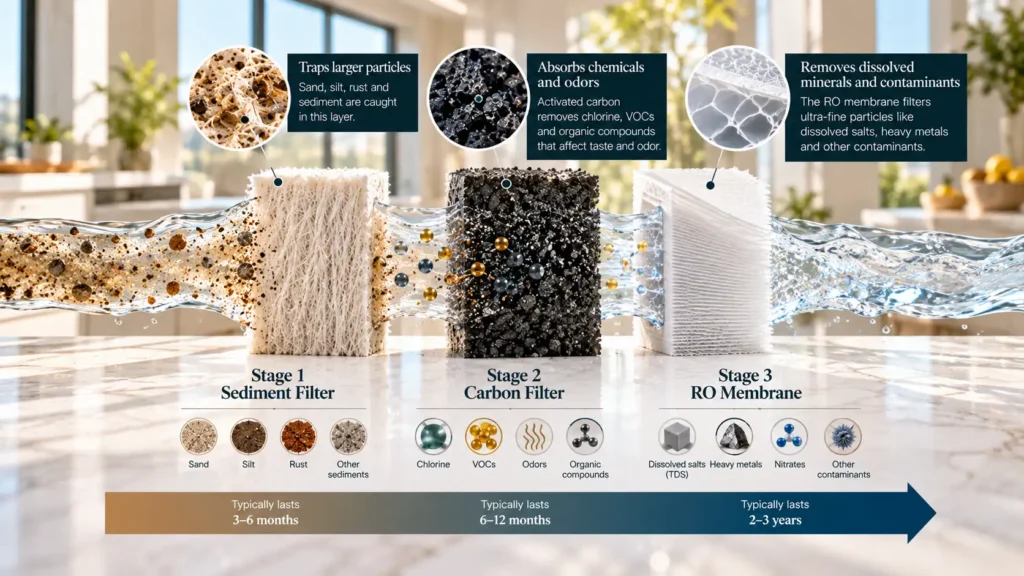
The lifespan of a reverse osmosis filter depends on the specific stage. A typical residential RO system may contain a sediment filter, one or more carbon filters, an RO membrane, and a post-filter. The prefilters generally need attention more frequently than the membrane.
As a general guide, sediment and carbon filters are often replaced about every 6 to 12 months, while an RO membrane can commonly last around 2 to 3 years. A post-filter may also need replacement roughly once a year. These are not universal deadlines.
A home with heavy water use or poor incoming water quality may need filter changes sooner. A lightly used system with good source water and proper maintenance may go longer. The most useful replacement schedule is the one based on the condition and performance of your particular system.
Why don’t all RO filters last the same amount of time?
The different filters in an RO system are designed for different jobs. The sediment filter catches particles such as dirt, rust, and suspended material before water reaches the membrane. Carbon filters help reduce chlorine and certain compounds while also protecting the membrane.
The RO membrane performs the primary separation of many dissolved substances. It is a more specialized component and usually lasts longer than the prefilters. The final post-filter helps polish the treated water before it reaches the drinking faucet. Because each stage has a different responsibility, replacing every filter on the same schedule is not always necessary.
This is one reason understanding your RO system is more useful than simply buying a replacement filter whenever the water tastes slightly different.
What affects reverse osmosis filter lifespan?
Water quality is one of the biggest factors. If your incoming water contains a high amount of sediment, the sediment filter can become loaded more quickly. High chlorine exposure can place additional demand on carbon filtration.
Water hardness can also affect the overall system. Hard water may contribute to scale formation and reduce membrane performance if the system is not properly configured or protected. Household usage matters too. A family that uses RO water for drinking, cooking, coffee, ice, and other purposes will send considerably more water through the system than a household with lighter use.
Water pressure and temperature can also affect RO performance. This is why two homes with the same RO model can have different filter replacement schedules.
What happens if you don’t change your RO filters?
An overdue filter does not always fail dramatically on a particular day. Instead, performance can gradually decline. A clogged sediment filter can restrict water flow. A spent carbon filter can become less effective at protecting the membrane. An aging membrane may produce water more slowly or reduce dissolved substances less effectively.
You may notice that the storage tank takes longer to fill or that the faucet produces less water than it used to. Taste can also change, although taste alone is not a reliable way to determine whether an RO membrane is still performing properly. A system can look perfectly normal from the outside while its filtration stages are no longer operating as intended.
How do I know when my reverse osmosis filter needs replacing?
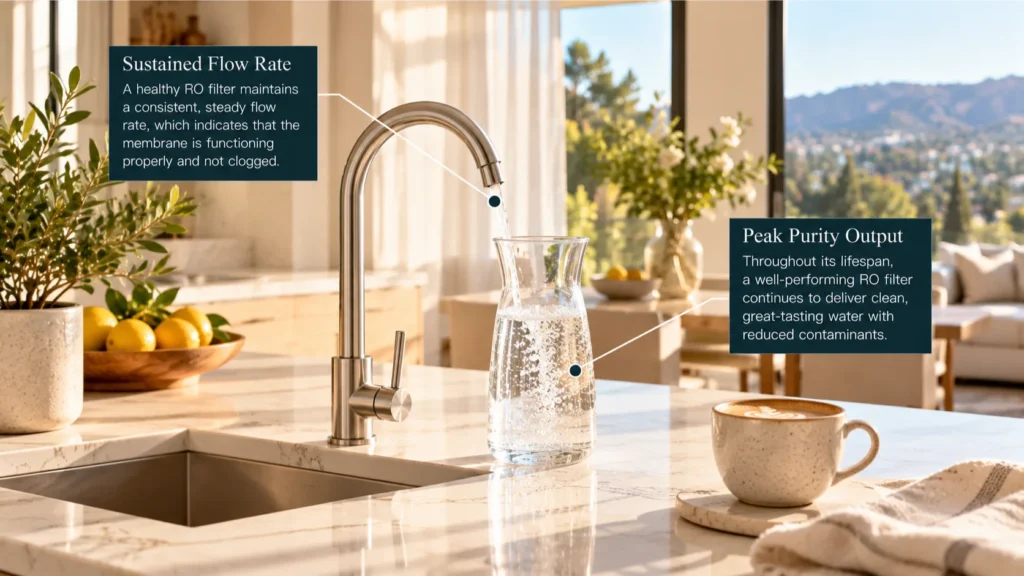
The calendar is useful, but performance provides additional clues. If your RO faucet has noticeably weaker flow, the storage tank is taking much longer to fill, or the water tastes different, the system may need attention.
You may also notice that filter replacement has been overlooked because the system continues producing water. Production alone does not prove that every filtration stage is working properly. A water test can provide a more meaningful indication of membrane performance, particularly when the concern involves dissolved solids. For homeowners who rely on RO for drinking water, testing can be a better approach than waiting until the system stops producing water altogether.
Does an RO membrane last longer than the filters?
Usually, yes. The RO membrane is designed to last considerably longer than the sediment and carbon prefilters when it is protected and maintained properly.
The prefilters are there partly to protect the membrane. If they become exhausted and are not replaced, the membrane may be exposed to conditions it was not designed to handle for long periods. This is why replacing inexpensive prefilters on schedule can be important for the overall life of the system. Think of the prefilters as the first line of defense. Keeping them in good condition can help the more expensive membrane perform properly for longer.
Can hard water shorten RO membrane life?
Hard water can affect RO system performance. Calcium and magnesium can contribute to scale formation on the membrane. When scale accumulates, water production and membrane performance can decline.
This does not mean every home with hard water needs to replace its RO membrane frequently. Proper system design and maintenance can make a significant difference. Some homes may benefit from treating hardness before the water reaches the RO system. A water softener can reduce the calcium and magnesium entering the RO system, while the RO handles the dissolved substances it is designed to reduce. The right setup depends on the actual water conditions.
Should you replace or service your RO system?
A filter replacement is not always the answer. If the system is relatively new and only a scheduled filter change is due, replacing the appropriate filter may be enough. If the system has poor flow, unusual noises, leaks, repeated filter problems, or a membrane that has not been replaced for years, a broader inspection may be worthwhile.
The condition of the tubing, storage tank, shutoff valve, membrane housing, and other components can also affect performance. A system that has been neglected for years may need more than a new cartridge.
How often should you maintain a reverse osmosis system?
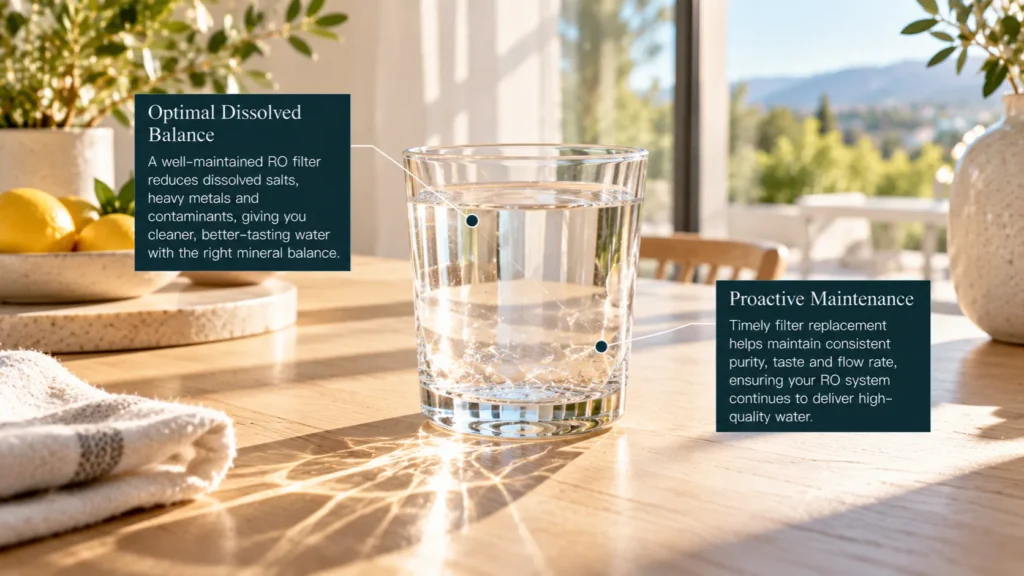
Regular maintenance helps protect both performance and filter lifespan. Follow the replacement recommendations for your specific system and pay attention to how the system behaves between changes.
Keep the area around the system clean and check for leaks. If your system has a storage tank, make sure it is operating properly. When filters are replaced, the system should be serviced according to the manufacturer’s requirements. Most importantly, do not treat filter replacement as a one-time installation task. Reverse osmosis is a treatment system that needs ongoing care.
Why Irvine homeowners have trusted the McCowin family since 1972
I’m Brian McCowin. My family has been solving water problems in Orange County since 1972, one home and one honest answer at a time. When it comes to reverse osmosis filter lifespan, there is no single replacement schedule that applies perfectly to every home. Incoming water quality, household usage, hardness, pressure, and maintenance all influence how an RO system performs.
We start with the water and the system. A free, in-home water test can help determine the characteristics of your water and whether your existing RO system is still performing as expected. If you are experiencing slow production or wondering whether your membrane needs replacement, testing can provide a clearer starting point than replacing parts blindly.
We’re a licensed California water treatment contractor (CSLB C-55 #1022717), serving Irvine and the surrounding communities: Tustin, Santa Ana, Newport Beach, Costa Mesa, Lake Forest, Mission Viejo, Orange, Anaheim, Huntington Beach, Fountain Valley, Yorba Linda, Laguna Niguel, Laguna Hills, Aliso Viejo, Rancho Santa Margarita, San Juan Capistrano, and San Clemente.
The McCowin Promise
For more than fifty years, we’ve helped Orange County homeowners understand their water through professional testing, honest recommendations, and customized solutions.
“If the system we install doesn’t perform the way we promised… If your water doesn’t taste, feel, or behave the way we said it would… We’ll pull the whole system out. And either replace it or make it right. No fine print. Because your trust is worth more than the sale.”
Don’t wait for your RO system to stop working
A reverse osmosis system is not a set-it-and-forget-it appliance. The filters and membrane each have a job, and keeping them in good condition helps the entire system continue doing its job properly.
If you are unsure how long your reverse osmosis filter has been in service, or your system is producing water more slowly than it used to, it is worth checking before the problem gets worse.
Book your free, in-home water test today, or call (949) 569-5736.
A water test and system evaluation can help determine whether you need a routine filter change, membrane replacement, maintenance, or a different solution altogether.
Frequently Asked Questions
How long does a reverse osmosis filter last?
It depends on the filter stage. Sediment and carbon filters commonly last around 6 to 12 months, while an RO membrane may last around 2 to 3 years when properly maintained. Actual lifespan varies with water quality and household use.
How often should RO filters be replaced?
Many residential RO systems need sediment, carbon, and post-filters replaced approximately every 6 to 12 months. The exact schedule depends on the system and incoming water conditions.
How long does an RO membrane last?
An RO membrane can often last around 2 to 3 years, although some systems may require replacement sooner or may continue performing properly for longer. Testing is useful when determining membrane condition.
What happens if you don’t change your RO filter?
Filters can become clogged or less effective. Water production may slow, taste may change, and an overdue prefilter can affect the protection provided to the RO membrane.
Does hard water affect RO filter life?
Hard water can contribute to scale formation on the RO membrane. Proper pretreatment and regular maintenance can help protect the membrane and support longer system performance.
Planning to choose the right RO system? Read our How Many Stages Does an RO System Have: What Each Stage Really Does to understand how each stage contributes to water purification.