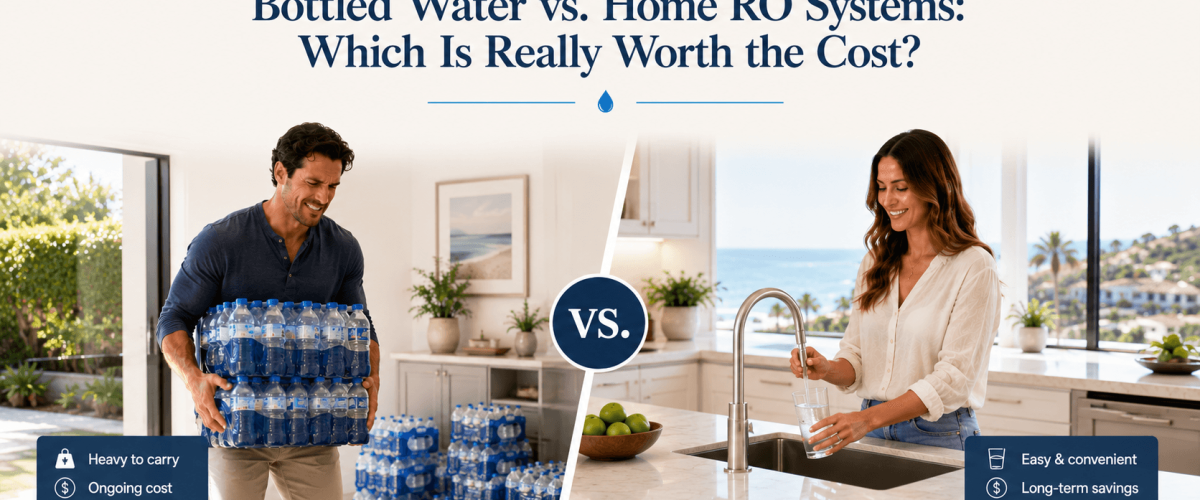

When comparing residential reverse osmosis vs bottled water cost, most Orange County homeowners are surprised to learn that bottled water is often the more expensive long term option. A properly installed residential reverse osmosis (RO) system provides clean, great-tasting drinking water directly from your tap, eliminates the hassle of constantly buying and storing bottles, and can significantly reduce long term drinking water costs. The best choice depends on your family’s water quality needs, usage habits, and long term goals.
Here’s a truth that bottled water companies hope you never calculate: Many families spend more on bottled water than they realize. Not a little more but a lot more than anticipated.
I’m Brian McCowin. My family has been helping Orange County homeowners solve water problems since 1972. And over the years, I’ve met countless homeowners who tell me: “We don’t trust our tap water, so we buy bottled water.”
At first glance, that seems reasonable. A few dollars here, a few dollars there. A case of water on sale, no big deal. But then I ask a simple question: “How much have you spent on bottled water in the last five years?” Most people have no idea. And when they do the math, the number is often shocking. The reality is that bottled water isn’t just a water purchase. It’s a subscription and that too a one that never ends.
Let’s look at the real costs, the real convenience factors, and the real differences between bottled water and a home reverse osmosis system.
Is bottled water actually safer than tap water?
Not necessarily.
This is one of the biggest misconceptions homeowners have. Many people assume bottle water automatically means better water. The reality is more complicated as bottled water quality differs depending on the source, the treatment methods used, and the brand itself.
That’s why the smarter question isn’t: “Is bottled water better?” The smarter question is: “What do I actually know about the water I’m drinking?”
Whether water comes from a bottle or a faucet, understanding its quality is what matters most.
What is the difference between bottled water and a residential reverse osmosis system?
The biggest difference is where your drinking water comes from and how it’s delivered.
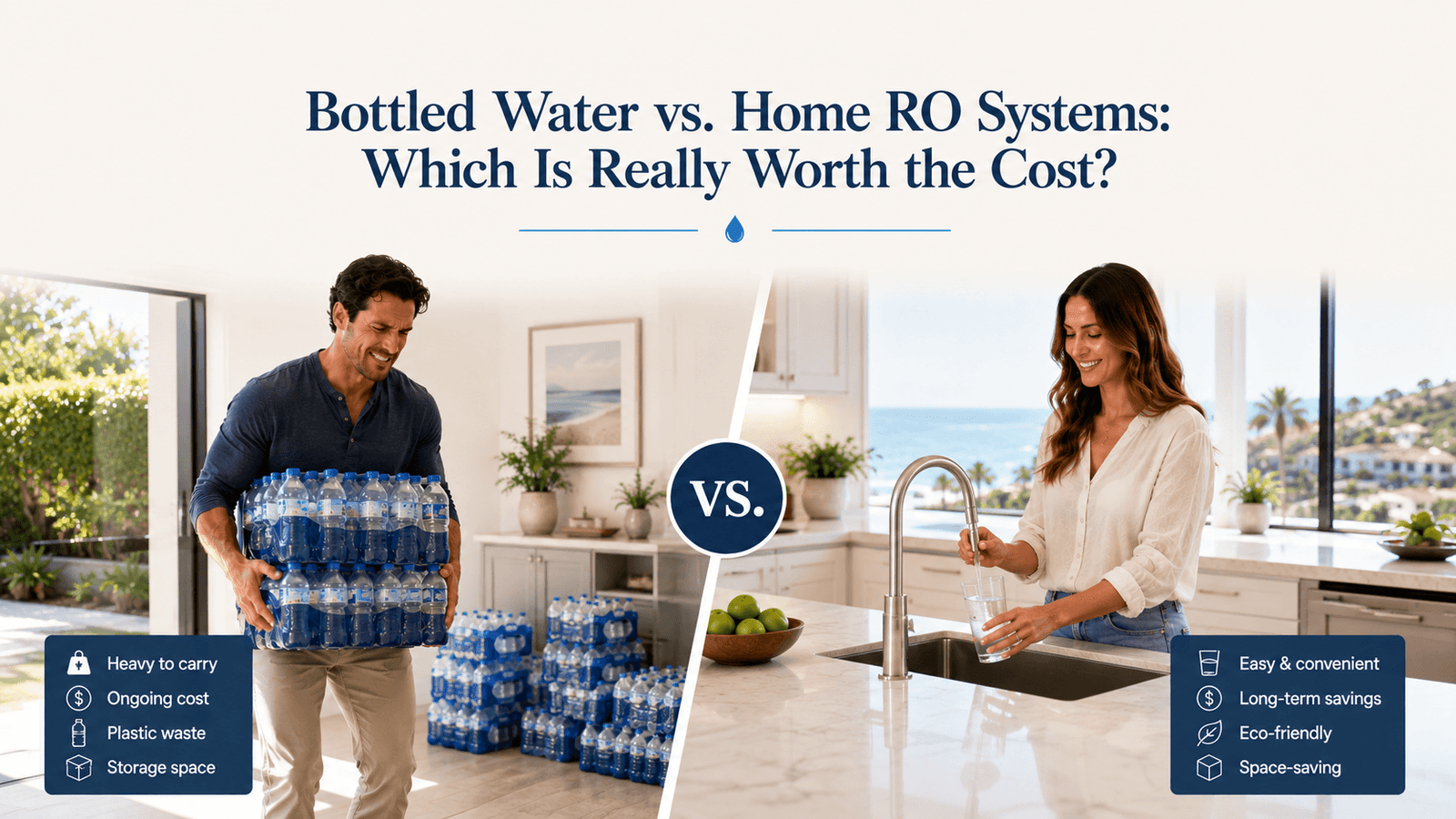
With bottle water:
- You buy it repeatedly
- You transport it home
- You store it
- You recycle or dispose of bottles
With a residential reverse osmosis system:
- Water is treated at your home
- Drinking water is available on demand
- No bottle storage is required
- No recurring trips to the store are necessary
Think of it this way. Bottled water is like ordering takeout every night. A reverse osmosis system is like having a fully equipped kitchen. Both provide food, but one provides significantly greater convenience over time.
Residential Reverse Osmosis vs Bottled Water Cost: Which Is More Affordable?
For many households, a residential reverse osmosis system becomes more economical than bottled water over the long term.
Let’s look at a simple comparison.
| Bottled Water | Residential RO System |
|---|---|
| ➤ Ongoing purchases | Long-term home solution |
| ➤ Continuous spending | Predictable maintenance |
| ➤ Requires storage space | Water available at the tap |
| ➤ Frequent store trips | Convenient daily access |
| ➤ Plastic waste | Reduced bottle usage |
| ➤ Costs continue indefinitely | Investment in home infrastructure |
The larger the family, the faster bottled water expenses tend to add up. Many homeowners discover they’ve spent thousands of dollars on bottled water over the years without realizing it.
Why do so many Orange County families rely on bottled water?
Many families buy bottled water because they dislike the taste of their tap water. This is one of the most common reasons we hear.
Homeowners often complain about:
- Chlorine taste
- Chloramine taste
- Mineral-heavy water
- Unpleasant odors
- Overall drinking water quality
Rather than addressing the source of the issue, many families simply switch to bottled water. It’s understandable, but it’s often a temporary solution to a permanent problem.
Can reverse osmosis provide the same convenience as bottled water?
For many families, reverse osmosis provides even greater convenience. Think about the routine associated with bottled water:
- Buying it
- Loading it into your vehicle
- Carrying it into the house
- Finding space to store it
- Running out unexpectedly
Now compare that to turning on a faucet. That’s one reason many homeowners who switch to reverse osmosis never go back to bottled water. As convenience becomes part of everyday life.
What water quality concerns are homeowners paying attention to today?
Many homeowners are increasingly asking questions about dissolved solids, chlorine, chloramines, PFAS, and drinking water quality. Public awareness surrounding water quality has increased significantly in recent years.
Homeowners frequently ask us about:
- Total dissolved solids (TDS)
- Hard water minerals
- Chlorine
- Chloramines
- PFAS and emerging contaminants
- Drinking water taste
The challenge is that every home’s water is different. That’s why assumptions are risky. Testing provides answers and these answers help homeowners make informed decisions.
Is reverse osmosis better for the environment than bottled water?
Many homeowners appreciate that reverse osmosis can help reduce plastic bottle consumption. Every family is different. But consider how many bottles an average household goes through in a year and then multiply that by several years.
For homeowners looking to reduce:
- Plastic waste
- Recycling volume
- Packaging consumption
A home drinking water solution can be an attractive alternative.
Why do some homeowners hesitate to install reverse osmosis?
Most hesitation comes from uncertainty not from the technology itself.
Common concerns include:
- Upfront cost
- Installation questions
- Maintenance concerns
- Not knowing if it’s necessary
That’s completely understandable. No homeowner wants to invest in the wrong solution. That’s why we always recommend understanding the water first. A proper evaluation helps determine whether reverse osmosis makes sense or whether another solution would be more appropriate.
Why do different water companies recommend different solutions?
Many companies only sell one type of equipment. This creates one of the biggest challenges for homeowners. Imagine visiting a dealership that only sells sports cars. No matter what you need, they’re probably going to recommend a sports car.
At McCowin Water, we’re like an Auto Mall for water treatment.
We carry a broad range of premium technologies because every home’s water is different. Some homeowners need reverse osmosis while some don’t. Our job is to figure out which category you fall into.
That’s why we test first.
What is the smartest first step before choosing between bottled water and reverse osmosis?
The smartest first step is understanding your water.
Before comparing products, you should know:
- What’s in your water
- What concerns actually exist
- Which treatment options make sense
- Whether reverse osmosis is appropriate
Once you have those answers, the decision becomes much easier and much more cost-effective.
The McCowin Promise
For more than fifty years, we’ve helped Orange County homeowners make informed water treatment decisions based on facts, not fear or sales pressure.

“If the system we install doesn’t perform the way we promised… If your water doesn’t taste, feel, or behave the way we said it would… We’ll pull the whole system out. And either replace it or make it right. No fine print. Because your trust is worth more than the sale.”
Schedule Your Free, In-Home Water Test
If you’re comparing residential reverse osmosis vs bottled water cost, start by learning what’s actually in your water.
We perform professional, on-site testing right at your kitchen sink. You’ll see what’s in your water, understand your options, and receive honest recommendations with absolutely zero sales pressure.
Call us at (949) 569-5736 or Schedule a Free, In-Home Water Test today and find out whether a home reverse osmosis system could save your family money while providing cleaner, more convenient drinking water.
CSLB: C-55 #1022717