
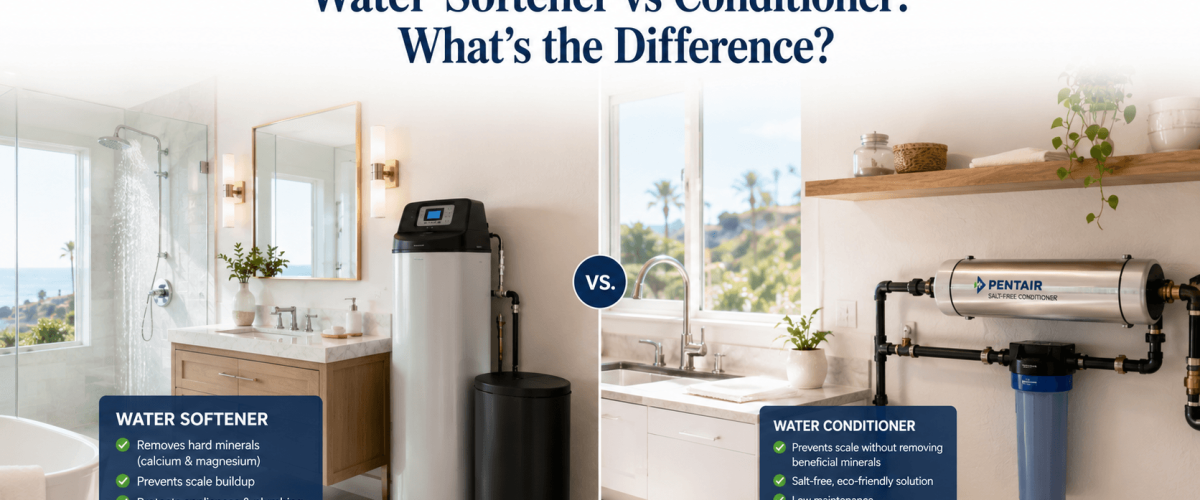

People use “softener” and “conditioner” as if they’re the same product. They’re not, and the difference decides whether you get that slippery soft-water feel or simply less scale in your pipes. Here’s how to tell which one your home actually needs.
The short answer: A salt-based softener removes calcium and magnesium, giving you true soft water: better lather, softer skin, cleaner laundry. A salt-free conditioner leaves the minerals in but changes their form so they’re less likely to form scale, with no salt and no brine. Choose a softener for the soft-water feel, a conditioner for scale protection without salt.
How a salt-based softener works
A softener runs your water through a bed of resin that swaps the hard minerals for a small amount of sodium. This is ion exchange, and it genuinely removes the calcium and magnesium. The result is true soft water: soap lathers richly, skin and hair rinse clean, laundry comes out soft, and scale stops forming. Periodically the resin regenerates with a brine rinse, which is the part that uses salt and a little water.
How a salt-free conditioner works
A conditioner, often using template-assisted crystallization, takes a different path. It doesn’t remove the minerals. Instead it nudges them into a crystalline form that tends not to stick to surfaces, so you get much less scale. There’s no salt, no brine discharge, and no water wasted on regeneration. What you don’t get is the classic slippery soft-water feel, because the minerals are still in the water.
| Feature | Salt-based softener | Salt-free conditioner |
|---|---|---|
| Removes hardness minerals | Yes | No, changes their form |
| Soft-water feel and lather | Yes | No |
| Reduces scale | Yes | Yes |
| Uses salt | Yes | No |
| Discharges brine | Yes | No |
| Best for | Soft-water feel, skin, laundry | Scale protection, no salt |
The California wrinkle: parts of California restrict brine discharge from salt-based softeners because of salinity in the recycled water supply, and some communities limit self-regenerating units. Where that applies, a salt-free conditioner is the compliant path. We know the local picture and factor it in. Dig deeper in salt-based versus salt-free softeners.
A.O. Smith Expert Series RC softener
A high-efficiency softener that pulls the scale-forming calcium and magnesium out before they reach your pipes.
Hague WaterMax softener and conditioner
A softener and conditioner in one that adapts to your household water use for efficient, consistent soft water.
Hague HydroClean HC3 whole-house system
A single-tank whole-house system that softens and filters at once, protecting plumbing and appliances from scale.
Keep learning about your water. Start with salt-based versus salt-free softeners Then the signs you have hard water Then hard water versus soft water.
Softener vs conditioner: your questions
What’s the difference between a water softener and a water conditioner?
A salt-based softener actually removes calcium and magnesium from the water through ion exchange, giving you true soft water. A salt-free conditioner (often using template-assisted crystallization) doesn’t remove the minerals; it changes their form so they’re less likely to stick as scale. One softens, the other conditions.
Is a salt-free conditioner as good as a softener?
It depends on your goal. A salt-based softener gives the classic soft-water feel, better lather, and softer skin and laundry. A salt-free conditioner mainly reduces scale buildup without adding salt or wasting water on regeneration. If you want that slippery soft-water feel, choose a softener. If scale protection with no salt is the priority, a conditioner fits.
Do I need soft water or just scale protection?
That’s the real question. If your complaints are dry skin, dull hair, and flat lather, you want true softening. If your main worry is scale in the pipes and water heater and you’d rather avoid salt, a conditioner may be enough. A test and a conversation sort it out.
Are salt-free conditioners better for the environment?
They don’t discharge brine and don’t use salt, which matters in California where brine in the recycled water supply is a concern. That’s a genuine advantage where salt-based softeners are restricted.
Get matched to the right one for your water
A free in-home test measures your hardness and your goals, so we can tell you honestly whether a softener or a conditioner fits your Orange County home.
Book your free in-home water test
Prefer to talk it through first? Call us at (949) 569-5736. Family owned in Irvine since 1972, licensed and insured, California CSLB C-55 #1022717, serving all of Orange County.