
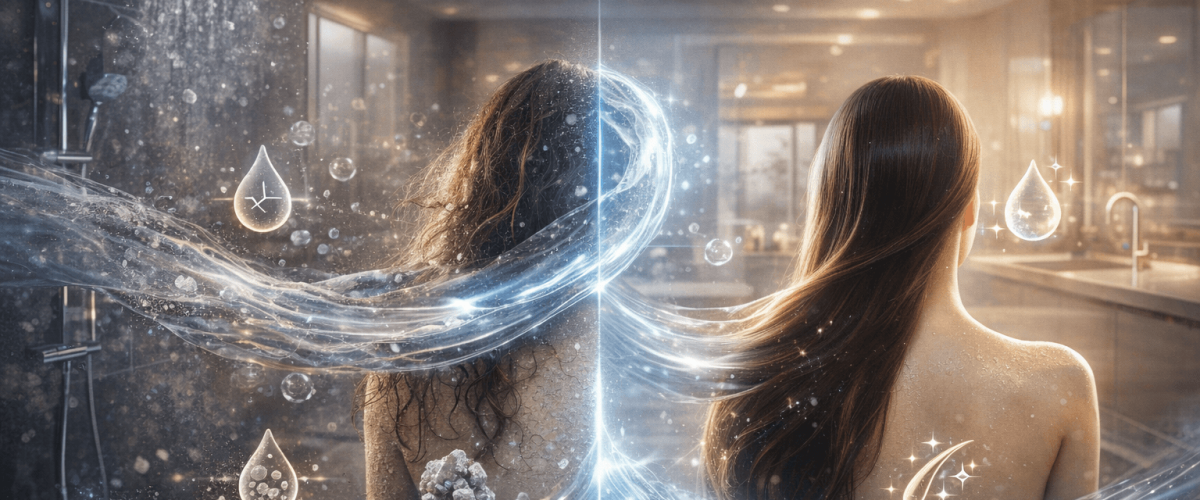

The difference between hard and soft water is just a few dissolved minerals. But those minerals touch almost everything in your daily life, from the first shower of the morning to the water heater you never think about. Here’s what actually changes.
The short answer: Hard water carries calcium and magnesium; soft water has them removed. That one change means better lather, cleaner-rinsing hair and skin, longer-lasting appliances, less scale in your pipes, and lower long-term costs. The minerals are harmless to drink, but hard on your home.
Your hair and scalp
This is where people notice the switch fastest. Hard water leaves a mineral film on hair that no rinse fully removes, so hair feels coated, dull, and hard to manage. Shampoo struggles to lather, so you use more. Switch to soft water and that film stops accumulating. Within a week or two, a lot of people describe hair that feels lighter, softer, and shinier, and a scalp that feels less tight. It’s the same head of hair, just without the residue.
Your skin
Hard water and soap don’t rinse away cleanly. What’s left is a faint mineral film that can leave skin feeling dry and tight after a shower, no matter how much lotion you use. Soft water rinses clean, so your soap and moisturizer actually work instead of competing with residue.
Your plumbing and appliances
Every time hard water is heated, minerals drop out and form scale. That scale lines your pipes, coats the heating element in your water heater, and works its way into dishwashers, coffee makers, and washing machines. Think of it like plaque in an artery: slow, invisible, and expensive. Soft water stops the buildup, so the equipment you already paid for lasts closer to how long it should.
| In your home | Hard water | Soft water |
|---|---|---|
| Soap and shampoo | Poor lather, uses more | Rich lather, uses less |
| Hair and skin | Filmy, dry, dull | Clean rinse, softer feel |
| Glasses and fixtures | Spots and scale | Spot-free |
| Appliance lifespan | Shortened by scale | Protected |
| Laundry | Stiff and gray | Soft and bright |
| Long-term cost | Creeps up quietly | Lower |
The Orange County angle: because our water runs hard nearly everywhere, most homes here are living with the hard-water column above without realizing it. If you’re not sure, read the signs you have hard water, or just measure it. A softener is the tool that moves you to the soft column, and you can compare the options in water softeners in Orange County.
A.O. Smith Expert Series RC softener
A high-efficiency softener that pulls the scale-forming calcium and magnesium out before they reach your pipes.
Hague WaterMax softener and conditioner
A softener and conditioner in one that adapts to your household water use for efficient, consistent soft water.
Keep learning about your water. Start with the signs you have hard water Then softeners versus conditioners Then salt-based versus salt-free softeners.
Hard vs soft water: your questions
What’s the difference between hard water and soft water?
Hard water carries dissolved calcium and magnesium. Soft water has had those minerals removed. That single change ripples through everything: how your soap lathers, how your hair and skin feel, how long your appliances last, and how much scale builds up in your pipes.
Does hard water damage your hair?
Hard water leaves mineral residue on hair and scalp that makes hair feel dull, filmy, and harder to rinse clean. Many people notice softer, shinier hair within a week or two of switching to soft water, because the residue stops building up.
Is soft water better for your skin?
Most people find soft water gentler on skin. Hard water leaves a mineral film that can feel drying and tight, while soft water rinses clean, so soap and moisturizer do their job instead of fighting residue.
Does soft water save money?
Over time, usually yes. Soft water prevents scale that shortens the life of water heaters and appliances, and it lets you use less soap and detergent. The savings show up slowly, in things that don’t break and bills that don’t creep.
See which column your home is in
A free in-home test measures your hardness in grains per gallon, so you know exactly how hard your water is and what soft water would change.
Book your free in-home water test
Prefer to talk it through first? Call us at (949) 569-5736. Family owned in Irvine since 1972, licensed and insured, California CSLB C-55 #1022717, serving all of Orange County.