
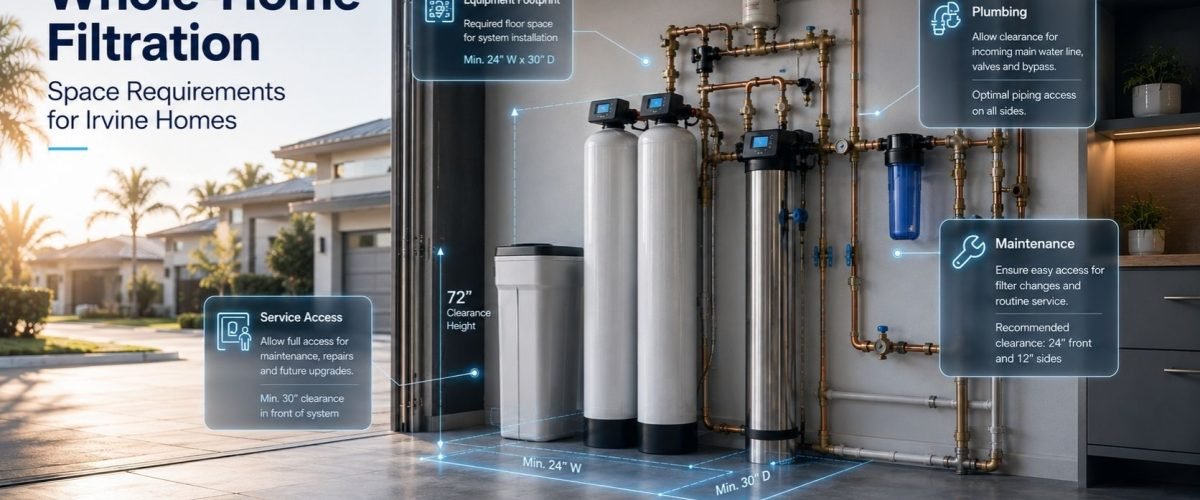

The right whole-home filtration space requirements depend on more than the size of the filter tank. You need enough room for the treatment equipment, shutoff valves, plumbing connections, filter changes, service access, and safe drainage where required. Start by testing your water and reviewing your home’s main water entry point, flow needs, and available installation area. A professional evaluation can help you avoid buying a system that technically fits but is difficult to maintain.
If you are planning a water-treatment upgrade, one mistake is easy to make: measuring the equipment and assuming that is the space you need. In practice, whole-home filtration space requirements include the working room around the equipment, not just the footprint of the tank or filter housing.
The best installation fits the home, remains accessible, and matches the water conditions.
What are the most important whole-home filtration space requirements?
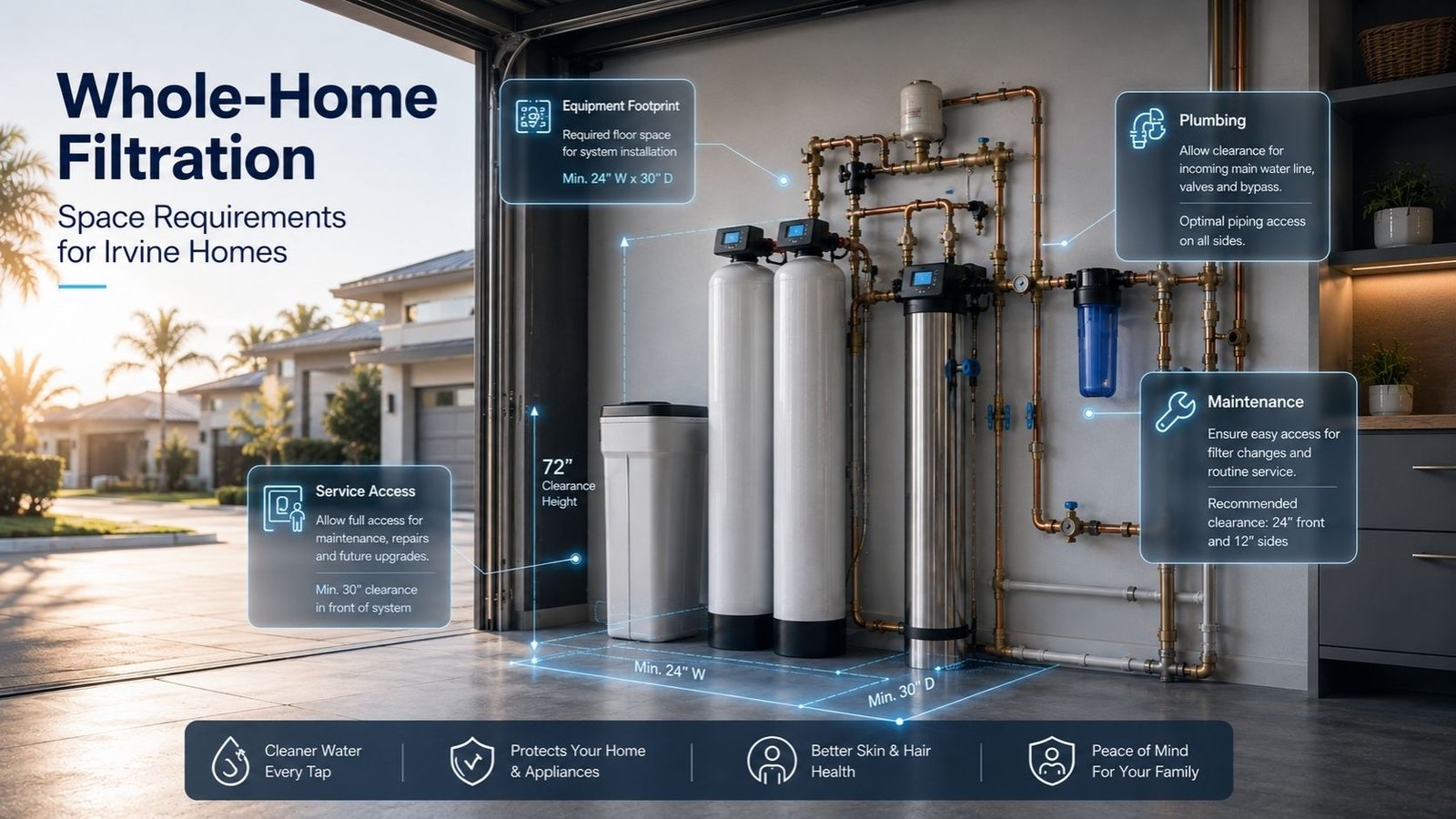
The most important whole-home filtration space requirements are equipment footprint, service clearance, plumbing access, drainage needs, and enough room to operate valves and replace filters safely.
- Equipment footprint: The tank, filter housing, control head, or other components need a stable installation area.
- Service clearance: A technician or homeowner needs enough room to inspect components and perform routine maintenance.
- Plumbing access: The main water line, shutoff, bypass, and connections need to be reachable.
- Drainage: Some treatment technologies may require a drain connection or discharge path. The exact requirement depends on the equipment.
- Electrical access: Certain systems use controls, pumps, or other powered components, so the installation plan may need an appropriate power source.
- Safe surroundings: The area should not make maintenance awkward or expose the equipment to avoidable damage.
This is why whole-home filtration space requirements should be evaluated before you choose a system.
Why does available space matter more than homeowners expect?
Available space matters because whole-home filtration space requirements affect maintenance, inspection, and service.
A common mistake is choosing a compact unit because it has the smallest advertised footprint. If connections or filter housings are hard to reach, the installation may be a poor long-term fit.
The practical whole-home filtration space requirements also include “working space.” Leave room for the tasks that will happen after installation: checking valves, changing media or cartridges, inspecting connections, and troubleshooting.
Should I test my water before planning the installation area?
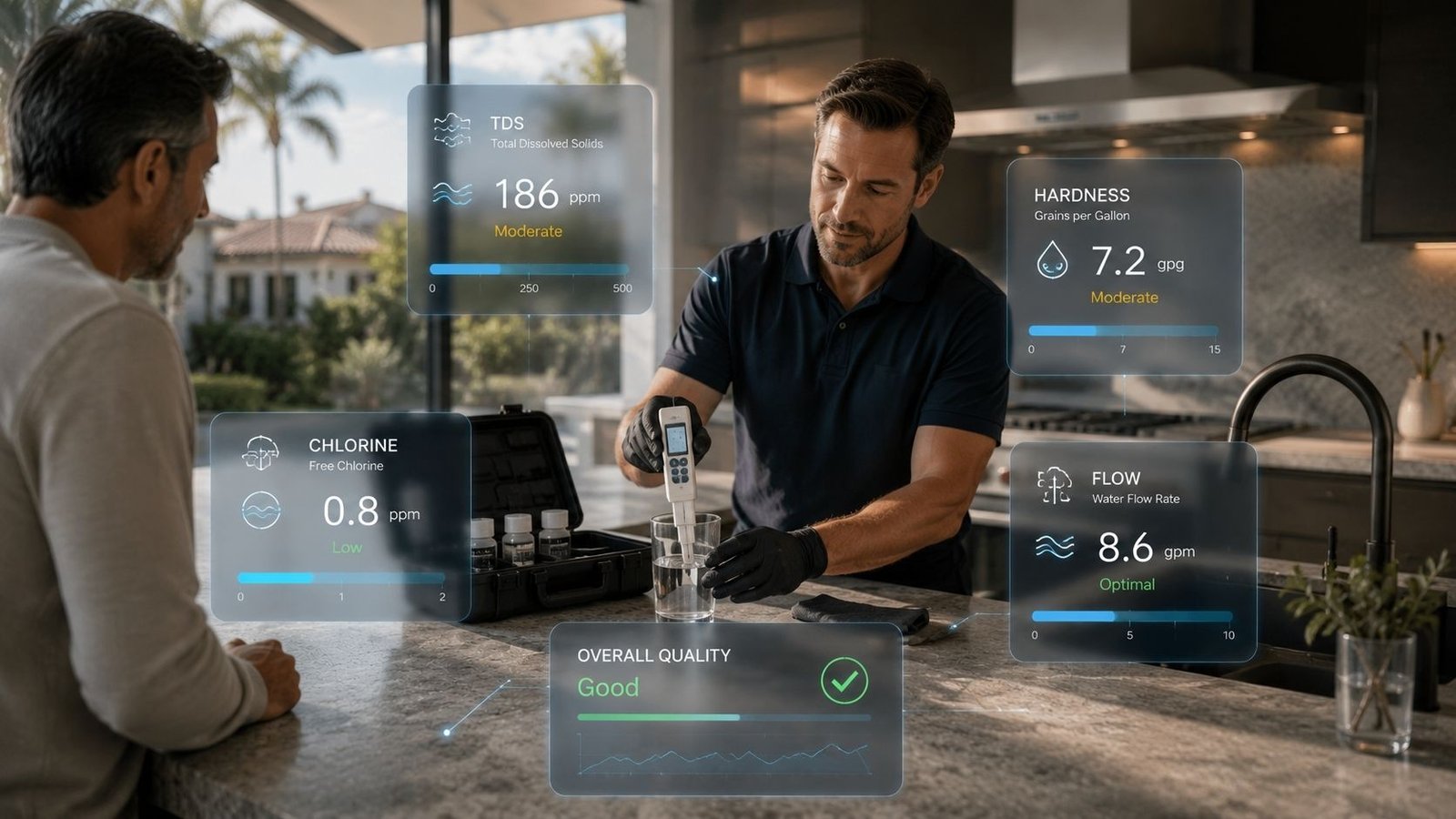
Yes. Water testing should come before final equipment selection because treatment needs determine what type and size of system belongs in the available space.
The CDC recommends testing your water and choosing treatment based on the contaminants or water-quality concerns you actually need to address. Different treatment technologies do different jobs, and a whole-home filter is not automatically the right answer for every water problem.
For Irvine homeowners, this means the whole-home filtration space requirements should be considered alongside hardness, chlorine, sediment, taste and odor concerns, household water use, and the desired treatment outcome. You may need filtration, softening, a combination, or a separate point-of-use reverse osmosis system for drinking water.
McCowin Water’s approach starts with an in-home water test and an assessment of the home’s conditions before recommending a treatment solution.
How much room should I leave around a whole-home filter?
There is no single universal clearance number for every whole-home system, so use the manufacturer’s installation requirements and have the actual site evaluated.
Before installation, ask about whole-home filtration space requirements:
- What is the equipment’s actual footprint?
- How much access is needed to replace cartridges or service the media?
- Can the main shutoff and bypass be reached easily?
- Where will water go if the system needs to discharge?
- Can a technician work on the system without removing unrelated equipment?
- Will doors, vehicles, storage items, or landscaping block access?
Which home locations usually work best?
Garage, utility areas, and suitable exterior spaces can work, provided the location supports safe access, plumbing, drainage, and the equipment’s installation requirements.
Common locations include:
| Location | Potential advantage | What to check |
|---|---|---|
| ➤ Garage | Often provides practical access to plumbing and equipment | Vehicle clearance, storage, temperature, service access |
| ➤ Utility area | Keeps equipment organized and accessible | Available floor/wall space and plumbing route |
| ➤ Side-yard or exterior area | Can work where the home’s plumbing layout supports it | Weather exposure, protection, drainage, local installation requirements |
| ➤ Mechanical space | May place treatment near existing utilities | Tight clearances and access for future service |
Two houses with similar square footage can have very different installation challenges. A smaller home with a convenient main water line may be easier to treat than a larger home with a cramped mechanical area.
Do whole-home filtration systems need space for maintenance?
Yes. Maintenance access is part of the installation, not an optional extra.
The CDC notes that home water-treatment systems need regular maintenance and filter replacement according to the manufacturer’s instructions. Poor maintenance can affect performance and can create conditions where germs grow in filters. (CDC)
That makes whole-home filtration space requirements a long-term consideration. Imagine the system five years from now: can someone reach the filter, operate a valve, and service the equipment?
How should I compare filtration, softening, and reverse osmosis?
Compare them by the water problem they are designed to address, where they treat water, and how their installation and maintenance needs fit your home.
| Treatment | Primary role | Typical location | Space consideration |
|---|---|---|---|
| ➤ Whole-home filtration | Treats water entering the home | Point of entry | Equipment plus service and plumbing access |
| ➤ Water softener | Addresses hardness through ion exchange | Point of entry | Equipment, salt/brine area where applicable, service access |
| ➤ Reverse osmosis | Provides highly treated water at a specific fixture | Point of use | Under-sink or dedicated area, storage and drain needs vary |
A whole-home system and an under-sink RO system are not automatically competitors. They can solve different problems. EPA and CDC guidance distinguish point-of-entry treatment, which treats water as it enters the home, from point-of-use treatment at a particular fixture. (US EPA)
That distinction is central to whole-home filtration space requirements. You should not allocate a large equipment area for a whole-home system if your actual goal only requires treatment at one drinking-water tap. Conversely, treating only one tap may not address a whole-house water-quality concern.
What should I ask an installer before approving the system?
Ask the installer to explain the treatment goal, equipment footprint, required clearances, plumbing changes, maintenance access, and what the system will not remove.
A trustworthy evaluation should make the whole-home filtration space requirements understandable before you approve the work. Ask for the proposed location and why it is appropriate.
Also ask whether the equipment is certified for the specific reduction claim you care about. The CDC recommends checking certification information on filter labels to understand what a filter is tested to remove.
Be cautious when a salesperson starts with a product before asking about your water. EPA guidance emphasizes evaluating treatment technology, installation, operation, maintenance, and cost.
What are the most common space-planning mistakes?
The most common mistakes are measuring only the equipment, blocking service access, ignoring plumbing routes, and choosing a system before understanding the water problem.
Here are four to avoid:
- Buying for footprint alone: A compact system may still need substantial working clearance.
- Forgetting future service: Filters and components need to be accessed later.
- Ignoring the main water line: The best-looking location may be impractical if plumbing changes are excessive.
- Treating every water problem the same: Filtration, softening, and RO have different purposes.
The biggest lesson is simple: whole-home filtration space requirements should follow the treatment plan, not dictate it. First determine what your water needs. Then determine which technology fits. Then plan the installation space around that solution.
What is the smartest way to evaluate my Irvine home?
The smartest approach is to combine water testing, a site assessment, treatment goals, and maintenance planning before choosing equipment.
For Irvine homeowners, whole-home filtration space requirements are only one part of the decision. You also want to understand water demand, existing plumbing, available installation area, and whether you need filtration, softening, RO, or a combination.
McCowin Water’s published approach emphasizes testing water, pressure, flow rate, and existing plumbing before designing a solution.
If you are comparing whole-home filtration space requirements right now, start with the actual conditions in your home. A professional assessment can show whether your whole-home filtration space requirements are practical, what installation work may be needed, and which treatment approach makes sense.
The McCowin Promise
We believe homeowners deserve a treatment recommendation based on their actual water and home not a product chosen first and explained later. Our goal is to make the system understandable, practical to maintain, and appropriate for the job.
“If the system we install doesn’t perform the way we promised… If your water doesn’t taste, feel, or behave the way we said it would… We’ll pull the whole system out. And either replace it or make it right. No fine print. Because your trust is worth more than the sale.”
Areas We Serve
As a trusted local water expert, we understand the unique water conditions across Southern California and provide solutions tailored to every home and business.
Anaheim · Santa Ana · Irvine · Huntington Beach · Costa Mesa · Orange County · Mission Viejo · Tustin · Lake Forest · Newport Beach · Yorba Linda · Laguna Niguel · San Clemente · Aliso Viejo · San Juan Capistrano
Whether you need water filtration, water softening, reverse osmosis, or another water-treatment solution, McCowin Water serves homeowners throughout these communities.
Before You Buy: Check Your Water and Your Space
If you’re comparing whole-home filtration space requirements for an Irvine home, don’t start by ordering a tank. Start by understanding the water, the plumbing, and the installation area.
Call us at (949) 569-5736 or Schedule a Free, In-Home Water Test today to help you evaluate those factors and explain what your results mean before you choose a system.
CSLB: C-55 #1022717